
GLP-1 receptor agonists like semaglutide and tirzepatide are delivering weight loss results that were almost unthinkable with diet alone. People are losing 15, 20, even 25 percent of their body weight within a year. But buried inside those impressive numbers is a problem that doesn't get nearly enough attention: a significant chunk of the weight you're losing isn't fat. It's muscle.
That matters far beyond aesthetics. Lean mass is directly tied to metabolic rate, insulin sensitivity, bone density, and long-term functional health. Losing it accelerates the very aging processes most people are trying to reverse. If you're on a GLP-1 drug, or thinking about starting one, understanding how to protect your muscle is non-negotiable.
How Much Muscle Are GLP-1 Users Actually Losing?
The clinical data is consistent and sobering. Studies examining body composition changes in GLP-1 users find that between 25 and 40 percent of total weight lost can come from lean mass, not fat. That range shifts depending on two variables: how active you are, and how much protein you're eating.
In trials where participants weren't following structured exercise or high-protein diets, lean mass losses landed at the higher end of that window. In populations that maintained resistance training and adequate protein intake, losses dropped substantially. The drug itself isn't uniquely destructive to muscle tissue. The problem is what it does to your appetite, and therefore your protein intake.
GLP-1 agonists slow gastric emptying and suppress appetite at the brain level. For weight loss, that's the mechanism. For muscle preservation, it creates a serious supply problem. When you're simply not hungry, hitting the protein targets your muscles need becomes a genuine daily challenge.
This is compounded by the fact that rapid weight loss of any kind, whether from drugs, surgery, or severe caloric restriction, inherently puts muscle at risk. The body under a large caloric deficit tends to cannibalize lean tissue unless given very specific nutritional signals to protect it.
The Protein Target You Should Actually Be Hitting
Standard dietary protein recommendations, around 0.8g per kilogram of body weight per day, are set for weight-stable, sedentary adults. They are not adequate for someone losing weight rapidly on a GLP-1 drug.
Current expert consensus places the minimum for GLP-1 users at 1.2 to 1.6 grams of protein per kilogram of target body weight per day. Note the phrasing: target body weight, not current weight. If you weigh 220 pounds (100kg) but are aiming for 165 pounds (75kg), you base your calculation on 75kg, not 100kg.
For that person, the target range is roughly 90 to 120 grams of protein per day. On a standard Western diet with suppressed appetite, most GLP-1 users fall well short of that. Research tracking dietary intake in people on semaglutide found average daily protein intake often dropping below 60 grams as appetite suppression set in. That's a gap with real consequences.
If you're older, the case for the higher end of that range is stronger. Muscle protein synthesis becomes less efficient with age, a phenomenon called anabolic resistance, meaning older adults need more dietary protein to generate the same muscle-building signal as younger people. For a fuller look at how this plays out specifically after 50, Toned Arms After 50: What Science Actually Says covers the underlying physiology in detail.
Protein-First Meal Sequencing: A Practical Strategy
When your total food intake is compressed by appetite suppression, the order in which you eat matters more than it ever did before. Protein-first meal sequencing means exactly what it sounds like: you eat your protein source before anything else on your plate.
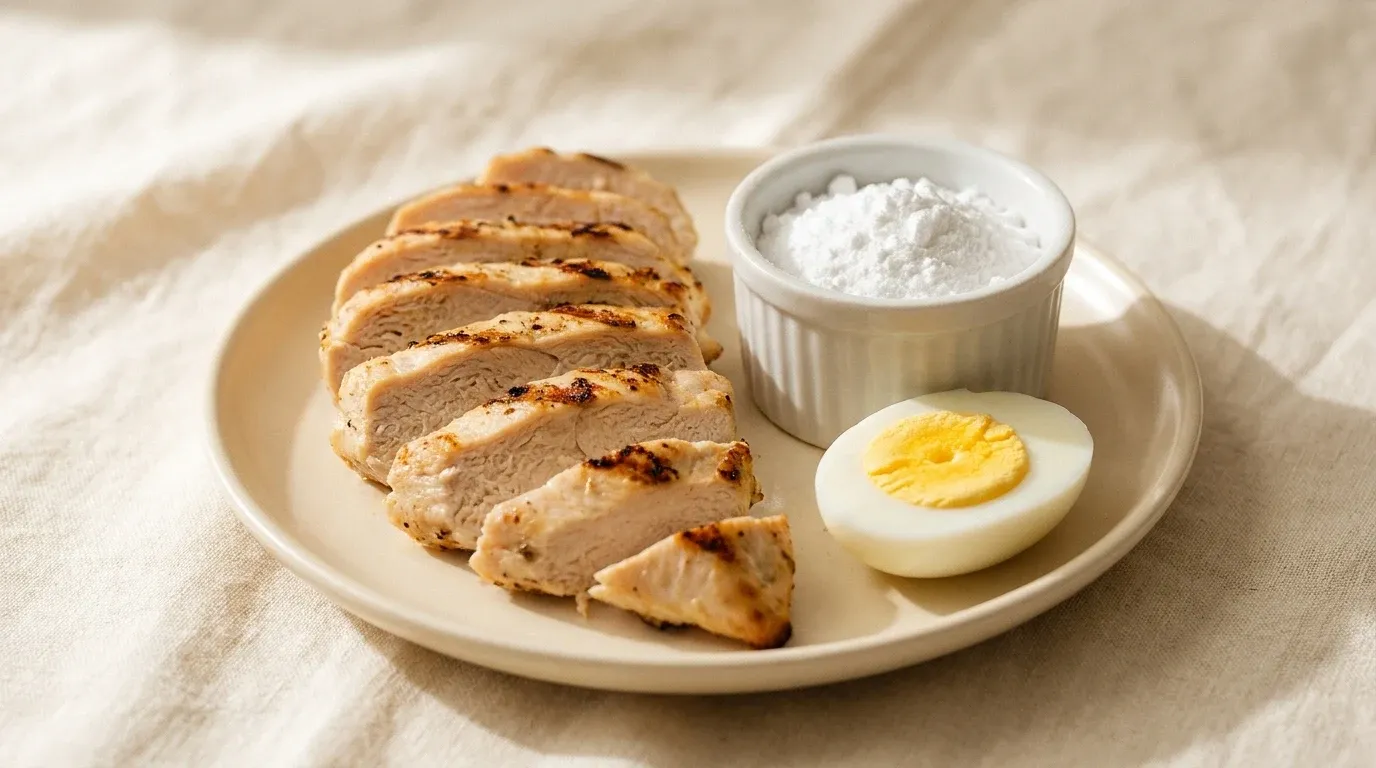
The rationale is straightforward. On a GLP-1 drug, you'll likely hit fullness before finishing your meal. If you've already eaten the chicken, the eggs, or the Greek yogurt before you touched the rice or the salad, you've secured the nutrients your muscles need most. If you do it in reverse, you risk filling up on lower-priority foods and leaving the protein behind.
This approach also has a secondary benefit: protein is the most satiating macronutrient per calorie, so front-loading it may actually help moderate the total caloric intake in a more controlled way, rather than letting hunger or fullness dictate choices unpredictably.
Practical applications of this look like: eating chicken before vegetables at dinner, finishing a protein shake before adding fruit to your morning routine, or choosing eggs as the first item you consume at breakfast before any toast or fruit.
Distributing Protein Across the Day
Total daily protein is important, but distribution across meals is a separate variable with its own impact on muscle protein synthesis. The research consistently shows that muscle-building signals are optimized when protein intake is spread relatively evenly across three to four eating occasions, rather than concentrated in one or two large meals.
A per-meal target of roughly 30 to 40 grams of high-quality protein appears to be the threshold that reliably triggers meaningful muscle protein synthesis in most adults. Below that threshold, the anabolic stimulus is blunted. Above it, you're not getting proportionally more benefit.
For GLP-1 users whose appetite is inconsistent and whose meal sizes are smaller, hitting 30-40 grams of protein in a single sitting can feel like a lot. This is where protein-dense, lower-volume foods become especially useful. Greek yogurt, cottage cheese, canned fish, eggs, edamame, and high-quality protein powders are all efficient vehicles. A single cup of full-fat cottage cheese delivers around 25 grams. Two scoops of a quality whey or casein protein powder can provide 40 to 50 grams in a small liquid volume that's far easier to consume when appetite is suppressed.
Fortified Foods and Supplements Worth Considering
Protein powders aren't the only tool. The fortified food category has expanded significantly, and for GLP-1 users struggling with volume, it offers real practical value. High-protein versions of familiar foods, including protein-enriched pasta, fortified yogurts, and protein bars with clean ingredient profiles, can quietly close the gap without requiring you to eat more food by volume.
Beyond protein itself, a few other supplements have a reasonable evidence base for muscle preservation during weight loss:
- Creatine monohydrate: One of the most studied supplements in sports science. At 3 to 5 grams per day, it supports muscle strength and lean mass retention, particularly in combination with resistance training. It's inexpensive, safe, and especially relevant for older adults on GLP-1 drugs.
- Leucine-enriched protein sources: Leucine is the amino acid that most directly triggers muscle protein synthesis. Whey protein is naturally high in leucine. If you're using plant-based protein, look for blends that include leucine supplementation or combine multiple sources like pea and rice protein to optimize the amino acid profile.
- Omega-3 fatty acids: Evidence suggests omega-3s can enhance muscle protein synthesis, particularly in older adults. A dose of 2 to 4 grams of combined EPA and DHA per day is the range most studied for this effect.
It's worth noting that the supplement space is noisy and many products target GLP-1 users with marketing that outruns the science. Stick to compounds with established evidence. Creatine, leucine-rich protein, and omega-3s clear that bar. Most proprietary blends marketed specifically at GLP-1 users do not.
Resistance Training Is the Other Half of This Equation
Nutrition alone won't fully protect your lean mass. Resistance training is the most potent anabolic signal available to you, and it works synergistically with adequate protein intake. Without it, even optimal protein distribution will only partially attenuate muscle loss during rapid weight reduction.
The minimum effective dose for muscle preservation during weight loss is two full-body resistance training sessions per week. Three is better. The goal at this stage isn't necessarily hypertrophy. It's sending a consistent enough signal to your body that the muscle you have is being used and therefore worth keeping.
If you're newer to strength training or returning after a long break, Online Workouts Over 60: The Missing Ingredient addresses how to build a sustainable resistance training habit alongside the nutritional strategies covered here, particularly for those managing sarcopenia risk. For users who are more experienced and want to maximize their training efficiency, How to Add Explosive Work to Your Lifting Routine outlines how power-focused movements provide an additional stimulus for preserving fast-twitch muscle fiber, which is disproportionately lost during weight loss.
The broader research on interventions that slow aging-related muscle and metabolic decline also supports this combination approach. A Yale review of 51 anti-aging interventions found that protein adequacy and resistance training consistently ranked among the highest-evidence strategies, separately and together.
Putting It Into Practice
The core framework for protecting muscle on a GLP-1 drug comes down to a few non-negotiable habits:
- Calculate your daily protein target based on your goal body weight, using 1.2 to 1.6g per kilogram.
- Eat protein first at every meal, before anything else on your plate.
- Aim for 30 to 40 grams of high-quality protein per eating occasion, spread across at least three meals.
- Use protein-dense, low-volume foods and fortified options when appetite suppression makes eating larger volumes difficult.
- Resistance train at least twice per week. Don't skip this step.
- Consider creatine monohydrate and omega-3 supplementation as adjunct support.
GLP-1 drugs are genuinely effective tools for weight loss. But the goal isn't just to weigh less. It's to be leaner, stronger, and metabolically healthier. That outcome doesn't happen automatically. It requires you to stay deliberate about what you eat, how you train, and how you structure your day while the drug is doing its part.
The muscle you protect now is the foundation everything else is built on.