
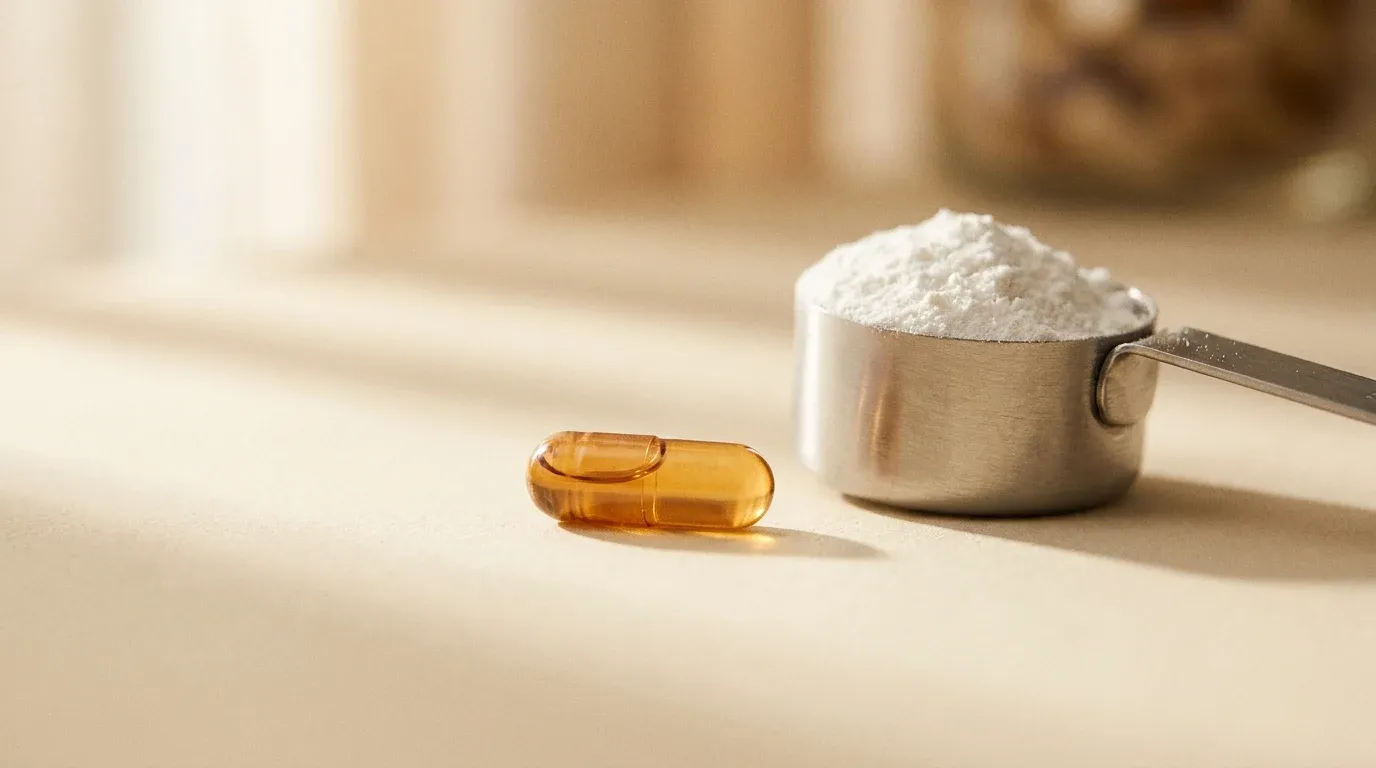
If you follow supplement trends, you've probably noticed a new wave of products pairing creatine with something called HMB. Creatine you know. HMB, for most people, is still a blank. That's worth fixing, because the evidence behind it is more interesting than its obscurity suggests.
HMB stands for beta-hydroxy beta-methylbutyrate. It's a metabolite produced naturally when your body breaks down leucine, the amino acid most closely linked to muscle protein synthesis. The problem is that your body only converts roughly 5% of dietary leucine into HMB, which means food sources alone don't get you very far. That's where supplementation enters the picture.
What HMB Actually Does
The key mechanism here isn't muscle building. It's muscle protection. HMB works primarily by reducing the activity of the ubiquitin-proteasome pathway, which is the cellular machinery responsible for breaking down muscle protein. When you're in a caloric deficit, recovering from injury, or simply aging, that breakdown pathway becomes more active. HMB appears to put a brake on it.
This makes HMB fundamentally different from creatine, which increases phosphocreatine stores in muscle to support high-intensity output and promotes cell hydration and anabolic signaling. Both compounds ultimately support muscle mass, but from opposite ends. Creatine helps you build and perform. HMB helps you hold onto what you have when conditions work against you.
Studies have consistently shown that HMB supplementation reduces markers of muscle protein breakdown, particularly in populations under physiological stress. The signal is clearest during caloric restriction, periods of immobilization, and age-related muscle loss, also known as sarcopenia.
Who Actually Benefits
The research doesn't support HMB as a universal performance supplement. If you're a well-trained athlete eating at maintenance or in a surplus, the evidence for meaningful muscle gain is limited. Meta-analyses have found small or non-significant effects on lean mass and strength in already-trained individuals. The story changes significantly when you look at specific populations.
Adults over 40. Muscle protein breakdown rates increase with age, even without changes in diet or training. Older adults also tend to have blunted anabolic signaling from protein intake, a phenomenon called anabolic resistance. HMB addresses the breakdown side of the equation directly. Several clinical trials have shown that HMB supplementation in older adults can meaningfully slow lean mass loss, particularly in sedentary or hospitalized populations.
GLP-1 users. This is the group generating the most attention in 2025 and 2026. Medications like semaglutide and tirzepatide drive rapid weight loss, but a substantial portion of that weight is lean mass. One widely cited estimate suggests that 25 to 40 percent of weight lost on GLP-1 agonists can come from muscle, depending on protein intake and activity level. HMB is now being positioned as a practical tool to reduce that lean mass loss. The logic is sound, even if long-term trial data in GLP-1 users specifically remains limited.
Athletes in cutting phases. Bodybuilders, combat sport athletes, and endurance athletes who periodically reduce calories to reach a target weight or body composition face a real dilemma: cutting calories accelerates muscle catabolism at exactly the moment you need to preserve performance. HMB supplementation during these phases has shown modest but real benefits in maintaining lean mass without compromising fat loss targets.
The Creatine Pairing: Complementary, Not Redundant
New product launches in 2026 are increasingly bundling HMB and creatine together, which makes scientific sense even if the marketing doesn't always explain why. These two compounds act through entirely different pathways, and their effects are additive rather than overlapping.
Creatine supports the phosphocreatine energy system, promotes intracellular water retention in muscle, and activates satellite cells involved in muscle repair. HMB suppresses the proteolytic breakdown of existing muscle tissue. Together, they cover both the anabolic and anti-catabolic sides of the muscle maintenance equation. For someone in a caloric deficit or navigating age-related muscle loss, that combination is more comprehensive than either compound alone.
Worth noting: HMB is available in two forms. HMB-Ca (calcium salt) is the form used in most older research. HMB-FA (free acid) is absorbed faster and may produce more acute effects, but the long-term evidence base is thinner. Most supplement formulas currently use HMB-Ca at a standard dose of 3 grams per day, split across two or three servings.
The Evidence Base: Strengths and Limits
HMB has been researched since the early 1990s, which gives it a longer clinical track record than many trendy ingredients. The evidence is most robust in three areas: muscle preservation during caloric restriction, lean mass maintenance in older adults, and recovery from muscle-damaging exercise.
Where the research gets murkier is in trained athletes looking for performance gains. A 2014 meta-analysis generated significant buzz by suggesting large effects on muscle hypertrophy, but subsequent re-analysis raised concerns about statistical anomalies in the underlying data. More recent and independently conducted trials have shown more modest results in resistance-trained populations. That's not a reason to dismiss HMB. It's a reason to use it for what it actually does well.
If you're also thinking about how nutrition timing interacts with supplementation, it's worth knowing that current science on this is more nuanced than it used to be. Meal Timing Myths: What Science Actually Says in 2026 breaks down which timing strategies hold up under scrutiny and which don't.
HMB also fits within a broader shift toward personalized nutrition strategies, particularly for older adults and clinical populations. Precision Nutrition: Is One-Size-Fits-All Eating Finally Dead? covers how individual physiology is reshaping supplement and dietary recommendations across age groups.
Practical Considerations Before You Buy
The standard research dose is 3 grams of HMB per day. Lower doses haven't demonstrated consistent effects. Most studies ran for 4 to 12 weeks, which is a reasonable window to assess results. HMB appears safe across that range, with no significant adverse effects reported in clinical trials to date.
Standalone HMB supplements typically run between $25 and $45 per month in the US market. Combination products with creatine tend to sit in the $40 to $65 range. Given that creatine monohydrate is one of the most cost-effective supplements you can buy, the markup on a combo product often reflects the HMB content more than the creatine.
One thing to factor in: HMB works best when protein intake is already adequate. It's not a substitute for sufficient dietary protein. The research generally assumes protein intake of at least 1.6 grams per kilogram of body weight per day. Below that threshold, addressing protein first will likely have more impact than adding HMB.
Recovery context also matters. HMB's anti-catabolic effects are most pronounced when catabolism is actually elevated, meaning during stress, restriction, or inactivity. If you're training hard, sleeping well, eating enough, and not in a deficit, you're not the target population the strongest evidence applies to. Recovery Is Becoming the Biggest Wellness Trend of 2026 offers useful framing on how supplementation fits into a broader recovery strategy.
The Bottom Line on HMB
HMB isn't a mass-building supplement. If that's what the marketing around it implies, that's the marketing overstating the science. What it is, based on a genuine and growing evidence base, is a meaningful tool for muscle preservation in the populations that need it most.
If you're over 40, taking a GLP-1 medication, or cutting calories for a competitive or aesthetic goal, HMB deserves a place in your supplement stack alongside adequate protein and, likely, creatine. If you're a well-trained athlete eating at maintenance, the cost-benefit calculus is less clear, and your money may be better spent elsewhere.
The supplement industry moves fast, and not every ingredient that gets bundled into a new product launch has earned its place there. HMB is one of the exceptions. It's not new, it's not flashy, and the honest version of the evidence is more useful than the hype. That's actually a point in its favor.
For a broader look at how nutrition science is evolving in 2026, The Nutrition Lab: Omega-3 and Sport. What the Science Actually Shows is a useful companion piece covering another frequently misunderstood supplement category.