

Walk into any supplement aisle or scroll through any health retailer and you'll find dozens of probiotic products making nearly identical claims. Billions of CFUs. Advanced gut health. Immune support. The language is confident, the packaging is clean, and the evidence behind most of it is thin. Choosing a probiotic that actually delivers on its promises requires a different approach than reading the front of a label.
This guide gives you a clear, research-grounded framework for evaluating probiotic products. It starts with the two criteria that disqualify most products immediately, then works through the variables that separate genuinely effective formulas from expensive filler.
Start Here: The Two Non-Negotiable Baseline Criteria
Before you evaluate strain specificity, CFU count, or delivery mechanism, two things must be present for any probiotic to be worth your time and money.
The first is third-party testing. Independent verification from organizations such as NSF International, USP, or Informed Sport confirms that the product contains what it claims and is free from contaminants and undisclosed ingredients. Without this, there's no way to verify that the bacteria listed on the label are actually present, alive, or at the stated count. A brand's internal quality assurance is not a substitute.
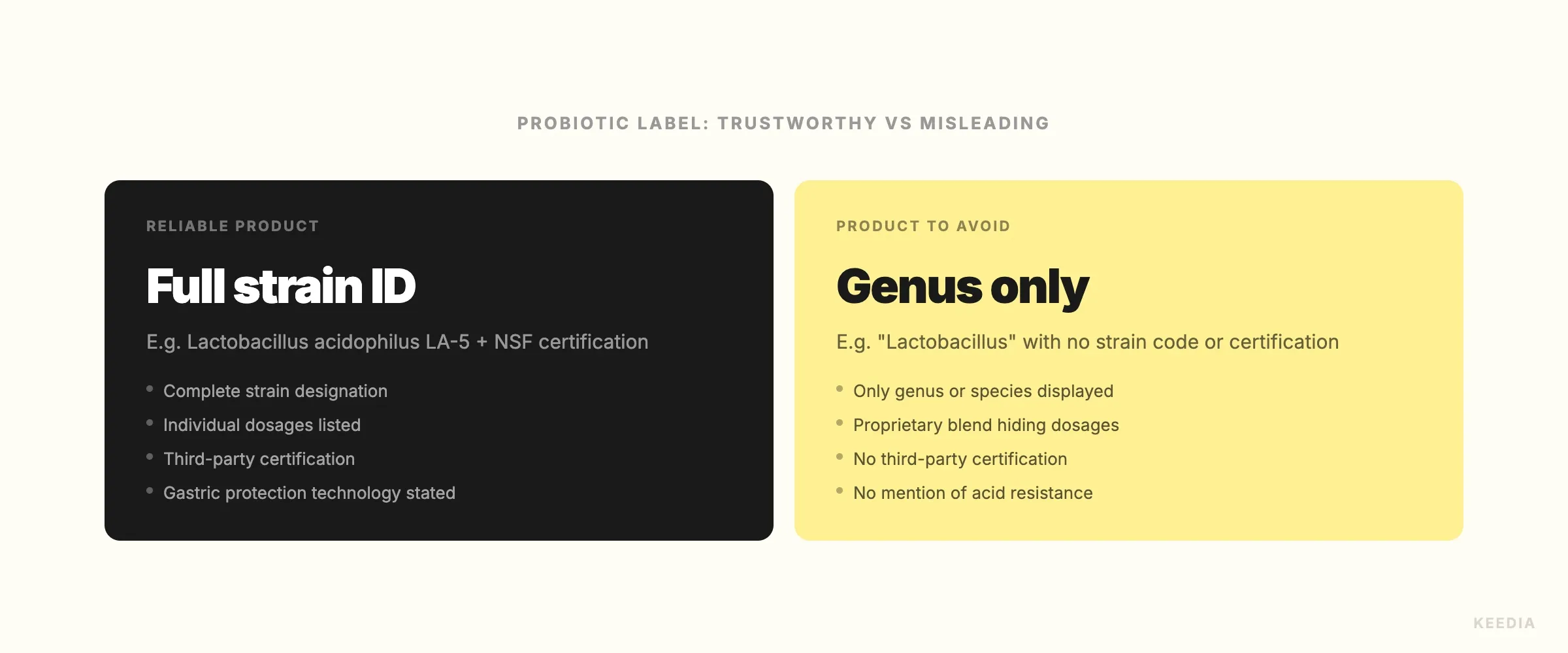
The second is transparent ingredient disclosure. Every strain in the product should be fully identified on the label. Proprietary blends that obscure individual strain amounts are a red flag. You need complete information to assess whether a formula is worth buying. If a brand isn't willing to tell you exactly what's in the capsule, that tells you something.
For a broader framework on evaluating supplement claims before spending money, The Supplement Trust Gap: How to Know What's Worth Buying walks through the evaluation process across multiple supplement categories.
Why Strain Specificity Is the Most Misunderstood Rule in Probiotics
Most probiotic labels list bacteria by genus and species. For example, Lactobacillus acidophilus. That sounds specific enough, but it's the equivalent of saying you take a "medication" without knowing the active compound or the dose. Genus and species identification leaves out the strain designation, which is the level at which meaningful differences in function actually occur.
The strain designation is typically an alphanumeric code that follows the species name, such as Lactobacillus acidophilus NCFM. Without that code on the label, you cannot match the product to published clinical research. You're trusting the marketing, not the science.
This matters more than most people realize because different strains of the same species can behave in completely different ways inside the human gut. One strain may colonize effectively and produce measurable effects on the gut lining. Another from the same species may pass through without producing any meaningful physiological change. The species name alone tells you nothing about which one you're getting.
What August 2026 Research on MG4693 and MG5474 Reveals
Research published in August 2026 on strains MG4693 and MG5474 reinforces exactly why strain-level identification is non-negotiable. The studies demonstrate that these two strains produce distinct effects on gut barrier integrity and immune modulation, even when compared to closely related bacterial strains from the same species.
Gut barrier integrity refers to the tightness of the junctions between intestinal epithelial cells. When that barrier is compromised, bacterial byproducts and partially digested particles can pass into the bloodstream, triggering systemic inflammation. Both MG4693 and MG5474 showed measurable effects on the proteins that regulate those tight junctions, but only at the strain level. Related strains without those specific designations produced no comparable effect.
This is the current direction of probiotic science. Research is moving away from species-level generalizations and toward identifying exactly which strains produce which mechanisms. For consumers, the practical implication is straightforward: if the label doesn't include the full strain designation, you can't connect it to any published evidence, including the emerging work on MG4693 and MG5474.

CFU Count Is Not the Quality Signal Brands Want You to Think It Is
Fifty billion CFUs sounds more impressive than five billion. Brands know this, which is why high CFU counts are often the primary selling point on supplement packaging. But the number of colony-forming units is only relevant if those bacteria survive the journey from your mouth to your large intestine.
The stomach is a highly acidic environment. Most probiotic bacteria are sensitive to that acidity. A product containing fifty billion CFUs at manufacture may deliver a fraction of that to your gut if it has no protection against stomach acid. The delivery system matters as much as the count.
Look for products that use one of the following:
- Enteric coating: A pH-sensitive shell around the capsule or tablet that dissolves only once it reaches the less acidic environment of the small intestine.
- Acid-resistant capsules: Capsule materials such as HPMC or delayed-release technology that protect bacteria through gastric transit.
- Verified survivability data: Some brands publish in vitro or in vivo data on bacterial survival through simulated gastric conditions. This is the gold standard.
Refrigeration requirements are also worth attention. Some strains require cold storage to remain viable. A product that needs refrigeration but has been sitting on an unrefrigerated store shelf for weeks may have significantly degraded potency. If a product claims refrigeration is not required, check whether the brand provides stability data to back that up.
Why Athletes and Active Adults Should Apply Different Selection Criteria
For the general population, probiotic selection is primarily about digestive health and, increasingly, immune function. For people training regularly at moderate to high intensities, there's an additional physiological factor that changes the calculus: exercise-induced intestinal permeability.
Sustained high-intensity exercise, particularly endurance training, causes measurable increases in gut permeability. Heat stress compounds this effect significantly. The physical demands of training divert blood flow away from the gut toward working muscles, and that reduced perfusion temporarily weakens the gut barrier. Research on gut barrier disruption under thermal stress is consistent with findings that extreme heat wrecks recovery for up to 72 hours, partly through mechanisms that include gut barrier compromise.
For athletes, selecting a probiotic with documented effects on gut barrier integrity is a meaningful criterion, not a bonus feature. Strains with evidence for tight junction support are more relevant to your physiology than strains studied only in sedentary or clinical populations. This should inform which strain designations you look for when comparing products.
Gut barrier support also connects directly to recovery quality. If your intestinal permeability is chronically elevated from training, systemic inflammation tends to follow, and that affects adaptation and recovery efficiency. Building a supplement stack that includes proven recovery strategies alongside gut support is covered in depth in 7 Recovery Supplements: Which Ones Actually Work.
How to Read a Probiotic Label: A Practical Checklist
Once the baseline criteria are satisfied, here's what to evaluate on the label itself:
- Full strain designation listed: Genus, species, and the specific strain code. All three must appear.
- CFU count at expiration, not manufacture: The count should be guaranteed through the end of shelf life, not just at the time of production.
- Delivery mechanism specified: Enteric coating, delayed-release capsule, or acid-resistance technology should be clearly stated.
- Storage requirements disclosed: Refrigeration requirements should be explicit, with stability data available on request or on the brand's website.
- Third-party certification mark: NSF, USP, Informed Sport, or equivalent. The certification mark should be on the label, not just claimed in marketing copy.
- No proprietary blends hiding strain amounts: Each strain's CFU contribution should be listed individually.
Products retailing between $30 and $60 per month in the US market can meet all of these criteria. A higher price doesn't guarantee better evidence, and a lower price isn't automatically a disqualifier. What matters is whether the product is verifiable at each point on this checklist.
The Bigger Picture: Probiotics Within a Recovery and Wellness Framework
A probiotic is not a standalone intervention. Its effects on gut health, immune function, and systemic inflammation interact with sleep quality, stress levels, training load, and overall dietary patterns. The research on gut-immune interactions has become more granular over the past two years, and that precision cuts both ways: the right strain under the right conditions can produce real effects, but no probiotic compensates for chronically poor sleep, high psychological stress, or inadequate dietary fiber to feed the bacteria you're trying to support.
If you're building out a broader wellness strategy, 5 Recovery Habits That Actually Extend Your Healthspan provides context for where gut health fits within a longer-term approach to resilience and healthy aging.
The probiotic market is crowded precisely because the demand is real and the barrier to producing a low-quality product is low. Applying a consistent evidence-based framework, starting with third-party testing and full strain disclosure, then working through delivery mechanism and strain-specific research, gives you a meaningful advantage as a consumer. Most products won't survive that evaluation. The ones that do are worth your attention.