
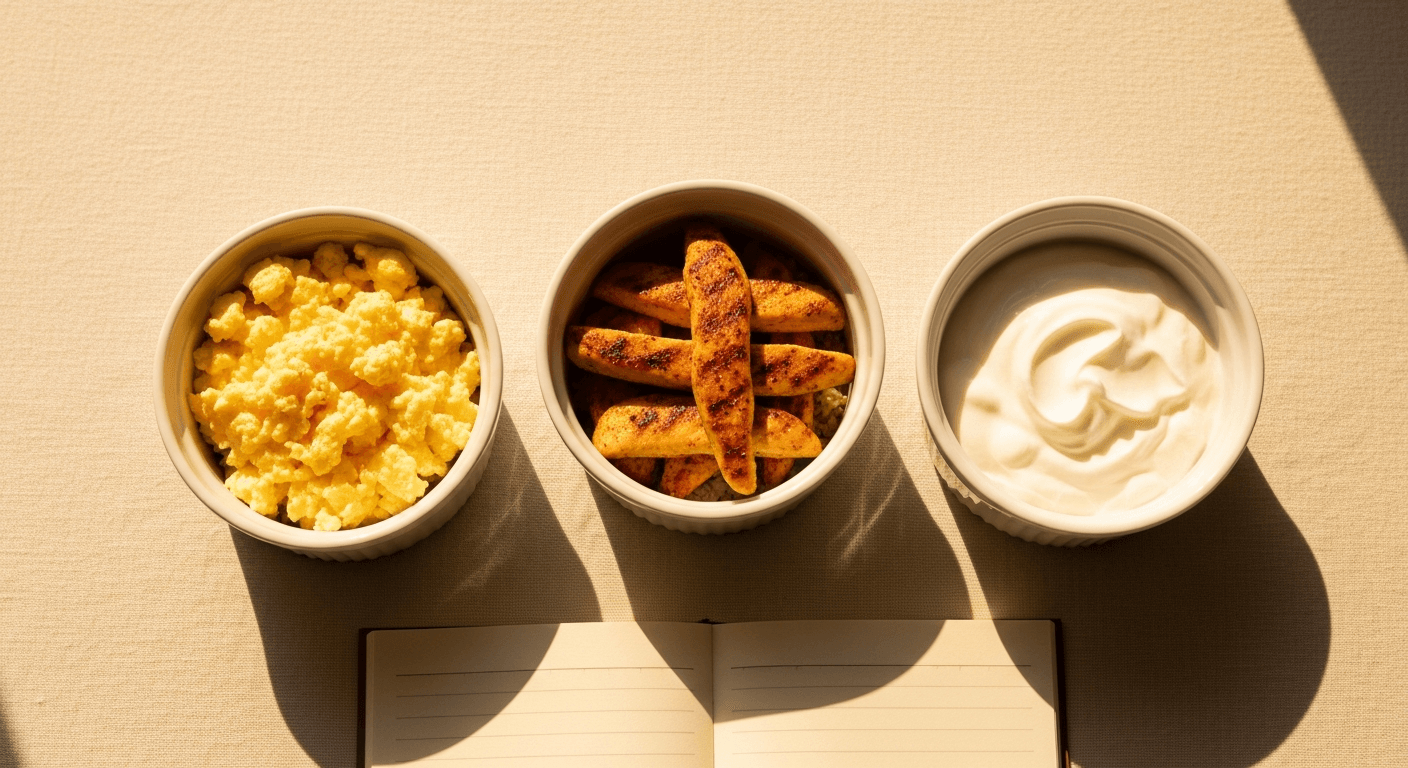
Most people obsess over their daily protein total and stop there. Hit 150 grams, check the box, move on. But emerging research from 2025 and 2026 is making it increasingly clear that when you eat your protein matters almost as much as how much you eat. The distribution across meals can meaningfully shift whether that protein actually drives muscle growth or simply gets processed and excreted.
This isn't a minor optimization for elite athletes. It's a practical framework that applies to anyone who trains consistently and wants their nutrition to actually match their effort in the gym.
Why Total Protein Isn't the Whole Story
The "1 gram per pound of bodyweight" rule has dominated fitness culture for decades. It's a rough shorthand, and it's not entirely wrong. But it treats all protein the same regardless of when you eat it, how much you eat at once, or how your body is actually able to use it.
Muscle protein synthesis (MPS) is the biological process that drives muscle repair and growth. It doesn't run continuously at a flat rate. It spikes in response to protein intake, particularly the amino acid leucine, and then returns to baseline. Eating 80 grams of protein in a single sitting doesn't produce double the MPS of eating 40 grams. There's a ceiling to how much your body can use at once to trigger that anabolic response.
Multiple trials published between 2025 and 2026 have reinforced this. Studies consistently show that distributing approximately 0.4 grams of protein per kilogram of bodyweight across at least four meals produces stronger MPS outcomes than eating the same total amount front-loaded or back-loaded. For a 75kg person, that's roughly 30 grams per meal across four eating occasions, rather than two large protein hits.
The Morning Problem Nobody Talks About
Ask most people what they eat for breakfast and you'll hear: a piece of toast, some fruit, maybe a yogurt. Occasionally nothing at all. Breakfast is consistently the most under-proteined meal of the day across virtually every population studied, and it's creating a meaningful anabolic gap during the morning hours.
After an overnight fast of seven to nine hours, your body's muscle protein synthesis rates are suppressed. The morning is actually when your muscles are most primed to respond to an amino acid stimulus. Eating a high-carbohydrate or low-protein breakfast at that moment means you're missing the most responsive window of the day.
This doesn't mean you need to force feed yourself at 6am if you're genuinely not hungry. But if muscle growth is a priority, structuring your first meal to include a meaningful protein target, around 30 to 40 grams, shifts your physiology in the right direction from the start. Eggs, Greek yogurt, cottage cheese, smoked salmon, or a protein shake blended into a real-food meal all work.
If you're also trying to dial in what surrounds that meal, what you eat before training matters whether that training happens in the morning or later in the day.
Pre-Sleep Protein: The Evidence Is Solid Now
This one has moved well beyond "interesting theory" territory. Research on pre-sleep protein has accumulated enough to make a clear recommendation: consuming 30 to 40 grams of slow-digesting protein before bed consistently supports overnight muscle protein synthesis without increasing fat storage in people who are resistance training.
The mechanism makes sense. During sleep, your body enters its longest repair window of the day. If amino acids aren't available in circulation, the rate of overnight MPS is blunted. Casein protein, the slow-digesting fraction found in dairy, releases amino acids gradually over four to six hours, which maps almost perfectly onto a typical sleep window.
Whole food sources work too. Cottage cheese is the most practical option for most people. A 200-gram serving provides roughly 25 to 28 grams of protein, predominantly casein. Full-fat Greek yogurt, a glass of milk with a handful of nuts, or a small portion of chicken breast also get the job done.
The concern that eating before bed leads to fat gain doesn't hold up in the research, particularly when protein is the macronutrient in question and calorie balance is managed across the day. The bigger issue for most people is that poor sleep undermines your recovery far more than any single meal timing variable. Protein before bed supports sleep-phase repair, but only if the sleep itself is adequate.
The Per-Meal Targets You Actually Need
Rather than tracking protein to the gram on every occasion, the 0.4g per kilogram per meal benchmark gives you a working minimum that's achievable with real food. Here's what that looks like for two common bodyweights.
For a 70kg person: Your per-meal minimum is approximately 28 grams. Your daily target across four meals lands around 112 grams, which aligns with a total intake of roughly 1.6g per kilogram of bodyweight. This sits in the evidence-supported range for active adults focused on muscle retention and growth.
For an 85kg person: Your per-meal minimum is approximately 34 grams. Four meals gets you to 136 grams daily. If you're in a heavy training phase or above 40 years old, where anabolic resistance means your muscles respond less efficiently to smaller doses, pushing each meal toward 40 grams may produce better results.
Practical Meal Templates for Real Life
Most people operate on three meals a day. Some manage four. Here's a structure for both.
4-Meal Template (70kg Person, Target: 28g per meal)
- Meal 1 (Breakfast): 3 whole eggs plus 150g of Greek yogurt with berries. Approximately 30g protein.
- Meal 2 (Lunch): 120g of canned tuna or grilled chicken in a whole grain wrap with greens and hummus. Approximately 32g protein.
- Meal 3 (Dinner): 150g of salmon fillet with roasted vegetables and a half cup of lentils. Approximately 35g protein.
- Meal 4 (Pre-Sleep): 200g of cottage cheese with a tablespoon of almond butter. Approximately 26g protein.
Total: approximately 123g protein. Well within the optimal range for a 70kg active adult.
4-Meal Template (85kg Person, Target: 34g per meal)
- Meal 1 (Breakfast): 4 whole eggs with 200g of low-fat Greek yogurt and 30g of granola. Approximately 40g protein.
- Meal 2 (Lunch): 150g of ground turkey in a grain bowl with edamame, brown rice, and tahini dressing. Approximately 38g protein.
- Meal 3 (Dinner): 180g of sirloin steak with a large baked potato and a side salad. Approximately 42g protein.
- Meal 4 (Pre-Sleep): 250g of cottage cheese or a 35g casein shake blended with milk. Approximately 35g protein.
Total: approximately 155g protein. Appropriate for an 85kg person in an active training block.
3-Meal Template (for People Who Don't Eat Four Times a Day)
If three meals is your reality, the per-meal target shifts upward. A 70kg person needs to hit approximately 37 to 40 grams per meal, while an 85kg person is looking at 45 to 50 grams. That's achievable but requires deliberate sourcing. Each meal needs an anchor protein source, not a supporting one.
- Breakfast: A 3-egg omelet with 150g of smoked salmon and a side of Greek yogurt. Approximately 45g protein.
- Lunch: 180g of grilled chicken breast over a large salad with a hard-boiled egg and 100g of chickpeas. Approximately 48g protein.
- Dinner: 200g of white fish or lean beef with lentil pasta and steamed greens. Approximately 45g protein. Add 200g of cottage cheese before bed to bring the overnight window into range.
Pairing smart protein distribution with recovery-focused foods can accelerate your results. The foods that actually support recovery overlap substantially with high-protein whole food sources.
What This Means in Practice
Getting your protein distribution right doesn't require a complicated tracking system. It requires a shift in how you think about each meal. Every eating occasion is an opportunity to trigger MPS. If a meal doesn't include a meaningful protein source, that opportunity is gone and can't be fully recovered by loading more at the next sitting.
This is also where technology is starting to help. AI-driven nutrition tools are increasingly capable of mapping your eating patterns and flagging under-proteined meals in real time, which takes some of the cognitive load off manual tracking.
The bigger picture is that muscle building isn't just a training problem. How you train matters enormously, but nutrition needs to meet training with equal precision. Spreading protein intelligently across your day is one of the clearest, most evidence-backed levers you have. Most people simply aren't pulling it.