
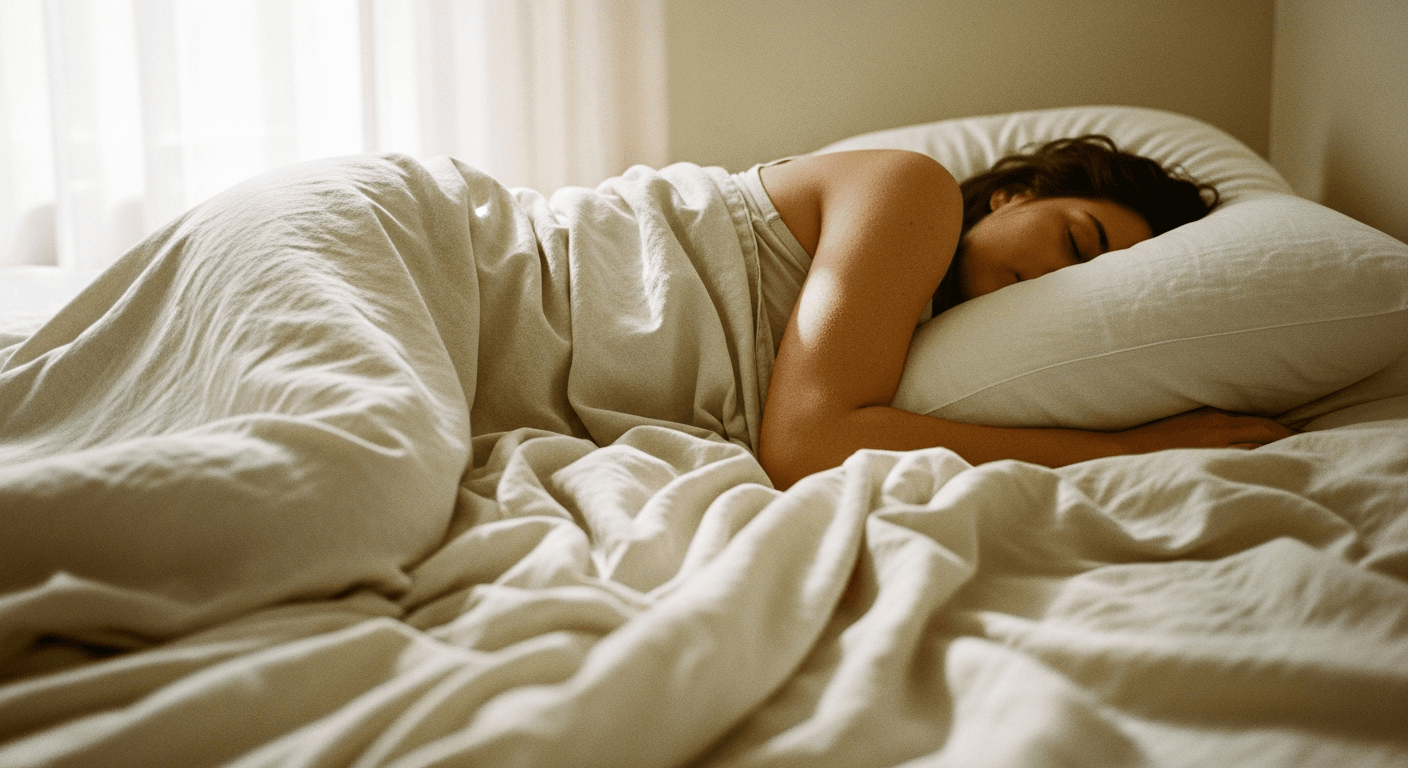
You track your macros. You follow a structured training program. You schedule rest days. And yet your performance stalls, your muscles stay sore longer than they should, and you feel perpetually run-down. The missing variable is almost certainly sleep. Not the casual "get more rest" advice you've heard before. The specific, measurable way that poor sleep dismantles the physical adaptations you're working so hard to build.
Most active people treat sleep as a passive background activity. It isn't. It's the most metabolically active recovery window your body has, and skimping on it costs you far more than grogginess the next morning.
Why Sleep Is Your Primary Recovery Window
The majority of human growth hormone (HGH) secretion happens during slow-wave sleep, specifically in the first few hours after you fall asleep. HGH drives tissue repair, stimulates muscle protein synthesis, and supports fat metabolism. Without adequate deep sleep, that hormonal release is blunted or delayed, and your muscles simply don't rebuild at the rate your training demands.
This isn't a minor inconvenience. Research consistently shows that the body's anabolic processes. the ones that turn a hard training session into actual muscle gain and strength adaptation. are overwhelmingly sleep-dependent. You can optimize pre- and post-workout nutrition with precision, but if you're consistently cutting sleep short, you're working against your own biology.
For athletes following structured progressive training, this matters even more. The stress you apply during a workout is only one half of the equation. The adaptation happens during recovery, and recovery is dominated by sleep. If you're building a cardio program using structured intensity work, as outlined in Heart Rate Training Zones: The Practical 2026 Guide, your body needs full recovery cycles to respond to that stimulus appropriately.
What One Bad Night Actually Does to Your Body
Here's where the science gets uncomfortable. Even a single night of reduced sleep. defined in most studies as getting fewer than six hours when your baseline need is seven to nine. produces measurable physiological damage to your recovery status.
Cortisol, your primary stress hormone, rises after sleep restriction. Elevated cortisol is catabolic, meaning it actively breaks down muscle tissue. At the same time, muscle protein synthesis rates drop. One study found that restricting sleep to five and a half hours reduced the proportion of weight lost as fat by 55 percent compared to a well-rested control group, with a corresponding increase in muscle mass loss. You're losing the wrong tissue and keeping the wrong tissue.
Injury risk also climbs sharply. Sleep-deprived athletes show slower reaction times, degraded neuromuscular coordination, and reduced joint stability. These aren't abstract risks. They translate directly into higher rates of soft tissue injury, poor form under fatigue, and longer recovery timelines when injuries do occur.
If you're supplementing your recovery protocol with anti-inflammatory support, such as the approaches covered in Boswellia for Muscle Recovery: What the Science Says, those interventions become significantly less effective when the foundational sleep variable is compromised.
Sleep Debt Is Not Linear. It Compounds
Most people assume that if they lose an hour of sleep on Monday, they can make it up on Friday. That's not how sleep debt works. The cognitive and physical impairments from accumulated sleep restriction stack in a non-linear way.
Research from the University of Pennsylvania demonstrated that subjects restricted to six hours of sleep per night for two weeks performed as poorly on cognitive tests as subjects who had been kept awake for 48 hours straight. Critically, the sleep-restricted group consistently underestimated their own impairment. They felt fine. Their performance said otherwise.
Five nights of six-hour sleep produces deficits equivalent to 48 hours of total sleep deprivation. That's the level of impairment you're training through if you're consistently under-sleeping during the work week. Your output in the gym, your coordination, your recovery capacity, and your decision-making around nutrition and training load are all operating at a substantial deficit.
Weekend recovery sleep helps partially, but it doesn't fully reset the physiological markers. Chronic partial sleep restriction creates a baseline impairment that's difficult to reverse without sustained, consistent sleep improvement.
Practical Sleep Hygiene That Actually Moves the Needle
The good news is that targeted sleep hygiene adjustments produce measurable improvements in sleep quality within five to seven days. You don't need supplements, expensive devices, or a complete lifestyle overhaul. Here's what the evidence supports most strongly:
- Fix your wake time first. A consistent wake time, even on weekends, anchors your circadian rhythm more effectively than a consistent bedtime. Your body calibrates its sleep pressure based on how long it's been awake. Set one wake time and protect it.
- Limit blue-spectrum light in the 90 minutes before bed. Screen light in the blue wavelength range suppresses melatonin production meaningfully. Dimming screens, using night mode settings, or switching to low-light activities in the evening helps your body begin its natural sleep preparation process on schedule.
- Keep your bedroom cool. Core body temperature needs to drop by approximately one to two degrees Fahrenheit to initiate and maintain deep sleep. A room temperature between 65 and 68 degrees Fahrenheit (18 to 20 degrees Celsius) is the most commonly supported range.
- Avoid alcohol within three hours of sleep. Alcohol accelerates sleep onset but fragments the second half of sleep, suppresses REM, and reduces slow-wave sleep. It directly undermines the growth hormone secretion window.
- Manage evening stress actively. Elevated cortisol in the evening delays sleep onset and reduces deep sleep time. Structured breathwork has shown measurable effects on pre-sleep nervous system state. The research behind this is explored in Breathwork Apps That Actually Reduce Anxiety.
For heavy training athletes, off-day recovery practices compound with better sleep to accelerate adaptation. The specific protocols worth considering are detailed in The Off-Day Recovery Routine Heavy Lifters Swear By.
Tracking Quality, Not Just Hours
Eight hours in bed is not the same as eight hours of restorative sleep. Sleep architecture matters as much as duration. Your sleep cycles through stages: light sleep, deep slow-wave sleep, and REM sleep. Each serves distinct recovery functions. Slow-wave sleep drives physical repair and hormone release. REM sleep consolidates motor learning, emotional regulation, and cognitive function.
If you're waking frequently, spending too little time in deep sleep, or experiencing poor sleep continuity, you can hit your target hours and still wake up under-recovered. This is where tracking becomes a practical tool rather than a vanity metric.
Consumer wearables, including devices from Oura, Garmin, WHOOP, and Apple, now provide reasonable approximations of sleep stage distribution and recovery readiness scores. They're not clinical-grade, but they're accurate enough to identify patterns. If your deep sleep percentage is consistently low, or your resting heart rate is elevated overnight, those are signals worth acting on before you add more training volume.
What you're looking for in quality sleep: a resting heart rate that drops 10 to 20 percent below your waking baseline overnight, heart rate variability that trends stable or upward across a training block, and sleep efficiency (time asleep divided by time in bed) above 85 percent. These numbers give you a more honest picture of recovery status than hours alone.
Sleep in the Context of Your Full Recovery Stack
Sleep doesn't operate in isolation. It interacts with your nutrition timing, your training load, your stress levels, and your supplementation choices. Getting your carbohydrate intake and hydration strategy right, as covered in Carbs and Hydration: The Exact Timing for Performance, supports glycogen replenishment that feeds into sleep quality and overnight recovery.
Adaptogens like ashwagandha have shown some evidence for reducing cortisol and improving sleep quality in chronically stressed individuals, and the evidence is assessed objectively in Adaptogens for Stress: What the Science Actually Says. These tools can support your sleep environment but don't replace the structural habits outlined above.
The broader point is this: sleep is not a passive default. It's an active physiological process that you can optimize with the same intentionality you bring to your training and nutrition. Most active people are leaving significant recovery capacity on the table not because they don't train hard enough, but because they haven't treated sleep as a performance variable.
Start with a consistent wake time. Dim your environment an hour before bed. Track your sleep quality for two weeks. The data will tell you what your energy levels have been masking.