

Intermittent fasting has spent the better part of a decade positioned as something close to a metabolic shortcut. The promise was compelling: eat less often, burn more fat, reset your hormones, live longer. Millions of people have structured their entire relationship with food around eating windows, skipped breakfasts with conviction, and defended 16:8 like a personal philosophy.
A February 2026 Cochrane-aligned systematic review just made that a harder sell.
What the Review Actually Found
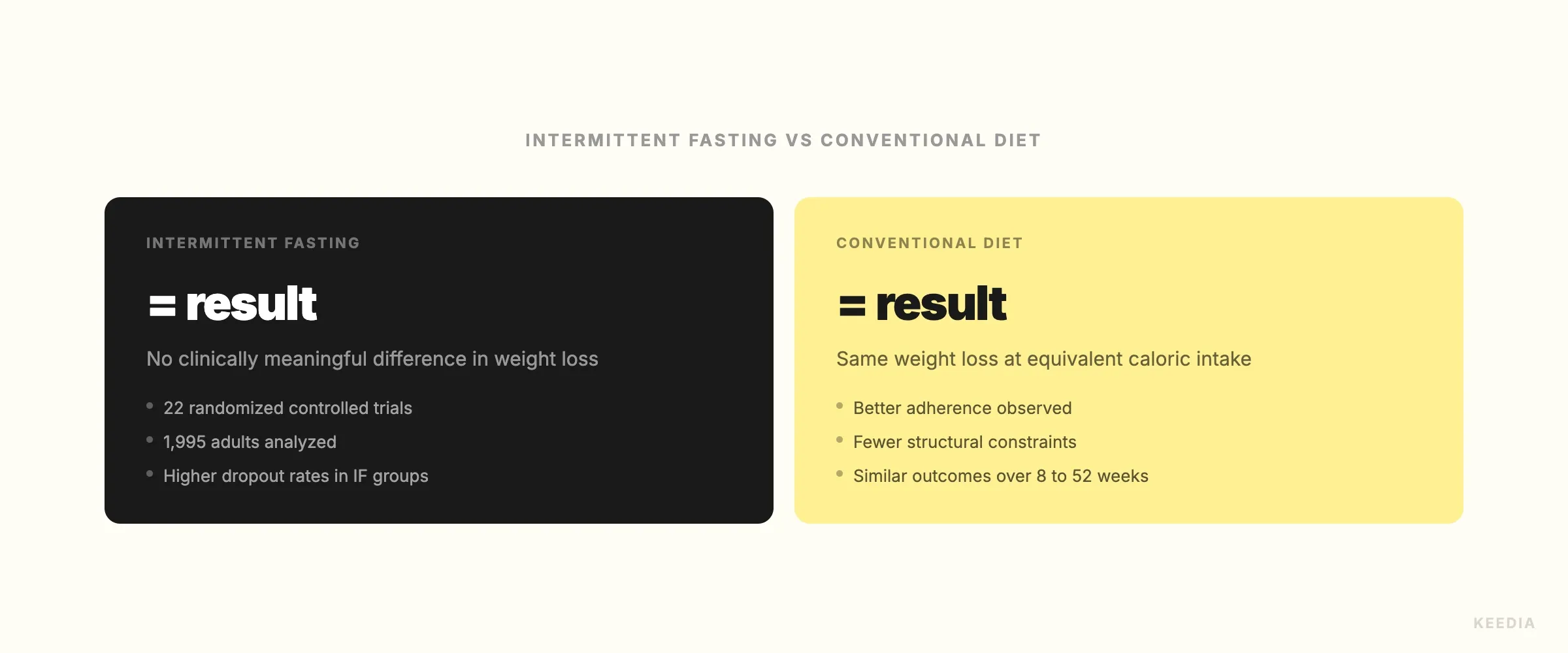
The study analyzed 22 randomized controlled trials involving 1,995 adults. The central finding: intermittent fasting produces no statistically meaningful difference in weight loss compared to conventional dietary advice. Not negligible. Not slightly worse. Simply not distinguishable from a standard calorie-reduction approach when you run the numbers across a controlled evidence base of this scale.
This matters because the comparison isn't IF vs. eating whatever you want. It's IF vs. a normal reduced-calorie diet. When the comparison is fair, the dramatic edge disappears.
What this tells you isn't that fasting is useless. It's that the mechanism most people credit for IF's results, the fasting itself, is likely doing far less work than the calorie deficit that tends to come with it. The structure creates the deficit. The deficit drives the weight loss. That's a different story than the one being told on social media.
No Metabolic Magic Without the Calorie Deficit
A January 2026 study out of Germany, the ChronoFast study, pushed this point further. Researchers examined time-restricted eating applied without any deliberate calorie reduction. The result: no meaningful metabolic benefit in terms of fat loss or body composition.
That's a direct challenge to the idea that the eating window alone triggers some independent metabolic switch. It doesn't appear to. Compress your eating hours without changing what you consume, and the scale doesn't move in any clinically significant way.
Here's where it gets interesting, though. The ChronoFast study did find one measurable effect: time-restricted eating shifted participants' circadian clocks. The timing of food intake has a genuine biological signal. It influences your internal body clock, which governs sleep quality, cortisol rhythm, insulin sensitivity across the day, and a range of downstream hormonal processes. That's not nothing. It just isn't the weight-loss mechanism that IF marketing has leaned on.
The Exception That Deserves Attention
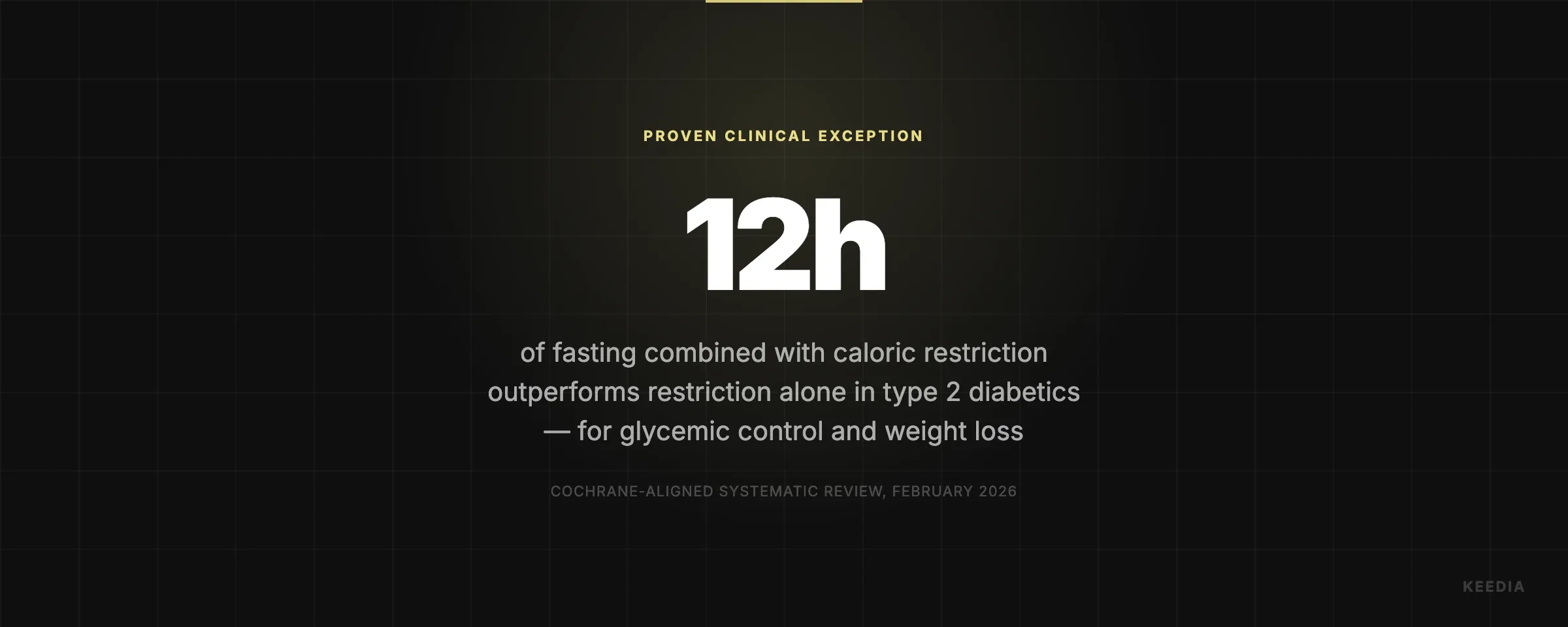
There is one population where the data looks meaningfully different: people with type 2 diabetes.
When a 12-hour intermittent fasting protocol was combined with calorie restriction in type 2 diabetic patients, the combination outperformed calorie restriction alone. Not just for weight. For glycemic control specifically. HbA1c improvements were larger, and the metabolic response was more favorable than you'd expect from calories alone.
This matters clinically. For a population where meal timing has a direct relationship with insulin response and blood glucose stability, structuring when you eat appears to add genuine value on top of how much you eat. If you're managing type 2 diabetes or working with someone who is, that distinction is worth taking seriously.
Timing Still Matters. Just Not the Way You Think
The circadian finding from ChronoFast connects to a broader and increasingly robust pattern in the research: early eating windows consistently outperform late-day eating windows, even when total calories are identical.
Studies comparing morning-to-early-afternoon eating patterns against late-afternoon-to-evening windows show measurable differences in fat oxidation, insulin sensitivity, and weight outcomes. The same caloric intake, eaten earlier in the day, produces better metabolic results than the same intake consumed later.
This has real practical implications. If you're doing time-restricted eating, the position of your window on the clock likely matters more than the window's width. A 10am to 6pm eating schedule is biologically different from a 1pm to 9pm schedule, even if both are technically 8-hour windows. Most IF protocols don't make this distinction. Most people eating late and calling it 16:8 are leaving outcomes on the table.
It also reframes the question. The debate shouldn't be "does IF work?" It should be "which version of IF, at what time of day, for which person, combined with what else?" That's a more honest framing, and the research now supports it.
What This Means for Athletes
If you train seriously, intermittent fasting can be made to work. But the most common version of it, skipping breakfast, training fasted, and hoping for the best on protein, is where things break down.
Muscle preservation during a calorie deficit requires hitting your protein targets consistently. That's not negotiable. Compress your eating window and you also compress the time available to distribute protein intake across meals. Research consistently shows that spreading protein across three to four meals within a day produces better muscle protein synthesis than the same total amount consumed in one or two larger meals.
If you're combining IF with a meaningful training load, the math gets tight quickly. A 180-pound male athlete targeting 160 grams of protein per day, eating in a 6-hour window, needs to front-load aggressively and hit those numbers in two or three meals. Most people don't do this. They under-eat protein during the fast, over-eat it in one sitting where absorption efficiency drops, and then wonder why body composition isn't responding the way they expected.
This is a similar dynamic to what's being documented with GLP-1 medications. The risk of lean mass loss when total intake drops is real and underappreciated. GLP-1 and Muscle Loss: What Training Can — and Can't — Fix covers the protein and resistance training protocols that apply here, and much of the same logic carries over to aggressive IF approaches.
The fix isn't complicated. Track protein daily during any IF protocol. Prioritize it at every meal within your window. Don't let fasting become an excuse for chronic under-consumption of the one macronutrient that protects the tissue you've built.
The Practical Takeaway
Here's what the current evidence actually supports:
- IF produces equivalent weight loss to conventional dieting when calories are matched. It's not superior. It's a different structure that achieves the same outcome through caloric restriction.
- Fasting without a calorie deficit doesn't produce fat loss. The window alone isn't a mechanism. The ChronoFast data is clear on this.
- Early eating windows are meaningfully better than late ones. If you're going to use time-restricted eating, position your window in the morning and early afternoon.
- Type 2 diabetes is a genuine exception. 12-hour IF combined with calorie restriction adds measurable glycemic benefit beyond calories alone.
- Athletes must prioritize protein distribution. Compressing meals doesn't reduce your protein requirements. It makes meeting them harder.
Recovery and sleep quality also interact with eating timing in ways that are easy to underestimate. If you're training hard, disrupted sleep from late eating compounds everything. Magnesium and Sleep for Athletes: Which Form, What Dose, What Results addresses some of the adjacent recovery factors that interact with meal timing and training stress.
The Bigger Picture
The February 2026 review doesn't kill intermittent fasting as a dietary strategy. It strips away the mythology around it. That's actually useful.
IF works for a lot of people. It works because it's a structure that naturally reduces calorie intake. It works because some people find it easier to skip a meal than to portion-control every one. It works because eating earlier in the day aligns with favorable circadian biology. Those are legitimate reasons. They're just more mundane than the metabolic transformation narrative that's been attached to it.
The people who do best with IF tend to be the ones using it as a practical tool rather than a belief system. They hit their protein targets. They position their window earlier in the day. They pair it with consistent training and adequate sleep. They don't rely on the fast itself to do work that only a sustained calorie deficit can do.
That approach is grounded in what the evidence actually shows. And it's a lot more sustainable than the version that requires you to believe fasting has properties it doesn't have.
If you're optimizing training alongside your nutrition strategy, How to Improve Your VO2max: The Research-Backed Protocols and Zone 2 Without a Lab: Find Your Zone Accurately are worth reading alongside this. Cardiovascular adaptation and metabolic health are closely linked, and your eating strategy should be designed to support your training, not work against it.