
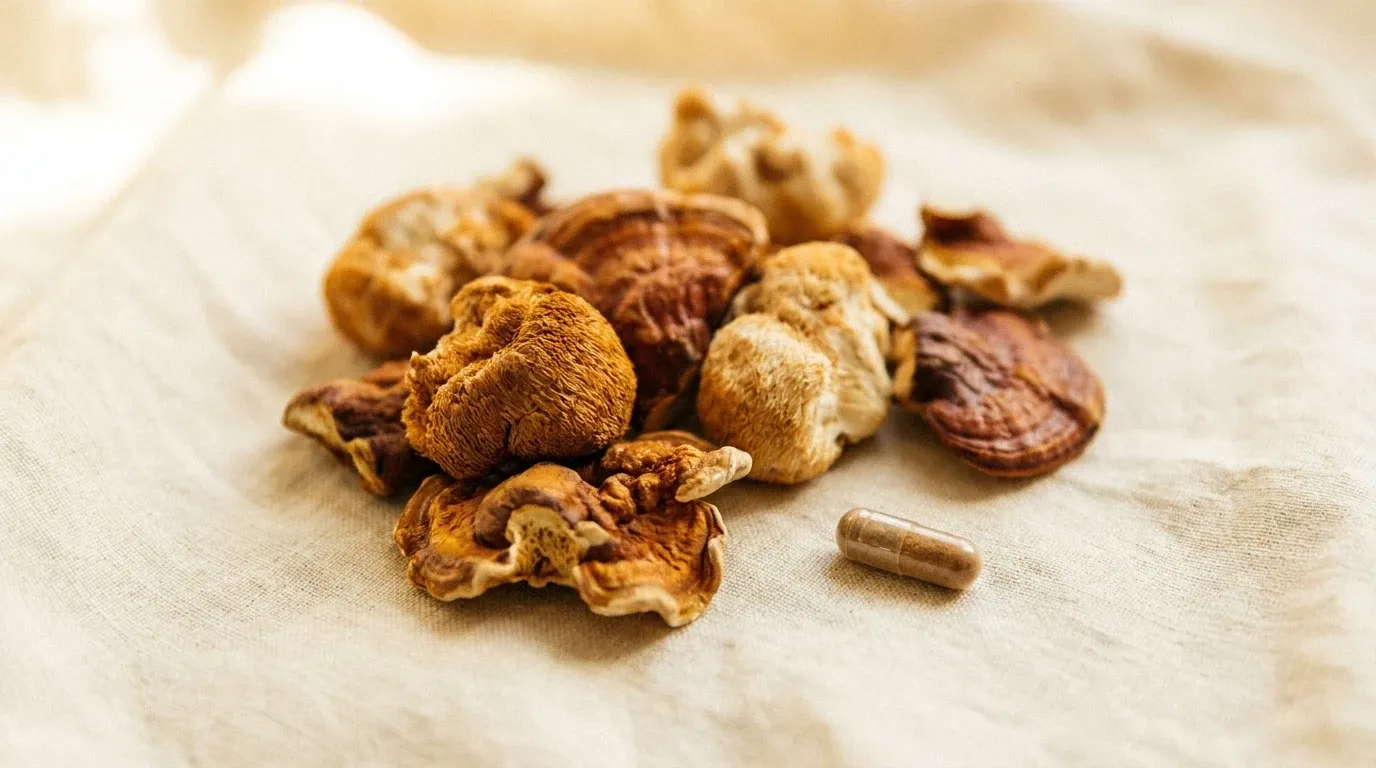
Walk into any supplement store or scroll through a wellness brand's Instagram in 2026, and you'll find lion's mane capsules, reishi tinctures, and chaga powders promising everything from sharper focus to a stronger immune system. The marketing is confident. The science is more complicated.
That doesn't mean mushroom compounds are snake oil. It means you deserve a clearer picture of what the research actually supports, where the gaps are, and what to look for before spending your money.
The Bioactive Compounds Worth Knowing About
Medicinal mushrooms contain several categories of compounds that researchers have studied for decades. The most documented are beta-glucans, a class of polysaccharides found in the cell walls of fungi. These compounds appear to interact with immune receptors, particularly dectin-1 receptors on immune cells, in ways that can modulate inflammatory response and activate certain white blood cell populations.
Beyond beta-glucans, species-specific compounds attract significant interest. Lion's mane (Hericium erinaceus) contains hericenones and erinacines, which have shown the ability to stimulate nerve growth factor (NGF) synthesis in cell cultures. Reishi (Ganoderma lucidum) contains triterpenoids with documented antioxidant and anti-inflammatory properties in laboratory settings. Turkey tail (Trametes versicolor) is the source of two compounds, PSK and PSP, that have moved well beyond the lab.
It's worth understanding that "mushroom supplement" is a broad category. You're not buying one thing. Different species, different extraction methods, and different parts of the fungus (mycelium versus fruiting body) produce very different chemical profiles.
What Lab and Animal Research Actually Shows
The preclinical evidence for mushroom bioactives is genuinely interesting. In vitro studies consistently show that beta-glucans can activate macrophages and natural killer cells, two key players in the body's first line of defense. Multiple animal studies have demonstrated antitumor activity, with some mushroom-derived compounds slowing tumor growth and enhancing the immune system's ability to identify and attack abnormal cells.
Antiviral properties have also been observed in lab settings. Certain polysaccharide fractions from reishi and shiitake have shown activity against influenza and other viral models in controlled cell studies. The mechanisms are plausible and reproducible under laboratory conditions.
Here's the critical caveat: showing an effect in a petri dish or in a mouse model is not the same as showing that effect in a human being who swallows a capsule. Bioavailability, dosing, and the complexity of human immune systems all create gaps that preclinical research can't bridge on its own. As of late 2026, the human trial data remains thin relative to the volume of marketing claims built on top of it.
The Clinical Exception: Approved Drugs in Asia
This is where context matters. Mushroom compounds aren't entirely without clinical validation. PSK, derived from turkey tail, has been approved as an adjunct cancer therapy in Japan since the 1980s. It's used alongside chemotherapy for gastric, colorectal, and lung cancers, and several randomized controlled trials conducted in Japan have shown improved survival outcomes in specific patient populations.
China has similarly approved lentinan, a beta-glucan extracted from shiitake, for use in cancer treatment protocols. These are pharmaceutical-grade, standardized compounds used under medical supervision at specific doses. They represent the clearest evidence that mushroom-derived bioactives can have meaningful clinical effects in humans.
That approval history is legitimate context for optimism. It's also why the hype exists. But there's a substantial difference between a standardized pharmaceutical compound administered in a clinical oncology setting and a $35 bottle of mixed mushroom powder you order online. That gap is what most supplement marketing quietly ignores.
Where the Human Evidence Still Falls Short
Outside of the Asian pharmaceutical context, large-scale randomized controlled trials (RCTs) in healthy adults are still lacking. Most published human studies on mushroom supplements are small, short in duration, and often lack placebo controls or use inconsistent product standardization. That makes it nearly impossible to draw firm conclusions about dose-response relationships or long-term effects.
The lion's mane category illustrates the problem well. The cognitive and neurological interest in this species is real, and the NGF research is compelling at a mechanistic level. But human trials to date have involved small sample sizes, typically under 60 participants, and follow-up periods of just weeks or months. Larger, well-designed RCTs are in progress at several research institutions, but results aren't yet available at scale.
This pattern, where the science is promising but premature, comes up repeatedly across the supplement industry. If you've read our breakdown of why ingredient testing doesn't predict your joint supplement's results, you'll recognize the structure: strong mechanistic data, weak translational evidence, and marketing that collapses the distance between the two.
Similarly, the immune-modulating claims attached to reishi and chaga supplements are plausible in theory. But "modulates immune function" is not the same as "prevents illness" or "treats disease," and supplement labels rarely make that distinction clearly.
The Gut Connection
One underreported angle in mushroom research is the potential interaction between fungal polysaccharides and the gut microbiome. Some beta-glucans appear to act as prebiotics, selectively feeding beneficial bacterial populations. This could represent an indirect pathway through which mushroom compounds influence immune function, given how deeply gut health and immune regulation are connected.
It's a plausible mechanism, but again, the human data is early. If you're already thinking through your gut health strategy, understanding the distinction between different supplement categories is worth your time. The differences outlined in postbiotics vs probiotics: which one should you take gives useful context for how the gut supplement space handles evidence and marketing claims more broadly.
What to Actually Look for When Buying
If you decide to try mushroom supplements, here's how to shop more intelligently.
- Standardized beta-glucan content. A reputable product will disclose the percentage of beta-glucans per serving on the label, typically between 20% and 40% for quality extracts. If a label only lists "mushroom powder" with no extraction ratio or beta-glucan percentage, you have no way of knowing what you're actually getting.
- Fruiting body vs. mycelium. Many products use mycelium grown on grain substrates, which can result in high starch content and lower concentrations of active compounds. Products made from fruiting bodies generally have better-documented compound profiles. Some quality products combine both, but the label should tell you which you're getting.
- Third-party testing. Look for certification from organizations like NSF International, USP, or Informed Sport. These verify that what's on the label is actually in the product and that it's free from heavy metals, pesticides, and contaminants. Fungi are efficient bioaccumulators, meaning they absorb whatever is in their growing environment, including toxins. Testing isn't optional.
- Extraction method disclosure. Hot water extraction is the standard method for releasing beta-glucans. Dual extraction (hot water plus alcohol) is used for compounds like reishi triterpenoids that aren't water-soluble. A brand that discloses its extraction process is signaling transparency. One that doesn't is hiding something or doesn't know enough to tell you.
- Realistic claims. Any product promising to "cure," "prevent," or "treat" a specific disease is making an illegal claim under FDA guidelines. Legitimate brands use language like "supports immune function" and direct you to the relevant research rather than making outcome guarantees.
Expect to pay between $30 and $70 per month for a quality single-species extract from a transparent brand. Products well below that range often cut corners on sourcing or testing. Products well above it are usually charging for branding.
How This Fits Into a Broader Wellness Stack
Mushroom supplements, used thoughtfully, might be a reasonable addition to an already solid foundation. But they're not a replacement for the basics. Sleep quality, consistent training, and diet quality have far more robust human evidence behind them than any supplement on the market.
The interest in cognitive performance that drives lion's mane sales, for example, is better served by understanding what research-backed interventions actually do for brain health. The data behind how lifting weights actually makes you smarter is considerably stronger than anything in the current mushroom supplement literature.
That's not a reason to dismiss mushroom compounds entirely. It's a reason to keep them in proportion. If you're sleeping well, training consistently, eating enough protein, and managing stress, adding a well-sourced lion's mane or turkey tail extract is a low-risk experiment with plausible upside. If you're skipping those foundations and hoping a supplement fills the gap, it won't.
The science on mushroom bioactives is genuinely promising. It's also genuinely incomplete. Your job as a consumer is to hold both of those things at the same time, and to demand that the products you buy meet a standard of transparency that matches the strength of their claims.