
Protein has officially become the most talked-about nutrient in fitness, and the market is catching up fast. Prices are rising, new formats are competing for shelf space, and the science is moving quickly enough that last year's buying decisions may already be outdated. Here's what's actually happening and what it means for your wallet and your training.
Key Takeaways
- Protein powder prices have risen 8-15% in 2026 due to higher raw material costs
- Single-serve sachets and protein bars are gaining ground over traditional 2 kg tubs
- Comparing price per gram of protein remains the best way to evaluate value
Why Protein Topped Every Nutrition Priority List in 2026
Consumer surveys conducted in early 2026 consistently place protein at the top of Americans' nutrition priorities, ahead of fiber, omega-3s, and even hydration. The reasons aren't random. Three forces converged at roughly the same time.
First, strength training participation has grown substantially over the past three years, with more recreational athletes tracking their lifts, their macros, and their recovery. Second, mainstream coverage of longevity research has pushed protein into conversations well outside the gym. Studies linking adequate intake to muscle preservation in aging adults have made protein relevant to a much broader audience than bodybuilders.
Third, the rise of GLP-1 medications has created an entirely new reason to think carefully about protein. As more people use these drugs to manage weight, the concern about muscle loss has become a real clinical and consumer issue. Research on GLP-1 drugs and muscle loss in 2026 is now influencing how both clinicians and supplement brands talk about daily protein targets.
Whey Is Getting More Expensive. Here's Why.
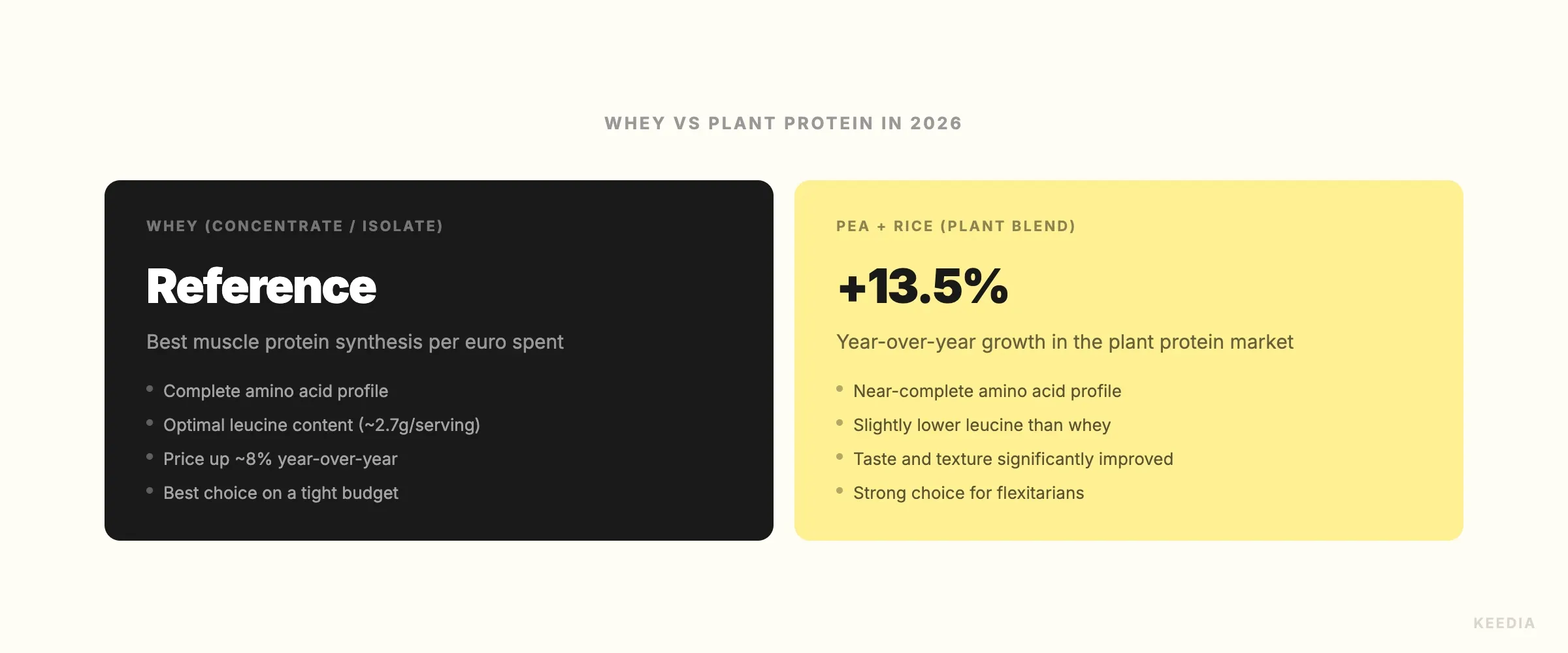
If your tub of whey protein isolate cost noticeably more this year than last, you're not imagining it. Whey prices rose approximately 8% from 2025 into 2026, and the causes are structural, not temporary.
Global demand for whey protein isolate, the higher-purity form, has outpaced supply. Processing capacity for isolate is more limited than for concentrate, and energy costs at dairy processing facilities have increased in key producing regions. At the same time, emerging markets in Asia and the Middle East are buying more whey-based products, adding competitive pressure to a supply chain that was already running lean.
What does this mean at the register? A quality 5-pound tub of whey isolate that retailed for around $60 to $65 in 2024 now typically runs $65 to $72, depending on the brand and retailer. Concentrate products have seen smaller increases but are trending in the same direction. Budget accordingly if you buy in bulk.

ILLUSTRATION: stat-card | Key data and figures from the article
Plant-Based Protein Is Growing Fast. And It's Getting Better.
Plant-based protein is the fastest-growing segment in the category, expanding at 13.5% year-over-year. That growth isn't coming from vegans alone. The majority of it is driven by flexitarians: people who eat animal products but are actively trying to reduce them, and who still want their supplement to perform.
The formulation story has improved significantly. Earlier generations of pea protein had texture and taste issues that limited adoption. Current blends, particularly combinations of pea and brown rice protein, are much closer to whey in terms of palatability. Some brands are adding leucine specifically to push the amino acid profile closer to what triggers optimal muscle protein synthesis.
That said, the gap with whey is narrowing, not closed. Per gram of protein, whey still delivers a superior leucine content and a faster absorption rate. For athletes focused on maximizing muscle protein synthesis, especially around training, that difference still matters. If you're managing cost and want an animal-free option, a well-formulated pea-rice blend is a legitimate choice. But it's a strong second, not a tie.
For context on how protein fits into broader dietary strategies, what 2026 data confirms about the Mediterranean diet and athletic performance offers a useful frame for thinking about whole-food protein sources alongside supplementation.
Peptides: The Emerging Category Worth Watching
Peptide-based formulations are generating genuine scientific interest, even if most athletes haven't heard of them yet. Unlike standard protein powders, peptide products use shorter amino acid chains that may be absorbed differently and act on muscle signaling pathways in ways that whole proteins don't.
The category getting the most attention right now involves creatine combined with faba bean-derived peptide compounds. Clinical data on one such ingredient, PeptiStrong, has shown measurable improvements in power output and performance metrics in trained adults, with effects appearing to stack with creatine's well-established benefits. The research is early but credible.
The catch is price. Peptide hybrid products currently retail in the $55 to $80 range for a month's supply, putting them at a significant premium over standard protein. For most athletes, that's hard to justify as a daily staple when the fundamentals of protein intake are still more important than the delivery mechanism. Worth watching. Not yet essential.
If you're also tracking recovery tools alongside your nutrition stack, the complete guide to active recovery and training without breaking down covers how to match your nutrition timing with recovery protocols effectively.
The Practical Buying Guide for Athletes in 2026
ILLUSTRATION: tip-box | Practical takeaways
Given rising costs and a crowded market, here's a straightforward framework for making smart decisions right now.
- Whey protein (isolate or concentrate): Still the most cost-effective option for muscle protein synthesis per dollar spent. Prioritize isolate if you're lactose-sensitive or want lower fat and carbohydrate content. Buy in larger quantities to offset per-serving cost increases.
- Pea and rice protein blends: A strong choice if you're reducing animal product consumption or simply want variety. Look for products that have added leucine or use a 70/30 pea-to-rice ratio. Expect to pay roughly $1.00 to $1.50 per serving for quality products.
- Peptide-based hybrids: Worth considering if you have budget flexibility and are already meeting your baseline protein targets through food and standard supplementation. Don't start here. Add it if everything else is already dialed in.
- Whole food first: No supplement replaces dietary protein from chicken, eggs, Greek yogurt, lentils, or fish. If your food-based intake is consistently hitting your target range of 1.6 to 2.2 grams per kilogram of bodyweight, supplementation fills the gaps rather than carries the load.
One area worth monitoring alongside protein strategy is sleep. The relationship between adequate sleep and muscle protein synthesis is stronger than most athletes realize. What the 2026 research shows about sleep and athletic performance makes a compelling case for treating recovery as part of your nutrition stack, not separate from it.
What to Expect Through the Rest of 2026
Whey prices are unlikely to drop significantly before late 2026 at the earliest. Supply chain adjustments take time, and global demand isn't softening. If anything, expect continued pressure on isolate pricing as the GLP-1 market expands and demand for high-protein products grows among a new consumer segment.
Plant-based protein will keep gaining shelf presence, and the formulations will continue to improve. The brands investing in taste and texture science right now are closing the gap in ways that matter to everyday athletes, not just dedicated plant-based consumers.
Peptides will move from fringe to mainstream over the next 12 to 18 months if the clinical data continues to hold. Watch for larger supplement companies to acquire or license peptide ingredients and bring costs down through scale.
The fundamentals, though, haven't changed. Hit your daily protein target, time it reasonably around training, choose a format that fits your budget and dietary preferences, and don't let the noise of a crowded market distract you from the basics. That's still where the results are. For a broader view of where the fitness industry as a whole is heading, what 10,000 fitness professionals agreed on at the HFA Show in San Diego provides useful context on how nutrition fits into larger performance trends.
Related articles
- Creatine: everything you need to know before taking it
- Why Protein Became Everyone's Top Nutrition Priority in 2026
- Paris Marathon 2026 (April 12): Everything You Need to Know Before Race Day