
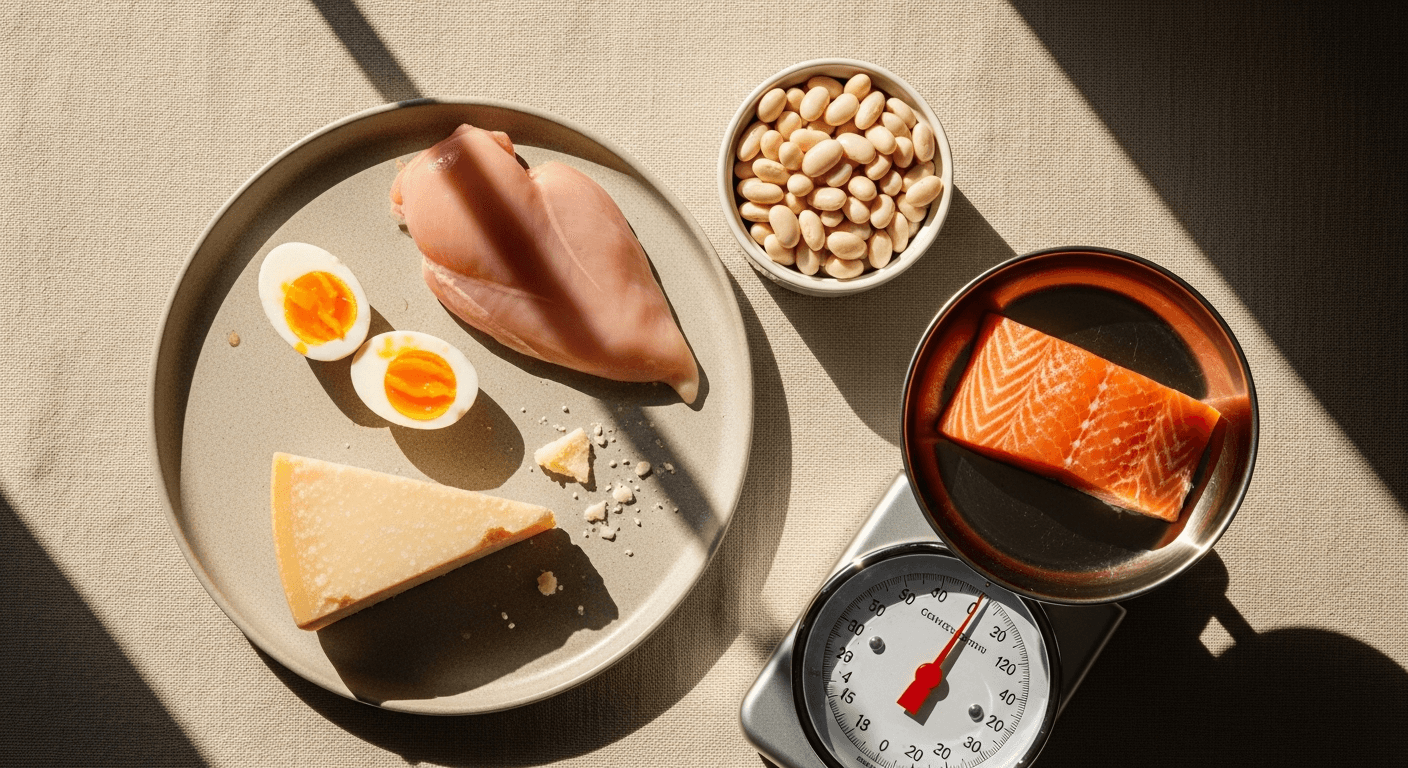
The official recommendation for daily protein intake has barely moved in decades. In the United States, the Recommended Dietary Allowance sits at 0.8 grams per kilogram of body weight. For a 175-pound adult, that works out to roughly 64 grams per day. It sounds reasonable until you understand what that number was actually designed to do.
It was designed to keep you from getting sick. Not to help you perform, build muscle, stay lean as you age, or support a metabolism that works in your favor. That's a meaningful distinction, and the gap between those two goals is wider than most people realize.
What the RDA Was Actually Built For
The RDA for protein is a deficiency threshold, not an optimization target. It represents the minimum intake estimated to meet the needs of roughly 97 percent of a healthy, sedentary population. The methodology behind it prioritizes preventing nitrogen deficiency and preserving basic body function. Longevity, body composition, metabolic health, and physical performance were never part of the calculation.
Researchers in sports nutrition and protein metabolism have been pointing this out for years. Studies consistently show that protein intakes well above the RDA produce measurable benefits in muscle protein synthesis, satiety, lean mass retention, and even immune function. The threshold that prevents deficiency and the intake that supports optimal health are not the same number.
This distinction matters more than ever given how most people are actually living. Sedentary office workers eating the RDA minimum may avoid clinical deficiency. But active adults, people over 50, anyone managing body composition, and virtually anyone dealing with physiological stress are operating in a different context entirely.
The "Adequate" vs "Optimal" Gap
Current research points toward a meaningfully higher protein target for most adults who aren't entirely sedentary. A body of evidence across multiple meta-analyses suggests that intakes between 1.6 and 2.2 grams per kilogram of body weight per day are associated with greater lean mass, better strength outcomes, and improved body composition, particularly when combined with resistance training.
That's roughly double the RDA for someone moderately active. For the same 175-pound adult, it translates to somewhere between 127 and 175 grams of protein per day. The difference isn't trivial.
What's particularly striking is that this research doesn't just apply to elite athletes. Studies on recreationally active adults, individuals in caloric deficits, and older populations all show similar patterns. Higher protein intakes help preserve lean tissue during weight loss, reduce age-related muscle decline, and support better metabolic outcomes across the board.
If you're also paying attention to your broader supplement and recovery stack, it's worth knowing that protein doesn't work in isolation. Creatine Plus Hydration: The Combo Taking Over outlines how combining creatine with proper hydration amplifies training adaptations, the kind of adaptations that depend on adequate protein to actually stick.
Older Adults Face the Highest Risk From Undereating Protein
Age changes everything about how your body handles protein. After around 40, muscle protein synthesis becomes less efficient in response to the same amino acid stimulus. This phenomenon, sometimes called anabolic resistance, means older adults need to eat more protein per meal and per day just to achieve the same muscle-building response as a younger person eating less.
Sarcopenia, the progressive loss of muscle mass and strength with age, is one of the strongest predictors of functional decline, falls, and loss of independence in older adults. It's also significantly underdiagnosed and undertreated. Yet the dietary advice most older people receive still defaults to the outdated 0.8 gram benchmark.
Research suggests that adults over 65 benefit from protein intakes closer to 1.2 to 1.6 grams per kilogram at a minimum, with some evidence supporting even higher targets in those who are physically active. For a 150-pound woman in her 60s, that means targeting 82 to 109 grams daily, not the 54 grams the RDA implies. The practical difference plays out in muscle maintenance, bone health, immune resilience, and overall vitality.
There's also an important connection to recovery quality. HMB: The Muscle-Preservation Supplement Worth Knowing covers a metabolite of the amino acid leucine that has shown genuine promise for protecting lean mass in older and untrained populations, especially relevant if dietary protein is still below optimal levels.
Active Adults Are Leaving Results on the Table
If you exercise consistently, whether that means lifting three times a week or logging serious cardio, the RDA is almost certainly not supporting your training. Resistance exercise increases muscle protein synthesis rates and, simultaneously, increases protein breakdown. To net a positive balance, you need sufficient dietary protein flowing in.
Endurance athletes aren't off the hook either. High training volumes elevate protein oxidation and muscle damage, raising requirements in a different way. Research suggests endurance athletes may need 1.4 to 1.7 grams per kilogram, putting them well above the RDA as well.
Caloric deficit scenarios are where undereating protein does the most damage for active people. When you cut calories without raising relative protein intake, you accelerate lean mass loss alongside fat loss. Studies repeatedly show that higher protein intakes during energy restriction protect muscle tissue, preserve metabolic rate, and improve body composition outcomes. Eating less doesn't have to mean losing muscle, but that protection requires intentional protein targets.
How to Estimate a Better Target for Yourself
You don't need a nutrition degree or a food scale obsession to eat more protein effectively. A few practical anchors are enough to recalibrate without turning every meal into a math problem.
- Start with a simple baseline: If you're active and generally healthy, targeting 1 gram of protein per pound of body weight (or roughly 2.2 grams per kilogram) is a practical and well-supported starting point. It's easy to calculate and errs on the side of adequacy without being extreme.
- Anchor protein to meals, not just totals: Research suggests that 30 to 40 grams of protein per meal optimizes muscle protein synthesis better than spreading the same total across smaller doses. Building at least two or three protein-anchored meals into your day is more effective than grazing.
- Adjust for age and activity: If you're over 50, lean toward the higher end of your range. If you're in a caloric deficit, prioritize protein over cuts to fat or carbohydrates. If you're sedentary and just beginning to exercise, even modest increases above the RDA will produce noticeable benefits.
- Don't obsess over per-meal precision: Total daily intake matters more than hitting an exact number at each sitting. If one meal is light on protein, the next can compensate. Consistency across the week matters more than perfection across the day.
- Prioritize whole food sources: Lean meats, eggs, dairy, fish, legumes, and whole soy foods deliver complete amino acid profiles along with other nutrients. Supplements like protein powder are useful tools for hitting targets when food isn't practical, not replacements for a varied diet.
It's also worth thinking about how protein fits within a broader nutritional strategy. Getting protein right while ignoring everything else produces limited returns. Sustainable Nutrition: The Angle Fitness Keeps Ignoring makes a compelling case for approaching your diet as a system rather than a checklist of isolated nutrients.
Why the Official Numbers Haven't Caught Up
Nutrition policy moves slowly, and official guidelines are typically anchored to the most conservative defensible position rather than the most current research. The RDA framework is designed to set a floor, not a ceiling. Regulatory bodies have limited appetite for recommending intakes higher than what's necessary to prevent disease, even when emerging evidence consistently suggests higher targets would benefit most people.
There's also the challenge of population heterogeneity. Guidelines need to apply across an enormous range of ages, activity levels, health statuses, and body sizes. What prevents deficiency in a sedentary 25-year-old is a very different number from what optimizes health in a 65-year-old who trains regularly. Averaged across that population, the RDA does its job. Applied to you specifically, it probably doesn't.
Recovery and longevity research is adding further dimension here. Sleep and Longevity: What 2026 Science Is Telling Us illustrates how multiple lifestyle inputs converge on aging outcomes, and protein intake is increasingly recognized as one of the most modifiable factors in that picture.
The Bottom Line
Meeting the RDA for protein means you're probably not deficient. It doesn't mean you're fueling your body well. For active adults, older populations, and anyone trying to manage body composition, the evidence consistently points toward intakes that are significantly higher than what official guidelines recommend.
The practical move isn't to track obsessively. It's to shift your default: build each meal around a meaningful protein source, adjust your targets based on your actual life, and stop treating a deficiency threshold as if it were an optimization target. Your body has different standards than a government guideline.