
Quercetin shows up on ingredient labels across hundreds of supplements aimed at athletes, weekend warriors, and anyone trying to manage inflammation. The science behind it is genuinely compelling. The delivery problem, however, has always been the catch. New research suggests that catch may finally be getting addressed, and it's worth understanding what that actually means before you update your supplement stack.
What Quercetin Actually Does
Quercetin is a flavonoid found naturally in onions, apples, capers, and leafy greens. It belongs to the polyphenol family, which means it acts as both an antioxidant and a modulator of inflammatory pathways. Specifically, quercetin inhibits certain enzymes involved in the production of prostaglandins and leukotrienes, the signaling molecules that drive post-exercise soreness and systemic inflammation.
Human trials have shown modest but real reductions in markers like interleukin-6 (IL-6) and C-reactive protein (CRP) with consistent quercetin supplementation. For athletes looking to shorten recovery windows and sustain training load, that's not nothing. Studies have also linked quercetin to improvements in mitochondrial biogenesis and aerobic capacity, though effect sizes are often small when measured in healthy, trained individuals.
The problem has never been the molecule itself. It's been getting enough of it into your bloodstream to matter.
Why Absorption Has Always Been the Bottleneck
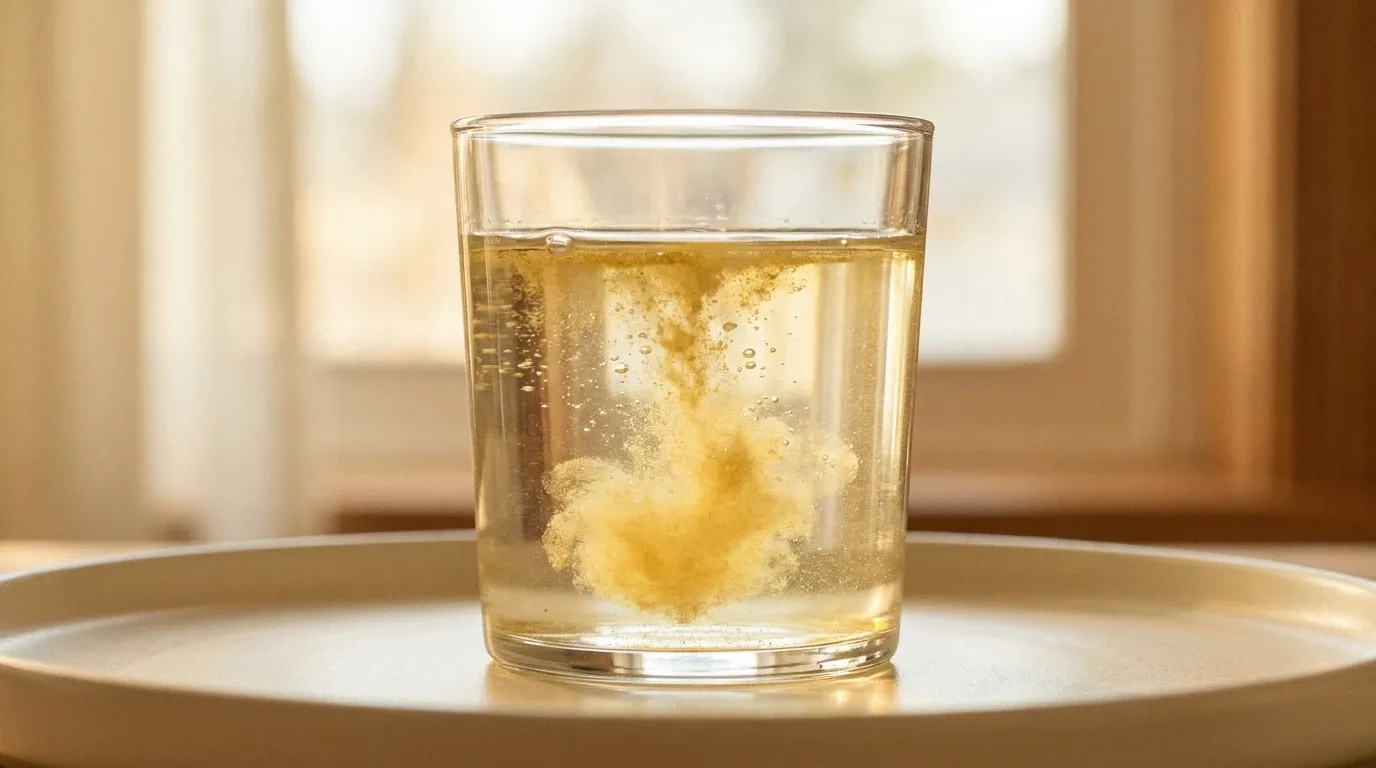
Quercetin is notoriously hydrophobic. It doesn't dissolve well in water, which means a standard quercetin capsule passes through your digestive system largely intact. Bioavailability estimates for conventional quercetin supplements typically sit between 1% and 17%, depending on the formulation, food matrix, and individual gut microbiome composition. That's an enormous range of uncertainty for a product that might cost you $30 to $50 a bottle.
This is actually a broader issue in the supplement industry. As covered in Why Ingredient Testing Doesn't Predict Your Joint Supplement's Results, the gap between what a label claims and what your body actually absorbs can be significant, especially for polyphenolic compounds. Quercetin sits firmly in that category.
Manufacturers have tried various workarounds over the years. Quercetin dihydrate, quercetin glycosides, and combinations with bromelain or vitamin C have all been marketed as absorption enhancers. They help, marginally. But they don't solve the underlying physics of poor solubility.
Gold Nanoparticles Enter the Picture
Research published in September 2026 offers a more radical solution. Scientists developed a method of binding quercetin to gold nanoparticles, creating a hybrid compound referred to as quercetin-stabilized gold nanoparticles (Que-AuNPs). The results across several biological endpoints were substantially different from what standard quercetin studies typically produce.
The nanoparticle formulation dramatically improved quercetin's solubility and stability in aqueous environments, which is the first barrier to better absorption. Beyond that, the quercetin molecules in the complex retained their biological activity while showing enhanced cellular uptake. The anti-inflammatory effects measured in cell and animal models were significantly stronger than those produced by free quercetin at equivalent doses.
Antibacterial activity also increased. The Que-AuNP complex inhibited the growth of multiple bacterial strains more effectively than quercetin alone, suggesting the nanoparticle matrix amplifies quercetin's bioactive surface area. This opens doors beyond sports nutrition into wound care and infection management, though those applications are further down the road.
Perhaps the most striking finding was selective cytotoxicity against breast cancer cells in vitro. The compound showed the ability to reduce viability of cancer cells without equivalent harm to healthy cells. These are early, in-vitro results, which means they reflect what happens in a laboratory dish, not in the human body. But they point toward a platform technology with implications well beyond recovery supplements.
What Nanoparticle Delivery Actually Changes
The core innovation here isn't quercetin. It's the delivery vehicle. Gold nanoparticles have been studied in pharmaceutical contexts for over two decades because of their chemical stability, low toxicity at the right particle sizes, and ability to carry bioactive compounds into cells more efficiently than oral delivery alone.
When quercetin is attached to a gold nanoparticle, several things happen. The molecule is protected from degradation in the GI tract. Its effective surface area increases. And cell membranes, which are themselves lipid-based and typically resistant to hydrophobic compounds in aqueous solution, interact differently with the nanoparticle complex. The result is better delivery to the sites where quercetin's anti-inflammatory mechanisms need to operate.
If this sounds like a significant leap from what you'd find at your current supplement retailer, that's because it is. Nanoparticle-based supplements are not yet commercially available at scale. Regulatory frameworks around nano-formulations in food and dietary supplements are still catching up in the US, UK, and elsewhere. The research is promising, but the translation from lab to shelf typically takes years and involves additional safety profiling, manufacturing standardization, and regulatory review.
What This Means for Athletes Right Now
You're not waiting passively. Recovery optimization is an ongoing practice, and quercetin at its current commercial form is still worth considering, with the right expectations and the right format.
Here's where the practical guidance lands:
- Standard quercetin capsules are the least efficient option. If you're using a basic quercetin supplement without any enhanced delivery system, you're likely absorbing a small fraction of the labeled dose. That doesn't make it useless, but it does mean you should recalibrate your expectations.
- Quercetin phytosomes bind the flavonoid to phosphatidylcholine, improving fat solubility and uptake through the intestinal wall. Studies suggest phytosome delivery can increase bioavailability by three to five times compared to standard quercetin. This is currently the most evidence-backed option on the market.
- Liposomal quercetin encapsulates the compound in lipid bilayers that mimic cell membranes, improving absorption through a different mechanism. The research base here is smaller than for phytosomes, but early data is encouraging.
- Food-matrix quercetin from whole food sources like red onions, capers, and apples comes packaged with co-factors that naturally improve uptake. It's not a practical primary source for therapeutic doses, but as part of an anti-inflammatory diet it contributes meaningfully.
Dosing in clinical studies typically ranges from 500 mg to 1,000 mg per day for anti-inflammatory effects. With enhanced delivery formats, you may see benefit at the lower end of that range.
Putting Quercetin in Context with Recovery
No single compound operates in isolation. Quercetin's anti-inflammatory effects are most relevant in the context of a training program that generates enough systemic stress to warrant intervention. High-volume training blocks, competition preparation, or return-to-training phases after injury are where the compound's properties become most applicable.
Recovery is also multifactorial. Quercetin supplements are one variable among many. Sleep quality, for instance, has a direct and potent effect on inflammatory marker levels and tissue repair. Cold exposure is another tool with genuinely mixed evidence, as explored in Cold Plunge After Training: Recovery Tool or Gains Killer?. Training structure itself, including the balance of strength, mobility, and movement quality work, shapes the inflammatory load you're managing in the first place.
For athletes building a recovery protocol, the evidence increasingly points toward stacking complementary strategies rather than chasing single-ingredient solutions. Quercetin is a solid supporting player when bioavailability is accounted for. It's not a standalone fix.
Movement quality and joint health also factor into how much inflammatory burden your body carries across a training cycle. Understanding the distinction between mobility and flexibility, for example, matters for building programs that reduce unnecessary mechanical stress on tissues. Mobility vs Flexibility: What Coaches Actually Need to Know breaks down why that distinction has real implications for recovery outcomes, not just performance.
The Bigger Picture on Delivery Technology
The quercetin-gold nanoparticle study is one piece of a broader trend in bioactive compound delivery. Researchers are revisiting dozens of polyphenols, adaptogens, and plant-derived anti-inflammatories that were previously dismissed or underutilized because of poor bioavailability. Curcumin has gone through a similar arc, moving from a compound with near-zero human bioavailability to a genuinely functional supplement through piperine combinations, phytosome complexing, and liposomal encapsulation.
Quercetin may be heading down the same path, with nanoparticle delivery as the next major step. The September 2026 research is not the endpoint. It's a signal that the platform technology works well enough to justify further investment in refinement, safety testing, and scaling.
In the meantime, if you're interested in polyphenol-based support for recovery and inflammation, you're not without options. Choosing a phytosome or liposomal formulation over a standard capsule is a meaningful upgrade. Pairing quercetin with vitamin C and a fat-containing meal can further support absorption. And keeping your expectations calibrated to what current delivery technology can actually achieve means you won't write off a genuinely useful compound just because the cheap version underperformed.
Nanoparticle quercetin is coming. How quickly it arrives on shelves in a safe, regulated, and affordable form is the open question. The science, at least, is finally catching up to the potential.