
Most people treat their first week of lifting as a warm-up. A trial run before the "real" program begins. That framing is costing them results they could be getting right now.
New research shows that just seven days of resistance training is enough to reactivate fat-burning molecular pathways in visceral fat. The biological machinery starts moving faster than almost anyone expects. What you eat during that window either accelerates the process or quietly stalls it before it gains momentum.
Here's what the evidence says you should actually be doing with your nutrition from day one.
Why the First Seven Days Are a Metabolic Window, Not a Grace Period
Visceral fat, the deep abdominal fat that wraps around your organs, responds to resistance training at the molecular level almost immediately. Within a week of starting a lifting program, studies show upregulation of lipolytic enzymes and mitochondrial activity in visceral adipose tissue. Your body begins signaling fat cells to release stored energy before you've lost a single measurable pound.
This is significant because visceral fat is metabolically active in ways subcutaneous fat isn't. It's linked to insulin resistance, systemic inflammation, and cardiovascular risk. Getting it moving early matters for health outcomes beyond aesthetics.
The problem is that most beginners treat week one as a time to "get used to training" while eating however they normally eat. That approach misses a primed window. The pathways are open. Nutrition determines whether fuel flows through them.
Protein: How Much You Actually Need in a Fat-Loss Deficit
When you're lifting to lose fat, you're asking your body to do two things simultaneously: preserve or build muscle tissue while mobilizing fat for fuel. Protein intake is the lever that makes both possible without one undermining the other.
Current evidence consistently supports a target of 1.6 grams of protein per kilogram of body weight per day as the threshold for supporting muscle protein synthesis during a caloric deficit. For a 175-pound (80kg) person, that's around 128 grams of protein daily. Some data suggests benefits extend up to 2.2g per kg, particularly for beginners whose muscles are adapting rapidly.
Going significantly above that range doesn't provide additional muscle-sparing benefit and starts displacing calories that could come from carbohydrates and fats your body also needs. Precision matters more than excess.
Practical sources to hit your target without overcomplicating things:
- Lean meats and poultry: chicken breast, turkey, lean beef
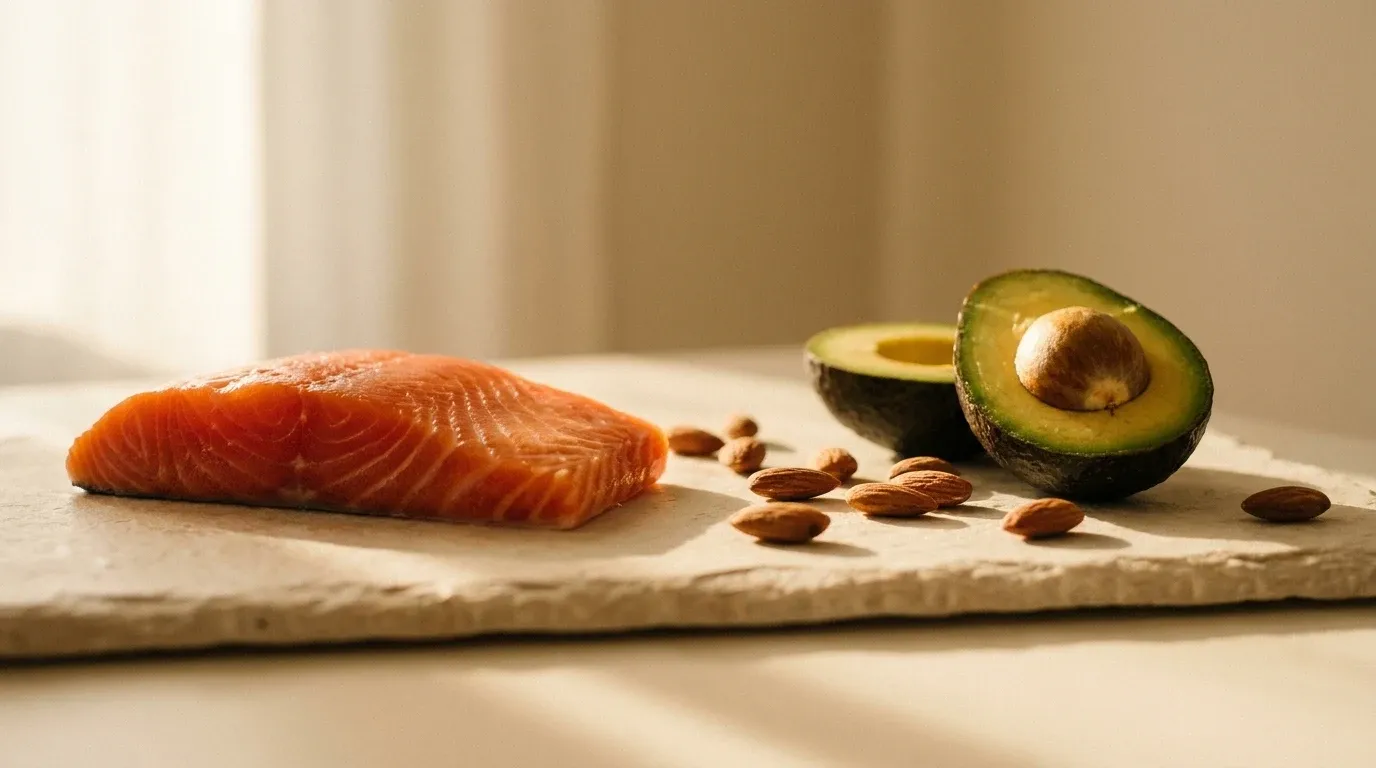
- Fish and seafood: salmon, cod, shrimp, canned tuna
- Eggs and egg whites
- Low-fat dairy: Greek yogurt, cottage cheese
- Legumes and tofu for plant-based variety
Distribute protein across three to four meals rather than front-loading it. Research on muscle protein synthesis shows that spreading intake maximizes the anabolic stimulus throughout the day.
Insulin Sensitivity Is Central to Fat Burning. Don't Wreck It.
The molecular pathways that resistance training reactivates in visceral fat are tightly regulated by insulin sensitivity. When your cells respond properly to insulin, glucose gets directed efficiently, and fat mobilization can proceed. When insulin sensitivity drops, those pathways become sluggish regardless of how hard you train.
Ultra-processed foods, particularly those combining refined starches, added sugars, and industrial seed oils, are among the fastest ways to blunt insulin sensitivity. Studies tracking dietary patterns show that even short-term exposure to high ultra-processed food intake impairs metabolic flexibility within days.
In week one especially, keeping ultra-processed foods out of your regular rotation isn't about rigid dieting. It's about protecting the biological environment that makes your training investment pay off. You don't need a perfect diet. You need a diet that doesn't actively work against your physiology.
Focus on whole or minimally processed foods: lean proteins, vegetables, fruits, legumes, whole grains, nuts, and healthy fats. These foods support the insulin sensitivity that lets fat mobilization do its job.
Carbohydrates: Timing Beats Restriction
Cutting carbohydrates entirely is a common beginner instinct when the goal is fat loss. It's also a strategy that often backfires during the first weeks of lifting, when your training quality is establishing the foundation for everything that comes after.
Resistance training is a glycolytic process. Your muscles use stored glycogen as their primary fuel source during sets. If glycogen is depleted from aggressive carbohydrate restriction, training performance drops, recovery slows, and the adaptive signal your muscles receive is weaker. You end up doing less effective work per session, which reduces the very stimulus you need for fat-burning results.
The better approach is carbohydrate timing. Rather than cutting carbs overall, concentrate them around your training sessions:
- Pre-workout (1-2 hours before): A moderate serving of complex carbohydrates, such as oats, rice, or sweet potato, provides sustained fuel without spiking blood sugar excessively.
- Post-workout (within 1-2 hours): A combination of protein and carbohydrates supports glycogen resynthesis and muscle repair simultaneously.
- Rest of the day: Lean toward fibrous vegetables, legumes, and lower-glycemic sources rather than eliminating carbs entirely.
This structure lets you maintain a moderate caloric deficit while keeping training quality high. The deficit drives fat mobilization. The training quality drives the metabolic adaptation. Both matter.
Hydration also plays a larger role in training performance than most beginners factor in. Pre-workout hydration has to start well before you arrive at the gym, not just in the minutes before you lift. Even mild dehydration degrades strength output and aerobic capacity during resistance work.
The Scale Will Lie to You Early. Here's What to Track Instead.
One of the most discouraging experiences for new lifters is eating well, training consistently for two weeks, and seeing no change on the scale. Sometimes the number goes up slightly, which can feel like failure. It isn't.
Visceral fat loss doesn't always register on a standard scale in the early weeks for several reasons. When you begin resistance training, your muscles retain more water as part of the adaptive process. Glycogen storage increases with training. Inflammation from novel exercise stimulus can temporarily elevate fluid retention. All of these factors affect body weight without affecting body composition in a negative direction.
What the scale measures is total mass. What you actually care about is the ratio of fat to lean tissue. Those are different variables.
From day one, build a tracking approach that captures more than weight:
- Waist circumference: A reliable early indicator of visceral fat change, since the abdomen is where visceral fat is concentrated.
- Progress photos: Taken at consistent lighting, time of day, and angles every one to two weeks.
- Training performance metrics: How much you're lifting, how your recovery feels, and how your energy holds during sessions.
- Body fat percentage: Even a basic tape-measure formula is more informative than weight alone.
If you have access to a DEXA scan or a reliable bioelectrical impedance device, periodic measurements give you granular data. But low-tech proxies work well for most people when used consistently.
Sleep also directly affects the body composition outcomes of your nutrition and training. Poor sleep elevates cortisol, increases appetite-regulating hormone dysregulation, and slows recovery. Research linking REM sleep to dramatically better health outcomes underscores that rest isn't passive. It's where a significant portion of adaptation happens.
What a Practical First-Week Day Looks Like
Pulling this together into a realistic eating structure doesn't require meal prepping for hours or tracking every gram obsessively. It requires a few consistent habits applied across each day.
Morning: A protein-anchored breakfast with at least 30-40 grams of protein. Eggs, Greek yogurt with fruit, or a high-protein smoothie with added oats are efficient options.
Pre-workout meal: Moderate carbohydrates and protein two hours before training. A bowl of oats with a scoop of protein powder, or rice and chicken if you train later in the day.
Post-workout: Protein and carbohydrates within two hours. This is not the meal to skip or replace with a coffee.
Evening: A lighter meal built around protein, non-starchy vegetables, and a small amount of healthy fat. Keep this meal lower in carbohydrates if you trained earlier in the day.
Stress is another variable most nutrition articles ignore. Chronically elevated cortisol from unmanaged stress directly impairs fat mobilization and increases appetite. Evidence-ranked stress management strategies show that even brief daily interventions can lower cortisol meaningfully, which matters for body composition outcomes.
One More Thing Worth Understanding
You don't need to be perfect. You need to be consistent enough that the metabolic signals from your training have a supportive nutritional environment to work in. That's the actual goal of first-week nutrition.
The research on early visceral fat adaptation is a reminder that your body responds faster than the scale suggests. The work you do in the first seven days sets the trajectory for the weeks that follow. Protecting insulin sensitivity, hitting your protein target, timing your carbohydrates around training, and tracking body composition rather than just weight gives that trajectory the best possible start.
If you're lifting consistently and want to understand how recovery factors into the equation, training your nervous system to recover better is an often-overlooked dimension of the fat-loss process that compounds over time.
Start with the basics. Apply them from day one. The biology is already moving in the right direction.