
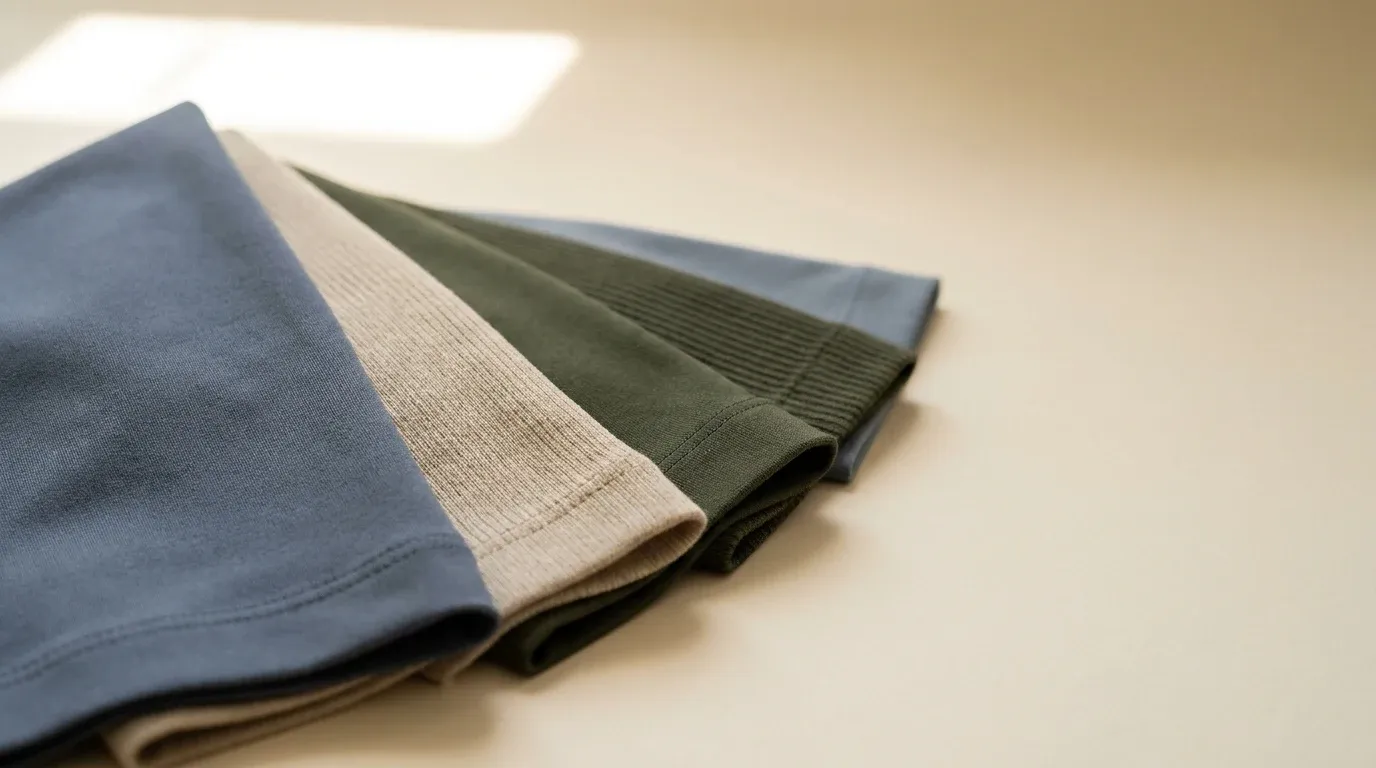
The athleisure category has outgrown its identity as a pandemic-era lifestyle trend. It's now a structurally dominant segment of global apparel, and the brands winning at scale in 2026 are not winning on colorways or silhouettes. They're winning on what their fabrics actually do.
If you're leading a fitness or wellness brand with any apparel component, the market data published this year should clarify your priorities fast.
The Market Numbers That Reframe the Opportunity
According to Market Research Future data published in October 2026, the global athleisure market is valued at $433.58 billion in 2026 and is projected to reach $952.18 billion by 2035, compounding at a CAGR of 10.18%. North America currently holds the largest revenue share, while Asia Pacific is expected to lead growth over the forecast period.
A parallel report from Metastat Insights places the 2025 market at $456.5 billion, tracking toward $978.9 billion by 2033. Within that figure, the women-focused segment alone is projected at $205.2 billion in 2026, rising to $401.1 billion by 2033. That's not a niche. That's the dominant growth engine of the category, and it demands dedicated product and materials strategy, not a unisex default.
These two datasets use slightly different base years and methodologies, but their directional alignment is unambiguous: athleisure is a nearly trillion-dollar category by the early 2030s, and the question for brand leaders is not whether to be in it, but how to differentiate within it.
Why Silhouette and Color Have Become Table Stakes
Five years ago, a well-executed colorway drop with a flattering cut could move product. That window has closed. The proliferation of private-label athleisure from fast-fashion platforms has commoditized silhouette and aesthetic iteration to the point where margin on those dimensions has collapsed.
What multiple 2026 market reports identify as the defining competitive shift is what analysts are calling a materials revolution. Engineered textiles with moisture-wicking properties, four-way stretch, UV protection, and thermal regulation are no longer premium differentiators. They're the entry point. What separates shelf-worthy product from commodity is how those properties are achieved, how they're communicated, and whether the technology behind them is proprietary.
Retail buyers at specialty and premium channels are applying this filter explicitly. Brands that cannot articulate a materials story backed by technical data are losing placement to those that can. The conversation has moved from "here's the look" to "here's what this fabric does and why we own it."
Sustainability Has Moved From Niche to Non-Negotiable
Recycled and bio-based fabrics are no longer a point of differentiation for a subset of environmentally conscious consumers. They're a baseline expectation for a large and growing segment of the market, particularly the 25-to-40 demographic that multiple reports identify as the primary driver of athleisure category growth.
This shift is happening at two levels. At the retail buyer level, sustainability credentials including third-party certifications such as Global Recycled Standard (GRS), bluesign, or OEKO-TEX are increasingly required for access to premium shelf positioning. At the consumer level, purchasing decisions in this demographic are influenced by verifiable environmental claims, not aspirational brand language.
The strategic implication is direct: sustainability is now a materials sourcing and certification challenge, not a marketing challenge. Brands that treat it as a communications layer without substantive product changes are being exposed. Those investing in certified recycled polyester, bio-based nylon alternatives, or closed-loop production partnerships are building credentials that compound over time and that competitors cannot replicate quickly.
This dynamic mirrors what's happening in adjacent wellness product categories. As Nutraceuticals' Clinical Pivot: What Brand Leaders Must Act On outlines, the pressure to validate product claims through third-party and clinical frameworks is restructuring entire categories. Athleisure is following the same arc.
The Women's Segment Demands Its Own Strategy
The $205.2 billion women's athleisure segment in 2026 is not simply a larger version of a gender-neutral product line. It reflects distinct performance needs, fit engineering requirements, and purchasing behavior. Brands that have historically built women's product as a derivative of men's are leaving margin and loyalty on the table.
The functional demands of women's athleisure, including support structures, compression gradients, and fabric opacity performance under stress, require materials R&D that is specific to the use case. This intersects directly with the growing body of fitness science around female physiology. Research on Strength Training Through Menopause: What to Change reflects the broader trend of fitness consumers demanding products and protocols built around their actual biology, not adapted from a male default.
For brand leaders, this means women's product development cannot be a colorway exercise. It requires dedicated fabric sourcing, fit testing protocols, and performance validation that speaks to the specific activities and life stages your audience is training through.
Where Product Development Spend Needs to Shift
Here's the structural reallocation that 2026 market data is pointing toward. Brands that are still distributing product development budgets primarily toward aesthetic iteration, seasonal colorways, and silhouette refreshes are optimizing for a dimension of competition that is fully commoditized. The return on that spend has diminished to the point where it's effectively defensive, not growth-generating.
The categories where margin and brand equity are being built in 2026 are:
- Proprietary fabric technology. Whether through in-house textile R&D or exclusive supplier partnerships, owning a performance claim that competitors can't replicate is where premium pricing power lives. This includes moisture management systems, stretch-recovery engineering, and thermal adaptive materials.
- Third-party sustainability certification. GRS, bluesign, and OEKO-TEX certifications require investment in sourcing infrastructure, but they produce verifiable credentials that retail buyers and informed consumers treat as a quality signal.
- Performance validation data. Brands that can support their materials claims with independent testing data, wear-trial outcomes, or clinical performance metrics are building a defensible position. This is the athleisure equivalent of the clinical evidence standard now required in nutraceuticals and health tech.
- Supply chain traceability. Transparency on fiber origin and manufacturing conditions is becoming a purchasing criterion in the 25-to-40 demographic. Brands with documented supply chain visibility are using it as a trust asset.
This reallocation is not just about product quality. It's about where brand equity accrues. In a category approaching a trillion dollars, the brands that will command premium positioning in five years are those that treated materials R&D as a core strategic asset in 2024 and 2025, not as a cost center managed by procurement.
The Adjacent Signals Pointing the Same Direction
The materials-first shift in athleisure doesn't exist in isolation. It's part of a broader restructuring of the premium fitness and wellness market around substantive, verifiable product performance. Brands across the wellness ecosystem are facing the same pressure to move from aspiration to evidence.
The growth of wearable health technology, as reflected in Oura's $625M Bet: Wearables Meet Primary Care, illustrates how performance claims backed by data infrastructure are commanding premium positioning and investor confidence simultaneously. The parallel for apparel brands is clear: the fabric is the hardware, and the performance data is the proof.
Similarly, the expansion of wellness services into new delivery models, as seen in Drip Gym Goes National: What At-Home IV Therapy Signals for Brands, reflects a consumer base that is actively upgrading its performance investment across categories. That same consumer is evaluating their apparel with the same scrutiny they apply to their recovery protocols. If your brand doesn't have a materials story, you're not in that conversation.
What You Should Be Doing Now
If you're a brand leader in athleisure or any adjacent fitness apparel category, the near-term actions are concrete.
Audit your current materials story. Can you articulate, in precise technical terms, what your fabrics do and why that matters to your target consumer? If the answer involves generic terms like "soft" or "breathable" without supporting specificity, you have a positioning gap that is actively costing you shelf access and margin.
Assess your sustainability credential timeline. Third-party certifications take 12 to 18 months to secure through sourcing transitions. Brands that start that process in 2026 will have verifiable credentials to bring to buyers in 2027 and 2028, when the expectation will be even more entrenched.
Evaluate your women's product development process independently. Given that the women's segment represents nearly half the total category value and is growing at a comparable rate, it warrants dedicated R&D investment, not shared development resources with a gender-neutral or men's primary line.
The $433 billion market is real. The growth trajectory is well-documented. The competitive dynamic that will determine which brands capture disproportionate share of that growth is already in motion. Engineered materials and sustainability credentials are where the moat is being built. The brands that recognize that now are the ones that will be positioned to defend it at $952 billion.