
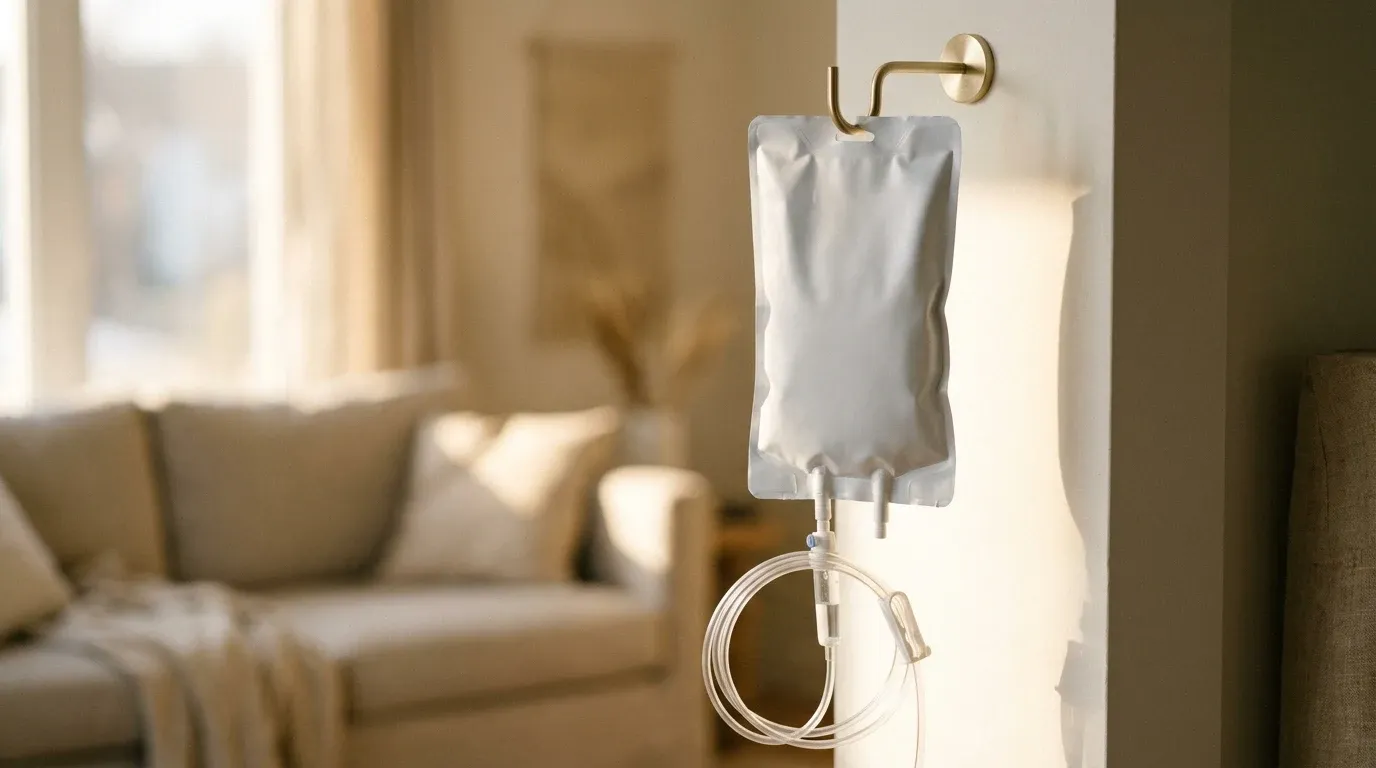
On November 12, 2026, Drip Gym made the most geographically expansive move in the at-home infusion category to date. The New York-based medical IV therapy provider launched physician-reviewed at-home iron infusion services across all 50 US states, bringing clinical-grade recovery directly to the consumer's front door. For fitness brands that have treated recovery suites and IV lounges as premium differentiators, that announcement should sharpen your thinking about where the margin actually lives.
This isn't a niche product targeting a small wellness cohort. Iron infusions address one of the most common nutritional deficiencies affecting athletic performance, particularly among women, endurance athletes, and anyone managing chronic fatigue. Drip Gym's national footprint means that a meaningful slice of your existing member base now has access to clinical recovery without leaving home. That changes the competitive equation in ways that go beyond pricing.
The Decentralization of Recovery Has Been Building All Year
Drip Gym's rollout didn't emerge in a vacuum. The demand surge for NAD peptide therapy and IV drips documented across the US wellness market in early 2026 signaled that consumers were already moving toward clinical recovery. The question was always whether supply would follow them home. It now has.
The pattern is consistent with what's happening across the broader wellness infrastructure. LERA Health's concurrent nationwide launch of concierge-style women's health care at a fraction of traditional clinic costs confirms the same underlying dynamic: clinical wellness is commoditizing through logistics innovation, not just digital delivery. When both iron infusions and comprehensive women's health services can be delivered to your door at accessible price points, the clinic and the gym lose their monopoly on credentialed care.
For brands that have invested in building premium recovery environments, this is the moment to audit what your in-person offer actually delivers that at-home services structurally cannot. The answer isn't nothing. But it's a shorter list than it was 18 months ago.
What This Means for Studios and Operators With Recovery Infrastructure
If your brand has positioned an IV lounge, a recovery suite, or a cryotherapy room as a membership differentiator, national at-home infusion delivery compresses your exclusivity window. The clinical credential that made in-clinic IV therapy feel premium is now available on demand, physician-reviewed, and delivered to the consumer's couch. That doesn't eliminate the value of your space, but it does raise the bar for what that space needs to deliver.
Operators should be asking three questions right now:
- What does your in-person recovery experience offer that at-home infusion doesn't? Community, real-time coaching integration, and multi-modality sequencing (compression, infrared, cold exposure combined in a single session) are legitimate answers. A branded waiting room is not.
- Are your clinical partnerships actually differentiated, or are they interchangeable? If your recovery partner operates on the same physician-reviewed model as Drip Gym, the brand equity is thinner than you think.
- How are you using member data to personalize recovery recommendations? At-home services will increasingly integrate with wearables and biomarker platforms. If your studio isn't already building that layer, you're ceding the data relationship to a home-delivery provider.
The boutique segment has navigated disruption before. What PVOLVE and JETSET's franchise expansion signals is that brands with strong methodological identity and community infrastructure can hold ground even as individual services get commoditized. The same logic applies here. Your recovery offer needs to be embedded in a larger member experience, not positioned as a standalone premium feature.
The Commoditization Curve Is Moving Faster Than Most Brands Have Planned For
The supplement market has already lived through one version of this story. The wave of billion-dollar supplement acquisitions in 2026 reflected CPG incumbents buying their way into a category where DTC brands had already democratized access to clinical-grade formulations. The result was margin compression across the mid-market and a bifurcation between commodity product and genuinely differentiated, education-led brands.
IV therapy is on a similar arc. At-home delivery lowers the access barrier, national rollouts normalize the category, and pricing pressure follows. For fitness brands that have bundled IV therapy or infusion sessions into premium membership tiers, the question is how long that bundle holds its perceived value when a consumer can book a physician-reviewed iron infusion directly through an app.
The honest answer is probably 12 to 24 months before the differentiation gap closes materially. That's your planning window.
The Strategic Move Is Bundling, Not Competing on Price
Trying to compete with Drip Gym on infusion pricing is a losing position for most fitness operators. The economics don't work, and clinical credentialing is not your core competency. The strategic opportunity is in bundling, not head-to-head pricing.
Here's what that looks like in practice. Your brand already owns several assets that at-home infusion providers don't: member relationships, training data, programming context, and community. A home-delivery infusion service knows what a member received; it doesn't know how hard they trained that week, what their recovery metrics look like, or what their coach is recommending for the next training block. That integration gap is your leverage.
Consider how this applies across your existing ecosystem:
- Recovery service partnerships: Rather than running your own IV lounge, evaluate co-branded agreements with at-home providers where your members receive preferred pricing and your platform receives aggregated recovery data to inform programming. This converts a competitive threat into a retention tool.
- Supplement stacks: Position your branded or partner supplements as the oral maintenance layer that complements periodic infusion protocols. Iron infusions address acute deficiency; ongoing supplementation and nutrition programming are the sustained engagement your brand can own.
- Wearable integrations: If your app or platform integrates with HRV, sleep, and training load data, you have the infrastructure to recommend recovery interventions. Home-delivery services that plug into that recommendation engine become a feature of your ecosystem, not a competitor to it.
This bundling logic mirrors what's already working in DTC athleisure, where personalization is demonstrably lifting average order value. The underlying principle is the same: the brand that owns the member's full context wins more of their wallet than the brand that owns a single transaction.
Member Retention Is the Frame That Matters Most
Recovery infrastructure has always been a retention play more than an acquisition play. Members don't typically join a gym because it has an IV lounge. They stay because the full experience, including recovery support, makes them feel like the brand is invested in their outcomes. At-home infusion services don't threaten that relationship unless you let them become a substitute for it.
The research on member retention is consistent on one point: the first 60 days determine whether a member develops a habit and a relationship with your brand, or exits quietly. Building a systematic retention approach around that early window is more durable than any single service feature, including recovery.
What Drip Gym's national launch should prompt is a sharper evaluation of your overall value proposition, not a reactive pivot to match their service. Members who feel their training is producing results, who are coached intelligently, and whose recovery is supported holistically don't defect to a home-delivery infusion service. They add it to their routine and keep their gym membership. That's the relationship you want to be building.
It's also worth noting that the recovery conversation can't be separated from the broader performance picture. Exercise variety is now linked to meaningful longevity outcomes, which means members are increasingly thinking about their training in terms of long-term health, not just aesthetic results. At-home clinical services fit naturally into that worldview. Your brand can either be the platform that contextualizes and integrates those services, or the one that gets disintermediated by them.
The Brands That Will Hold Ground Are Already Moving
Drip Gym's nationwide rollout is a signal, not a verdict. The at-home infusion category will continue to grow, clinical credentialing will become table stakes rather than a premium feature, and logistics innovation will keep compressing access barriers. That's the direction of travel regardless of what any single brand operator does in response.
The fitness and wellness brands that hold margin through this shift won't be the ones that compete on infusion services. They'll be the ones that deepen their integration with members' full recovery ecosystems, build data relationships that at-home providers can't replicate, and position their coaching and community infrastructure as the irreplaceable layer that makes clinical recovery more effective.
Your recovery suite, if you have one, is not your moat. Your member relationship is. The question Drip Gym's launch should force you to answer is whether you've built that relationship deeply enough to withstand the convenience of a clinical service delivered to the door.
If the answer is uncertain, that's your real strategic priority for 2027.