
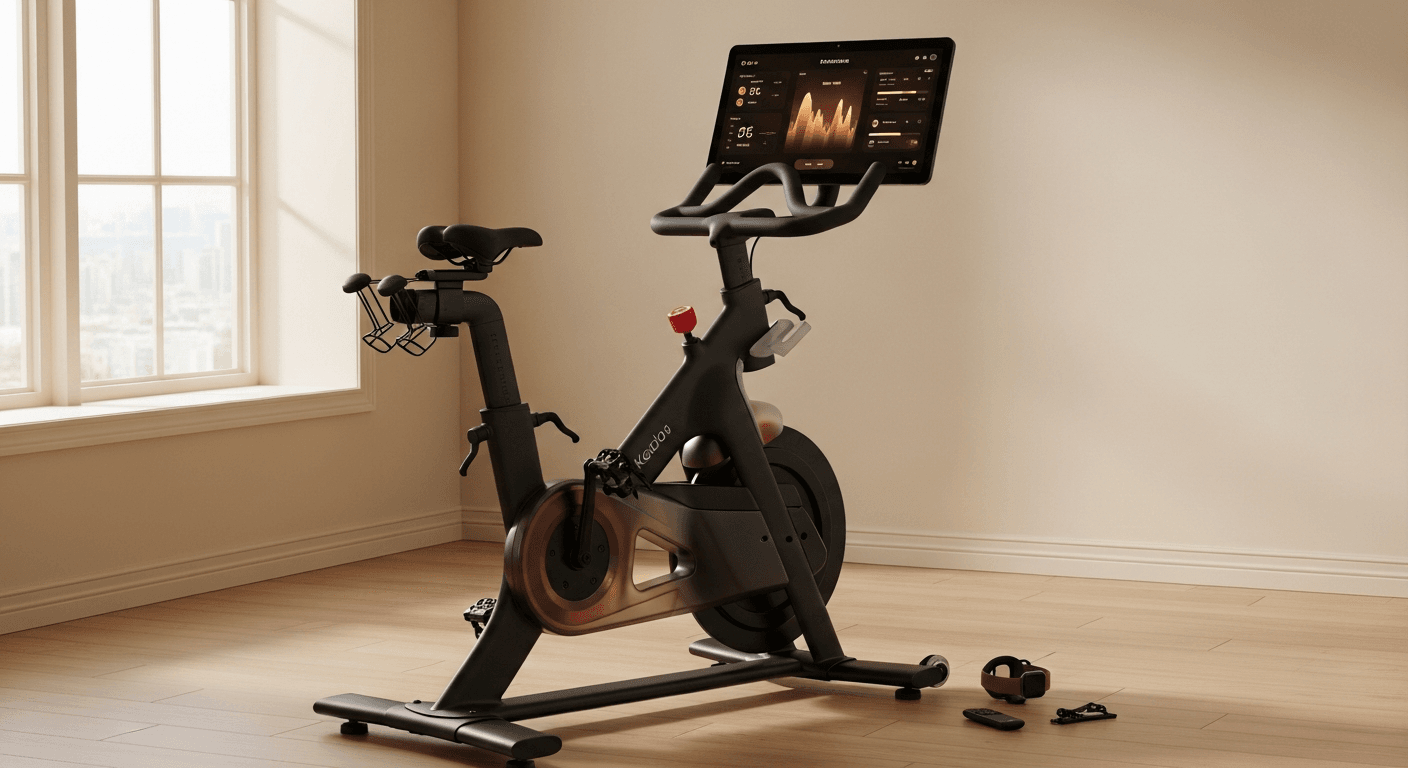
The US fitness equipment market is no longer a volume game. A May 2026 Grand View Research report values the market at $32.69 billion in 2025, projected to reach $49.00 billion by 2034 at a compound annual growth rate of 4.60%. That's a decade of steady, structural expansion. But the brands capturing disproportionate value won't be the ones moving the most units. They'll be the ones building ecosystems.
If you're operating a fitness equipment brand, a connected hardware startup, or a wellness platform with a physical product line, the strategic question has shifted. It's not about production volume or retail shelf space. It's about how much recurring revenue you can attach to each unit sold.
Three Forces Behind the Growth Curve
The $16.31 billion in projected market expansion doesn't come from a single trend. It's being driven by three structural forces that reinforce each other and reward brands that understand how they interact.
First: chronic disease and health consciousness. Cardiovascular disease, obesity, and metabolic disorders continue to rise across the US adult population. That's not a wellness industry talking point. It's a public health reality that converts into durable demand for home fitness products. Consumers who once treated gym memberships as optional are now treating home equipment as a long-term health investment.
Second: connected fitness technology. The integration of sensors, apps, live classes, and AI coaching into physical equipment has changed what a piece of hardware actually is. A treadmill is no longer just a treadmill. It's a content delivery platform with a motor. Brands that understood this early, and built their software layer before competitors caught up, are now compounding the advantage through data, personalization, and retention mechanics that commodity manufacturers simply can't replicate.
Third: corporate wellness adoption. Employers across the US are facing an estimated $322 billion in annual costs tied to employee burnout, disengagement, and health-related productivity loss. Benefits teams are under real pressure to show ROI on wellness spend. That's creating a procurement channel that didn't meaningfully exist five years ago. Equipment brands that can package hardware, software, and usage reporting into a B2B offer are now competing for budget lines that bypass the consumer entirely.
Compact Equipment Is Reshaping SKU Strategy
Post-pandemic home fitness didn't collapse. It recalibrated. The consumers who bought equipment between 2020 and 2022 kept using it. And the urban consumers who didn't buy then are now the primary growth segment. They're living in smaller apartments in denser cities. They want equipment that performs at a high level without consuming a dedicated room.
That demand signal is reshaping how smart brands approach SKU architecture. Compact treadmills, folding squat racks, adjustable dumbbell systems, and space-efficient cable machines are growing faster than traditional full-size commercial alternatives in the home segment. The consumer's decision framework has shifted: it's not about maximum feature breadth. It's about maximum capability per square foot.
For brand operators, that means your product roadmap needs to reflect spatial constraints as a genuine design requirement. Brands treating compact design as a secondary consideration are losing ground to competitors who've made it a primary one. And brands winning in compact aren't just selling smaller products. They're often delivering more software depth, because the physical footprint constraint pushes differentiation into the digital layer.
The Subscription Layer Is Where Margin Lives
The most significant strategic shift in the fitness equipment market over the last five years isn't a product category. It's a revenue model. Connected fitness brands that embed a subscription alongside their hardware have fundamentally changed their unit economics.
A piece of equipment that sells for $1,500 and generates zero recurring revenue is a one-time transaction with high customer acquisition cost and no natural retention mechanism. That same piece of equipment with a $39 per month software subscription attached is a multi-year customer relationship worth $1,500 plus potentially $1,400 or more in subscription revenue over three years. The lifetime value doubles. The churn signal gives you data. The engagement metrics tell you when to upsell.
This is the model that's pulling mid-market and premium equipment brands away from commodity competition. You can't price-compete with manufacturers producing at lower cost overseas. But you can build a software ecosystem they won't replicate because it requires content investment, coaching relationships, and platform engineering that takes years to develop. That's a durable moat.
The broader platform dynamic here mirrors what's happening across fitness media and community apps. Strava's $2.2 billion valuation following its May 2026 Sequoia round signals that investors understand engagement data and recurring digital revenue in fitness are worth multiples that pure hardware companies don't command. Equipment brands building toward that model are positioning themselves for a different kind of valuation conversation.
Corporate Wellness Is the White Space Most Brands Are Ignoring
The corporate wellness channel is real, it's growing, and most mid-market equipment brands are either unprepared for it or not pursuing it at all. That's a significant strategic gap.
Employers aren't just buying gym memberships anymore. They're investing in at-home fitness stipends, wellness reimbursement programs, and increasingly, curated equipment partnerships that give employees branded access to connected hardware and content. The B2B sale is structurally different from direct-to-consumer. Procurement cycles are longer. Decision-makers are HR and benefits directors, not fitness consumers. But the average contract value is substantially higher, and churn operates on annual renewal cycles rather than monthly cancellations.
If you're building a connected fitness brand and you don't have a dedicated B2B offer, you're leaving a revenue channel open for competitors who do. The brands that will own this space are the ones building usage dashboards, anonymized population health reporting, and employer-facing admin tools. That infrastructure makes your product stickier inside a corporate benefits ecosystem than anything consumer-facing alone can achieve.
The intersection of digital fitness ecosystems and corporate wellness budgets is the clearest white space available to mid-market brands right now. It's where you can escape commodity pricing pressure, build predictable revenue, and establish switching costs that protect your customer base. Premium gym operators are already navigating a version of this dynamic, as seen in Life Time's retention strategy and what it reveals about holding high-value members.
Where the Brand Playbook Actually Differs
Not every brand in this market is playing the same game. There are three distinct positioning strategies that are currently working, and they don't overlap.
- Premium connected hardware: High unit price, deep software layer, strong content investment, subscription revenue from day one. This strategy requires significant upfront capital and brand authority but generates compounding LTV and defensible data assets.
- Compact specialist: Purpose-built for the urban home consumer. Design-first, space-efficient, modular where possible. Differentiation comes from hardware quality and user experience, not software depth. Margin defense comes from product design IP and community, not subscriptions.
- B2B wellness platform: Equipment as the entry point into an employer health program. Revenue model built around corporate contracts, usage reporting, and population health data. Lower consumer brand recognition required, but enterprise sales capability is non-negotiable.
The mistake most brands make is trying to operate across all three simultaneously without the resources to execute any one well. The market is large enough that a focused strategy in one lane outperforms a diluted strategy across all three.
It's worth noting that the broader convergence of wellness and commerce is producing similar strategic clarity in adjacent categories. The athleisure market's $900 billion expansion is producing the same lesson: brands that own a clear positioning and build ecosystem depth around it outperform brands competing on product breadth alone.
What This Means for Operators Building Now
The $49 billion projection for 2034 is a market-level number. Your share of it depends entirely on decisions you're making now about software investment, channel strategy, and product positioning.
If you're in the connected fitness space, the priority is retention mechanics inside your app. Engagement data, personalized programming, and community features aren't nice-to-haves. They're what separates a subscriber who cancels at month four from one who upgrades at month fourteen. Coaches and trainers are already navigating a version of this challenge on the individual level, and the frameworks translate directly to platform design. The real barriers to coach revenue growth in 2026 map almost exactly onto the barriers facing connected fitness platforms trying to convert hardware buyers into long-term subscribers.
If you're in the corporate wellness channel, build the reporting infrastructure before you need it. HR decision-makers want to show utilization data to their CFO. If you can't deliver that, you won't win the renewal. If you can, you've created a switching cost that price alone won't overcome.
The fitness equipment market is growing at a rate that rewards patience and punishes reactive strategy. The brands that will reach $49 billion alongside this market aren't the ones chasing every consumer trend. They're the ones that locked in their ecosystem, built their software layer, and made their hardware the most defensible entry point into a recurring relationship with the customer.
That's the playbook. The brands executing it now are already separating from the field.