
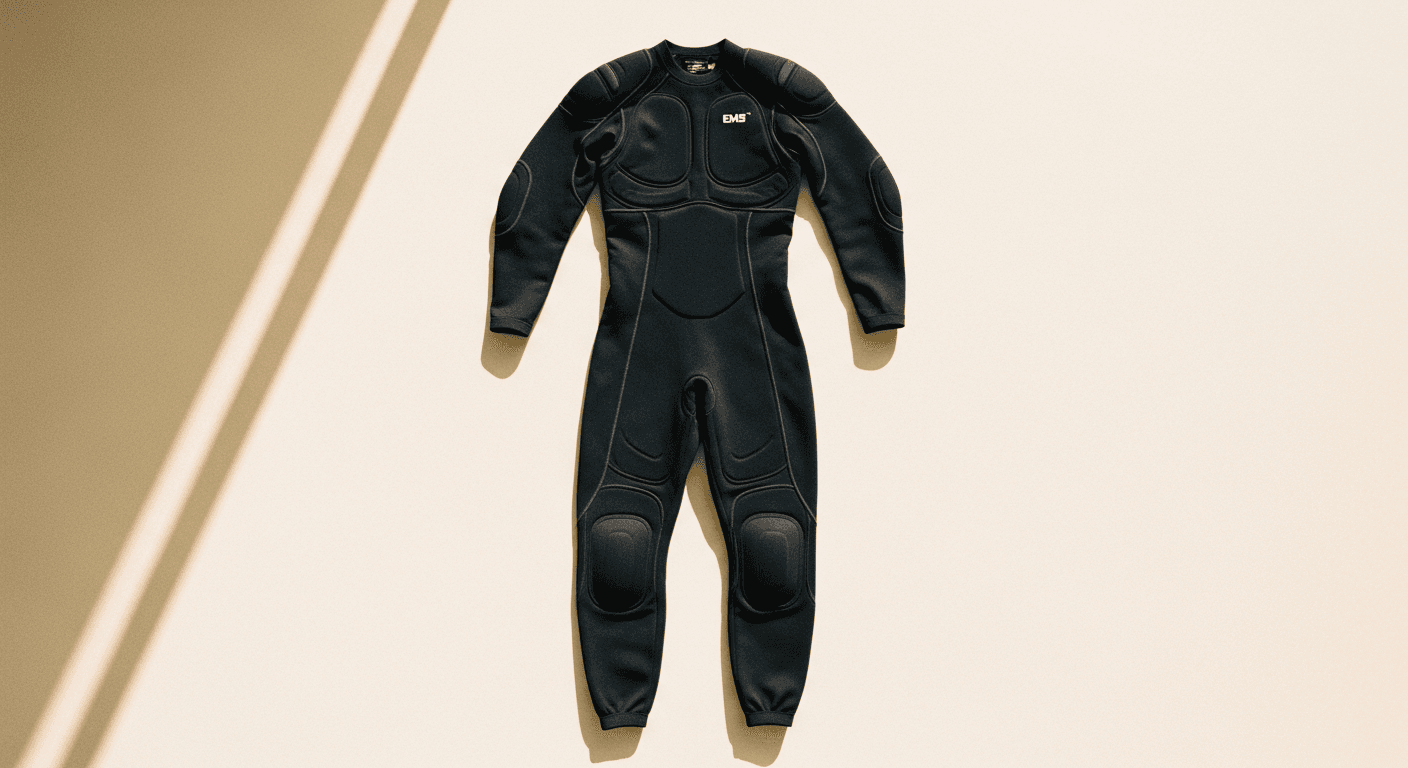
Most equipment upgrades move one number. A new rig fills a class. A better app improves retention marginally. A rebrand lifts leads for a quarter. What almost never happens is a single technology investment that simultaneously improves top-of-funnel acquisition, session frequency, and total revenue. That's exactly what BODY20's Dry Suit EMS technology appears to be doing, and in May 2026, Athletech News made it official by naming BODY20 one of the Most Innovative Fitness and Wellness Companies of 2026, with the Dry Suit integration cited as a measurable revenue driver.
For operators running boutique studios or high-value gym concepts, this is the kind of third-party validation that changes a capex conversation. Here's what the data actually shows, and what it means for your business model.
What the Dry Suit Changes About EMS
Electrical muscle stimulation training has been a premium product category for years. A standard EMS session typically runs three to five times the price of a conventional personal training hour, often sitting in the $50 to $100 range per 20-minute session in the US market, depending on location and membership structure. The technology's ability to recruit up to 90% of muscle fibers simultaneously, compared to roughly 30 to 40% in conventional resistance training, justifies that premium for clients who understand the physiology.
The traditional barrier wasn't price. It was process. Conventional EMS suits require clients to wear a dampened undergarment, electrodes need to be wetted before each session, and the setup time eats into throughput. For a studio operator trying to run back-to-back 20-minute sessions, that friction adds up fast. It also creates a hygiene perception problem that makes some prospective clients hesitate before booking their first session.
BODY20's Dry Suit format eliminates the moisture requirement entirely. The electrodes make effective contact without pre-wetting, which cuts setup time, removes the hygiene objection from sales conversations, and lets studios run higher session volumes per hour. That's not a marginal improvement. That's a structural change to the unit economics of the service.
The Three KPIs That Moved Together
BODY20 studios deploying the Dry Suit technology reported measurable increases across three distinct tracked metrics: leads generated, total revenue, and studio visit frequency. That trifecta matters because these numbers don't usually move in the same direction at the same time from a single change.
Lead generation improvements typically come from marketing spend or referral incentives. Revenue lifts usually come from price increases or volume growth. Visit frequency improvements are generally a retention play driven by programming or coaching quality. When one technology upgrade moves all three, it suggests the mechanism isn't purely operational. It's also a product story that clients are actively responding to and telling each other about.
The Dry Suit's role in lead generation likely works through two channels. First, the reduced friction lowers the barrier for first-time trial sessions, which converts curious leads faster. Second, the novelty factor gives studio operators a differentiated story to tell in a market where, as Fitness Innovation 2026: The Operator Takeaways makes clear, standing out on product rather than price is becoming the only sustainable competitive position.
Why This Matters in a 26.1% Penetration Market
HFA's 2026 Consumer Report puts US gym membership at 81 million members, representing a record penetration rate of 26.1% of the adult population. That's an extraordinary headline number. What it actually means for operators is that the low-hanging fruit is gone. The people who were going to join a standard gym have largely joined one.
The growth opportunity now sits in two places: converting non-members through dramatically differentiated experiences, and capturing a larger share of the existing member base by giving them a reason to pay more and visit more often. BODY20's data suggests the Dry Suit addresses both simultaneously.
This dynamic mirrors what's happening across the premium fitness segment more broadly. Planet Fitness grew 22% and an investor still sold, which signals that even strong top-line growth isn't enough if the market's thesis on where fitness value accumulates is shifting. High-margin, high-experience boutique formats are where operators are looking to build defensible businesses. Technology that amplifies both the experience and the economics is the mechanism that makes that possible.
The Capex Case for Operators Evaluating EMS
If you're evaluating whether to bring EMS technology into your facility, the BODY20 case gives you something that's been largely missing in the premium fitness equipment space: a 2026 data point that connects hardware investment directly to business outcomes rather than just client experience scores.
Most equipment ROI conversations rely on manufacturer projections or anecdotal testimonials. What BODY20's Athletech News recognition represents is third-party verification that the technology is producing measurable business results at the studio level, across multiple locations and multiple operators, not just a single flagship location with unusual demographic advantages.
The math on EMS as a service category already works in principle. If a standard personal training session in your market runs $80 to $120 per hour, and EMS sessions command a 3x to 5x premium on a per-minute basis while requiring less floor space and shorter session durations, the revenue per square foot comparison is compelling before you add any throughput improvements. The Dry Suit's setup efficiency makes that math more favorable still.
It's also worth noting that the visit frequency data point is particularly valuable for operators. Visit frequency is one of the strongest leading indicators of retention in membership-based businesses. Clients who visit more often cancel less. If the Dry Suit experience is driving clients to book more frequently, the lifetime value calculation changes substantially, which means the capex justification gets easier the longer you model it out.
How This Fits Into a Broader Programming Philosophy
EMS training isn't a replacement for conventional programming. It's a complement. The science on concurrent training, explored in Cardio and Lifting Together: What Science Confirms, shows that how you structure and sequence different training modalities matters as much as which ones you include. EMS sessions, particularly at the 20-minute format that most studios use, fit naturally alongside conventional strength and cardio work without creating interference effects.
For clients already familiar with efficient training formats, including those who've explored the minimum effective dose approach that's been gaining traction in evidence-based fitness communities, the EMS value proposition is intuitive. You're telling them they can get a high-quality training stimulus in 20 minutes, with documented physiological effects on muscle recruitment that conventional training can't replicate at that duration. That's a message that lands with the time-constrained, results-oriented client who makes up the core demographic for premium boutique fitness.
Operators who build EMS into a coherent programming structure, rather than positioning it as a standalone novelty, are the ones likely to see the strongest retention effects. If your coaching team can articulate how EMS sessions complement a client's weekly training plan, the perceived value of the service increases substantially. That's the conversation a trainer who follows the science should be able to have with every prospective EMS client on the first consultation.
What Operators Should Watch Next
BODY20's recognition and the underlying performance data represent a signal, not a blueprint. The Dry Suit technology is producing results in BODY20's specific studio format, with BODY20's pricing structure and client acquisition model. If you're operating a different format, the specific numbers won't translate directly, but the mechanism is instructive.
The lesson isn't "buy EMS equipment." The lesson is that technology upgrades which remove friction at the point of entry, improve the client experience during the session, and create a differentiated story that drives organic referrals can move multiple business metrics simultaneously. That's a rarer outcome than most equipment vendors will tell you.
In a market with 81 million gym members and a penetration rate that's already at an all-time high, the operators who will grow over the next three to five years are the ones building experiences that standard gym memberships can't replicate. BODY20's 2026 data is one of the clearest examples yet of what that looks like when it's working.
If you're building a capex case for your next technology investment, the question to ask isn't whether a piece of equipment improves the workout. The question is whether it moves leads, revenue, and retention at the same time. According to the data BODY20 is now putting on record, the Dry Suit EMS format clears that bar.