
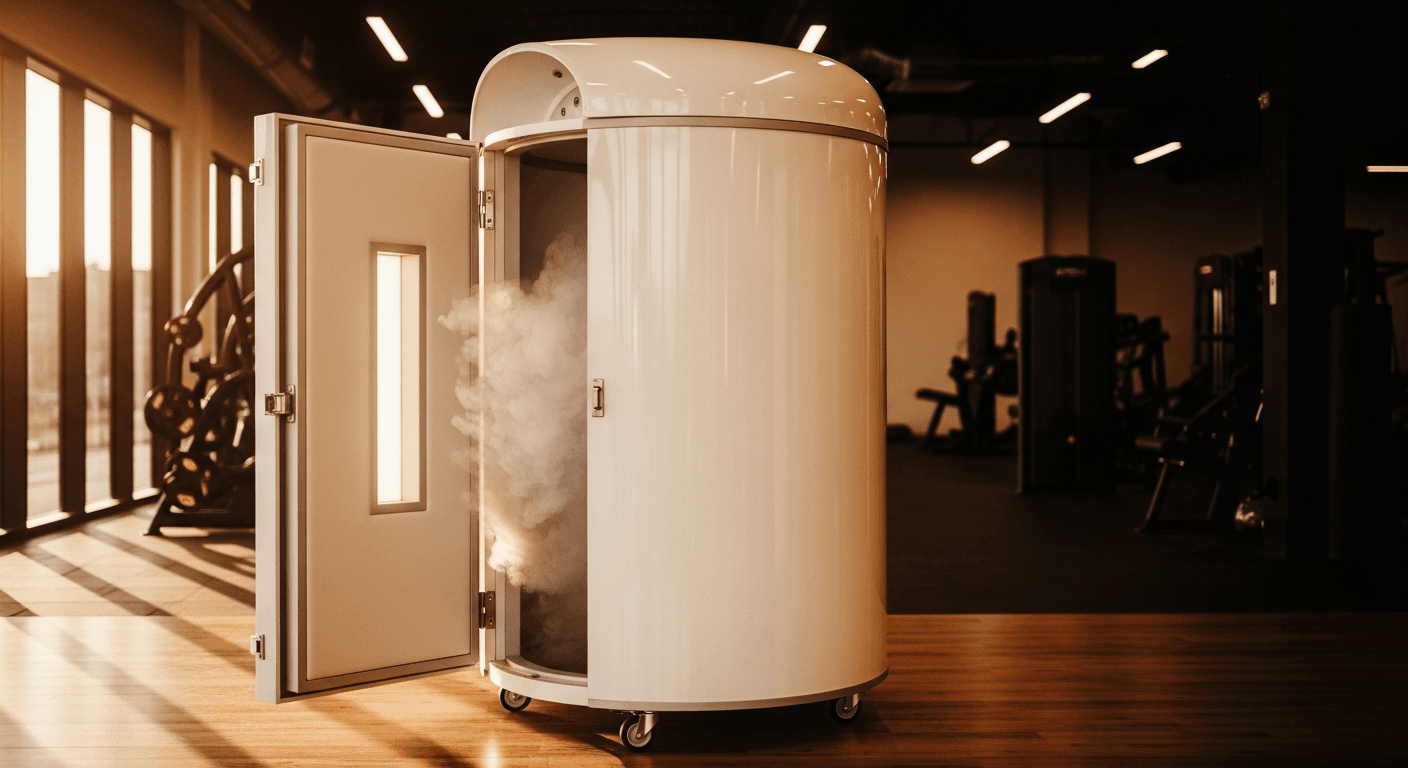
The recovery category is no longer a nice-to-have. It's becoming a core revenue line for gym operators who want to reduce their dependence on membership fees and personal training packages. And in mid-2026, one specific format is drawing serious attention from independent operators and regional chains alike: the mobile cryotherapy room.
The model is straightforward. Instead of building a permanent cold therapy suite, you lease or franchise a self-contained mobile cryotherapy unit, park it in your facility or on your lot, and start charging session fees from day one. No buildout. No lengthy permits. No six-figure capital commitment before you've validated demand.
That simplicity is driving adoption faster than most operators expected.
Why Mobile Cryotherapy Is Growing Now
The mobile cryotherapy room market has accelerated sharply through the first half of 2026, pushed by two forces working in parallel. First, gym chains and wellness spa groups have begun investing directly in the category, either acquiring unit manufacturers or signing multi-location supply agreements that signal long-term commitment. Second, consumer awareness of clinical-grade cold therapy has reached a tipping point.
A significant driver of that awareness is guidance published by the American Medical Association in 2026 on cold plunge and contrast therapy protocols. The AMA's position validated cold therapy as a legitimate recovery modality, not just a wellness trend. For consumers who were curious but skeptical, that kind of institutional backing shifted behavior. Session bookings at facilities offering whole-body cryotherapy and cold water immersion reported meaningful upticks in the months following the publication.
The result is a market where demand is building and supply infrastructure is catching up fast.
How Manufacturers Are Going to Market
North American and European manufacturers have recognized that selling equipment outright limits their addressable market. A $60,000 to $90,000 capital purchase puts whole-body cryotherapy chambers out of reach for most independent gym operators. So the dominant go-to-market strategy has shifted toward franchise and leasing partnerships.
Under a typical leasing structure, an operator pays a monthly fee in the range of $1,500 to $3,500 depending on unit type, territory, and contract length. The manufacturer retains ownership, handles major maintenance, and often provides staff training and software for session booking. The operator provides the space and the customer base.
Franchise models add a layer of brand licensing and sometimes proprietary protocols, which can support premium session pricing. Both structures dramatically lower the entry barrier compared to owned equipment, and they align manufacturer incentives with operator success in ways that outright sales don't.
This mirrors a broader pattern visible across fitness equipment and wellness technology. As personalized nutrition apps secure funding and scale through subscription models, hardware-adjacent wellness categories are following the same recurring-revenue logic. Manufacturers want predictable income. Operators want low-risk trials. Leasing solves for both.
The Revenue Case for Independent Operators
Here's the underlying business problem that mobile cryotherapy helps solve. Personal training currently represents approximately 47% of gym revenue across independent and mid-market operators. That's a meaningful concentration risk. If PT demand softens, whether from economic pressure on consumers or competition from digital coaching platforms, you're exposed.
Recovery services offer a diversification path with several favorable characteristics. Session-based pricing is easy to understand and sell. The experience is short (two to four minutes for whole-body cryo, longer for cold plunge formats), which means high throughput is achievable in a small footprint. And the demographic overlap with your existing membership is strong. Members who are already investing in strength training, longevity-focused fitness, and performance outcomes are the same people most likely to pay for structured recovery.
That audience is growing. Research on the relationship between structured training and long-term health outcomes continues to build consumer motivation. Projections for the global fitness market doubling by 2036 rest heavily on this kind of ancillary service expansion, not just membership growth. The operators who build multi-revenue models now will be better positioned as membership growth flattens in saturated markets.
On session pricing, current benchmarks in the US market range from $25 to $65 per whole-body cryo session, with cold plunge and contrast therapy packages often priced higher at $50 to $120. Membership bundles that include a fixed number of recovery sessions per month are becoming increasingly common and tend to improve both retention and average revenue per member.
What the Numbers Need to Look Like Before You Sign
Before committing to a leasing contract, you need to stress-test three specific variables: utilization rate assumptions, liability insurance requirements, and session pricing benchmarks relative to your local market.
Utilization rate. A leased unit at $2,500 per month requires you to cover that cost before generating profit. At $45 per session, you need roughly 56 sessions per month just to break even on the lease. That's fewer than two sessions per day. Most operators who report success are running four to eight sessions per day once the service is established. But "once established" is doing real work in that sentence. Build a conservative ramp curve into your model. Assume month one through three are below breakeven, and structure your cash reserves accordingly.
Liability insurance. Cryotherapy involves exposure to temperatures between negative 166 and negative 220 degrees Fahrenheit in whole-body formats. Your existing general liability policy almost certainly doesn't cover it. Expect to add a specific medical wellness or cryotherapy endorsement, and budget $1,200 to $3,000 annually depending on your insurer and session volume. Get this confirmed in writing before you take delivery of the unit.
Local pricing benchmarks. What standalone cryo studios in your market are charging matters more than national averages. If there's a dedicated cryotherapy studio within two miles charging $35 per session, your gym may need to compete on convenience and bundling rather than headline price. If you're the only cold therapy option in a 10-mile radius, you have more pricing latitude. Do the competitive audit first.
Fitting Recovery Into Your Broader Programming
Mobile cryotherapy doesn't operate in isolation. The operators getting the best utilization rates are the ones connecting cold therapy to their existing training ecosystem. That means positioning recovery sessions as a logical complement to your strength and conditioning programming, not a separate product that members have to be separately convinced to try.
Recovery is most compelling when members understand the physiological rationale. Post-session inflammation management, improved sleep quality, and faster return-to-training timelines are well-documented benefits of structured cold exposure when protocols are applied correctly. Staff who can explain those mechanisms during a sales conversation or a post-class cooldown moment will outperform staff who simply say "it's good for recovery."
This connects to a larger point about operator education. The members most likely to pay for cryotherapy are already engaged with evidence-based fitness content. They're reading about how structured strength programming supports long-term performance after 40. They're tracking their training load and thinking about systemic recovery, not just whether they're sore. Meet them at that level of sophistication and you'll have a much easier conversion.
It also helps to frame recovery services within your overall health positioning rather than as an upsell. Operators who integrate recovery into their onboarding conversations, their app or booking flows, and their PT recommendations see significantly higher session volumes than those who treat it as a side offering. Structure matters.
What the Competitive Landscape Is Telling You
The broader consolidation happening in fitness is worth tracking here. With US gym memberships approaching 77 million and growth slowing, operators can't rely on new member acquisition to drive revenue. The business model has to evolve toward higher spend per existing member. Recovery services, and particularly premium modalities like cryotherapy, are one of the clearest paths to achieving that.
Chain operators are already moving. When large gym groups sign multi-location supply agreements with cryotherapy manufacturers, they're absorbing favorable unit economics and locking in territorial advantages. Independent operators who wait risk finding that leasing supply tightens or that pricing power in their local market erodes as chain locations add the same service.
The window for early-mover advantage isn't permanently open. The manufacturers prioritizing independent operators today are doing so because they need distribution volume. As chain contracts fill their capacity, the terms available to independents will tighten. Evaluating the option now, with a clear financial model and a realistic utilization assumption, is the disciplined approach.
Mobile cryotherapy isn't the only recovery format worth considering. Cold plunge units, infrared saunas, and compression therapy all occupy parts of the same recovery revenue landscape. But the mobile format specifically addresses the capital and commitment barrier that has historically kept these services out of independent gym economics. That's the structural shift worth paying attention to.