
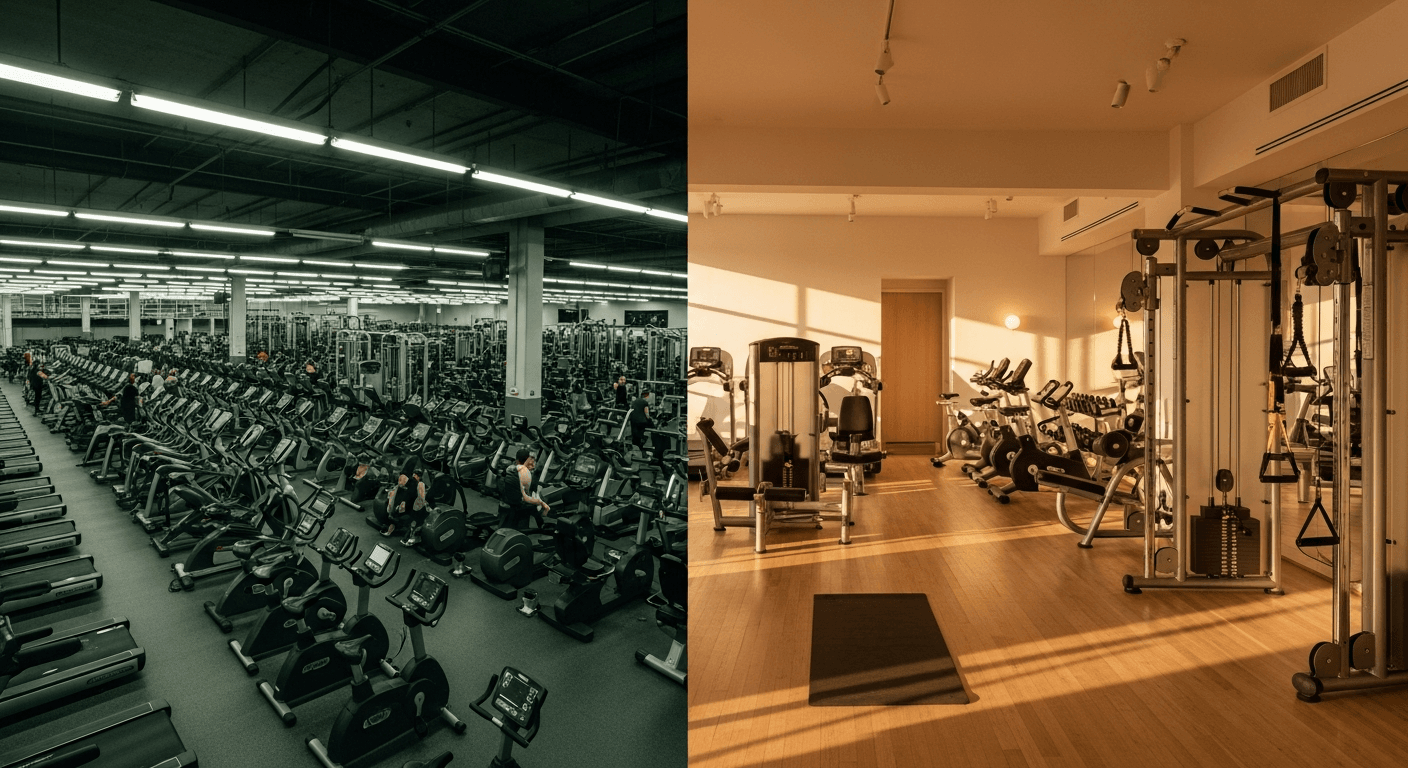
Q1 2026 earnings from Life Time and Planet Fitness put a name on something many gym operators have been feeling for months without being able to quantify it. The fitness industry isn't growing uniformly. It's polarizing. And this polarization is rewriting the strategic playbook for every club that isn't clearly premium or clearly budget.
Key Takeaways
- Life Time (premium) hit record revenue in 2025, with affluent members absorbing price increases without friction
- Planet Fitness cut its 2026 guidance, signaling fragility in the budget segment
- The market is splitting: premium and budget are holding, middle-market clubs are structurally squeezed
- Americans will spend approximately $60 billion on fitness in 2026
- SaaS-integrated technology is now a competitive baseline, not an optional differentiator
The Numbers Behind the Split
The K-shaped economy concept describes a market where two segments move in opposite directions simultaneously, creating a K shape rather than a uniform line. In fitness, Q1 2026 financial data confirms this pattern.
The Premium Segment: Thriving Life Time, targeting affluent consumers with premium club experiences, posted record revenue in 2025. Q1 2026 confirmed the trend: its membership base continues to absorb price increases without visible resistance. The premium experience, whether it's recovery amenities, integrated personal coaching, boutique classes, or spa-level facilities, maintains a level of desirability that economic pressure doesn't dampen for higher-income households.
The Budget Segment: Resilient but Under Pressure Planet Fitness posted 22% revenue growth in Q1 2026, with 700,000 net new members. But the company simultaneously cut its annual guidance, abandoned its 3-year targets, and paused its national Black Card price increase. Management cited marketing challenges with fitness beginners, weather impacts, and macroeconomic uncertainty. Clear signal: the budget segment is resilient, but more vulnerable to external shocks than it used to be.
The Middle Market: Structurally Compressed This is where the situation is most difficult. Clubs priced between $35 and $80 per month, neither clearly premium nor truly budget, face pressure from both directions. Above, members with income flexibility migrate toward premium experiences that better match their expectations. Below, price-sensitive members systematically compare their subscription against $20 alternatives. Without a strong distinctive positioning, these clubs are losing ground in both directions at once — a dynamic examined in depth in this data-driven breakdown of low-cost, premium, and boutique gym models.
Why $60 Billion Doesn't Benefit Everyone Equally
Americans will spend approximately $60 billion on fitness in 2026. Only 23% of consumers say they'd cut their fitness budget before cutting dining out or travel. Fitness spending is protected.
But protected doesn't mean uniformly distributed. These $60 billion are concentrating at two poles. And that concentration has direct implications for middle-market clubs.
The economic logic: when a consumer with solid income chooses between a $60 club and a premium $150 club, the gap is $90/month. If the premium experience is meaningfully better, the calculation is straightforward. Conversely, when a price-sensitive consumer compares a $50 club against a budget $20 option, the $30 monthly gap is real and carefully weighed. In both cases, the middle gets squeezed.
Technology as a Differentiation Factor
75% of fitness product development conversations in 2026 start with AI. Investing in integrated SaaS solutions isn't optional anymore, it's a competitive prerequisite.
This technology reality is particularly relevant for middle-market clubs, which often have fewer resources to invest in tech but need it most to differentiate. Here are the technology levers with proven impact in 2026:
Data-Driven Personalization AI tools that analyze attendance patterns, workout preferences, and engagement trends can predict which members are at risk of canceling. This capability, once exclusive to large chains, is now accessible to independent clubs through SaaS platforms.
Hybrid Membership Options The pandemic anchored flexible fitness behaviors. Clubs that offer hybrid memberships including digital programs or online access have a wider value surface: they serve the member who travels, works from home, or wants continuity between club visits.
Structured Onboarding The best-performing retention practices in 2026 converge around rigorous onboarding in the first 90 days. Members who receive an initial assessment, a personalized plan, and regular touchpoints in their first three months stay an average of 23.5 months, versus 6 months for members without structured onboarding.
Exit Strategies for Middle-Market Clubs
If you operate a mid-market club, you have three strategic options in 2026. None are comfortable, but all three are viable depending on your local market and resources.
Option 1: Move Up on a Specific Segment You don't need to become Life Time. You need a positioning distinctive enough that your target members stop comparing you to budget alternatives. This could come from specialization (women, 50+, performance athletes, recovery-focused), superior service experience (included coaching, systematic personalized follow-up), or facilities your competitors don't have.
Option 2: Rationalize Toward a Lean Budget Model If your market is dominated by established budget players, the race to the bottom can be winning, but only if you optimize your operational model to run profitably at thin margins and high volume. This is a deep transformation, not a simple price adjustment.
Option 3: Reinforce Local Community Anchoring The middle-market clubs that are holding have often something large chains can't replicate: a strong local community. In-club events, member challenges, local partnerships, and genuine staff relationships create perceived value that's difficult to dislodge, even when a budget competitor opens 500 meters away.
What This Means For You
The K-shaped fitness economy isn't a passing trend. It's the reflection of a broader economic polarization affecting every consumer category. Fitness isn't exempt.
If you operate a club or studio, the central strategic question of 2026 isn't "how do I attract more members?" It's "where am I positioned in this K, and is that positioning clear and deliberate?"
Clubs without a precise answer to that question are the most exposed. Not because the fitness market is struggling — $60 billion in spending and strong spending preference proves otherwise. But in a polarized market, positioning ambiguity translates directly into member attrition.
Sources: CNBC - Life Time, Planet Fitness earnings show K-shaped economy (February 2026), Athletech News - Inside the K-Shaped Economy Taking Over the Fitness Industry, ABC Fitness - The K-Shaped Economy Is Real, Seeking Alpha - Planet Fitness Q1 2026 Results, GlobeSt - Fitness Industry Strength Masks K-Shaped Consumer Spending