
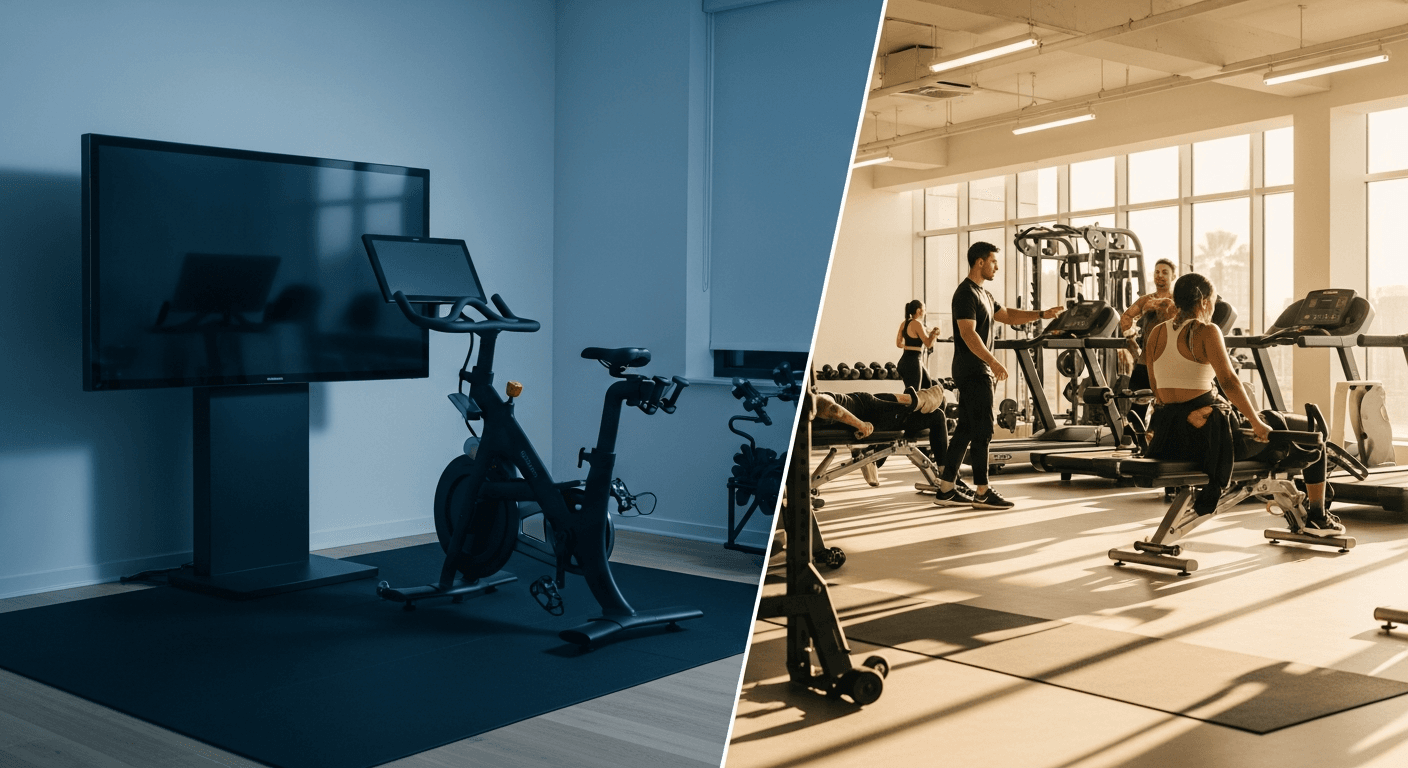
The U.S. smart home gym equipment market is projected to reach $2.44 billion, and that number isn't a distant forecast. It's arriving fast, backed by venture capital, hardware iteration cycles, and a consumer base that already proved during 2020 and 2021 that it will spend serious money to train at home. If you operate a brick-and-mortar facility and you're treating this as background noise, you're making a strategic mistake.
This isn't about treadmills and dumbbells sitting in spare bedrooms. It's about connected platforms, AI-generated programming, and subscription coaching layers that compete directly with the value proposition your club has spent years building. The response plan starts with understanding what you're actually fighting, and it doesn't end with a loyalty punch card.
What $2.44 Billion Actually Means for Club Operators
Market projections at this scale signal more than consumer preference. They signal capital allocation. When smart home gym equipment is a $2.44 billion category, manufacturers have the revenue to invest in content studios, hire certified coaches, build proprietary apps, and negotiate media partnerships. The Peloton playbook, despite its financial turbulence, proved the model: sell the hardware once, monetize the subscriber forever.
That's the competitive frame you need to internalize. You're not competing against a stationary bike. You're competing against a platform that delivers daily workouts, tracks progressive overload, and sends push notifications to your members at 6 a.m. before they've thought about driving to your facility.
The $2.44 billion figure also aligns with a broader market shift. As covered in our analysis of Wearables Hit $185B: Where Fitness Brands Capture Margin, the hardware-to-ecosystem transition is the defining commercial pattern in fitness right now. Smart home gym brands are executing the same playbook. Equipment is the entry point. Recurring digital revenue is the strategy.
The Real Gap: Accountability, Not Access
Here's where most operators misread the threat. The problem home gym users experience isn't equipment quality. A $3,000 setup with a smart mirror, adjustable dumbbells, and a connected rowing machine is genuinely capable hardware. The problem is everything that surrounds the equipment.
Research consistently shows that self-directed training produces inferior adherence and slower results compared to coached, structured environments. Home gym owners start strong, plateau quickly, and frequently abandon consistent training within 90 days of purchase because they lack programming logic, external accountability, and real-time feedback on form and intensity.
This is your marketing brief. Not "our equipment is better." Instead: "You already own the hardware. Here's what it can't give you." The research is clear that professional instruction dramatically accelerates outcomes, and operators who make this case explicitly, with data, will convert home gym owners into hybrid members rather than losing them entirely. For context on why that coaching relationship matters so much, the evidence laid out in Why Hiring a Trainer Actually Speeds Up Muscle Gain is exactly the kind of content you should be sharing directly with home-gym-curious prospects.
Group energy is another non-replicable asset. The motivational lift from training alongside other people. the social reinforcement of a class format, and the competitive pressure of a shared floor are all measurable contributors to consistency. No smart mirror currently solves for that.
Audit Your Irreplaceable Value Propositions
Before you build a response strategy, you need to know exactly what a well-equipped home gym cannot replicate. Here's an honest audit framework:
- Recovery infrastructure. Saunas, cold plunge pools, steam rooms, stretch zones, and massage therapy. A home gym at any price point cannot match this. If your facility has recovery amenities and you're not leading with them in your marketing, you're leaving your strongest differentiator unused.
- Modality variety. A home setup optimizes for one or two training styles. Your club likely offers strength, cardio, group classes, functional training, aquatics, and more under one roof. Variety sustains long-term engagement in ways that a single connected device cannot.
- Professional instruction and real-time correction. Form errors that accumulate over months of unsupervised home training lead to injury. Your floor coaches and personal trainers provide something that even the most sophisticated AI feedback loop has not yet replicated convincingly.
- Social environment and community. Regulars who know each other's names, staff who recognize members, and the low-grade social accountability of showing up to a shared space. This is not a feature that can be added to a hardware subscription.
- Equipment scale and commercial quality. Commercial-grade machines, a full free weights range, and specialty equipment like GHDs, sleds, and cable systems require floor space and investment that very few home setups reach.
Map your actual offerings against this list honestly. If your recovery amenities are minimal and your group class calendar is thin, that's not a marketing problem. It's a product problem, and it should inform your capital expenditure decisions before you spend another dollar on ads.
Hybrid Membership as the Structural Answer
The most effective structural response to the smart home gym market is a hybrid membership model. This isn't a discounted membership. It's a deliberately tiered access structure designed to capture consumers who already own home equipment and aren't going to buy a full club membership on traditional terms.
A hybrid model typically works like this: a reduced base rate grants facility access at defined times, usually off-peak, combined with optional digital add-ons such as app-based programming, virtual coaching check-ins, or class livestreams. The member keeps their home gym. You stay inside their fitness habit. Over time, a meaningful percentage of hybrid members migrate to full memberships as the club environment proves its value.
Pricing benchmarks vary by market, but hybrid tiers in the $35 to $55 per month range have shown strong acquisition results in urban U.S. markets where home gym penetration is high. The key is that you're not cannibalizing your full-price membership. You're creating a new entry point for a segment that was previously not converting at all.
This model also pairs well with the consolidation moves reshaping the industry. Operators who have studied how larger chains are structuring multi-location access, such as the approach detailed in Benefit Systems Absorbs Fit Meet and Core Fitness, will recognize that flexible access architecture is becoming standard at scale. Independent operators need to move in the same direction.
Building Your Digital Layer Before You're Disintermediated
The $2.44 billion projection carries a warning that goes beyond the physical competition. Smart home gym manufacturers are actively becoming content and coaching companies. They're hiring trainers, building programming libraries, and developing member communities that keep users loyal to the platform, not to any particular facility.
If your members' daily fitness habits run through a competitor's app, you're peripheral to their fitness identity even when they walk through your door. That's a fragile membership relationship, and it's the fastest path to churn when they reassess their spending.
You don't need to build a Netflix-scale content operation. But you do need a digital presence that keeps your coaching voice inside your members' weeks, not just the hours they spend on your floor. That means a branded app or at minimum a structured digital touchpoint, whether that's a weekly programming email, a private community channel, or short-form coaching video content your trainers produce consistently.
The operators who do this well position their coaching staff as the authority on their members' results. That's a relationship that a connected mirror or a smart bike's AI coach cannot displace. For insight into how to structure programming that members will actually follow between visits, the framework in Science Says Your Strength Program Can Be Really Simple offers a useful starting point for what your digital coaching content should communicate.
Staff, Compensation, and the Human Differentiator
None of this works without high-quality staff. Your coaches and trainers are the human layer that smart home gym platforms cannot buy at scale. They are, in the most direct sense, your competitive moat. Treating compensation as a cost-minimization problem in this environment is a strategic error.
The data on operator compensation benchmarks reflects a market where qualified trainers have options, and facilities that underpay are losing their differentiating asset to competitors who don't. If you haven't reviewed your pay structure against current industry benchmarks, the findings in the HFA 2026 Pay Report: What Operators Must Act On should be your next read.
Invest in continuing education for your training staff. Certified professionals who can deliver measurable results, explain their programming rationale, and build genuine relationships with members are the argument against any smart home gym platform. That argument has to be staffed and compensated appropriately to hold.
The Action Sequence
If you're an operator looking at the $2.44 billion projection and asking what to do first, here's the sequence that makes strategic sense:
- Audit your current value proposition against the home gym gap list above. Identify where your offering is genuinely differentiated and where it isn't.
- Design a hybrid membership tier with off-peak access and optional digital add-ons. Price it to acquire, not to maximize per-member revenue on day one.
- Build or formalize a digital coaching touchpoint. It doesn't need to be complex. It needs to be consistent and coach-led.
- Review trainer compensation and retention against current benchmarks. Losing a great trainer to a better-paying competitor is not a talent problem. It's a strategy problem.
- Market the accountability gap explicitly. Target home gym owners in your market with messaging that acknowledges their investment and makes the case for what they're missing, without being condescending about it.
The $2.44 billion smart home gym market is not the end of brick-and-mortar fitness. But it is a well-funded competitor that's getting smarter every product cycle. The operators who respond with structural changes, not just promotional discounts, are the ones who will still be growing in five years.