
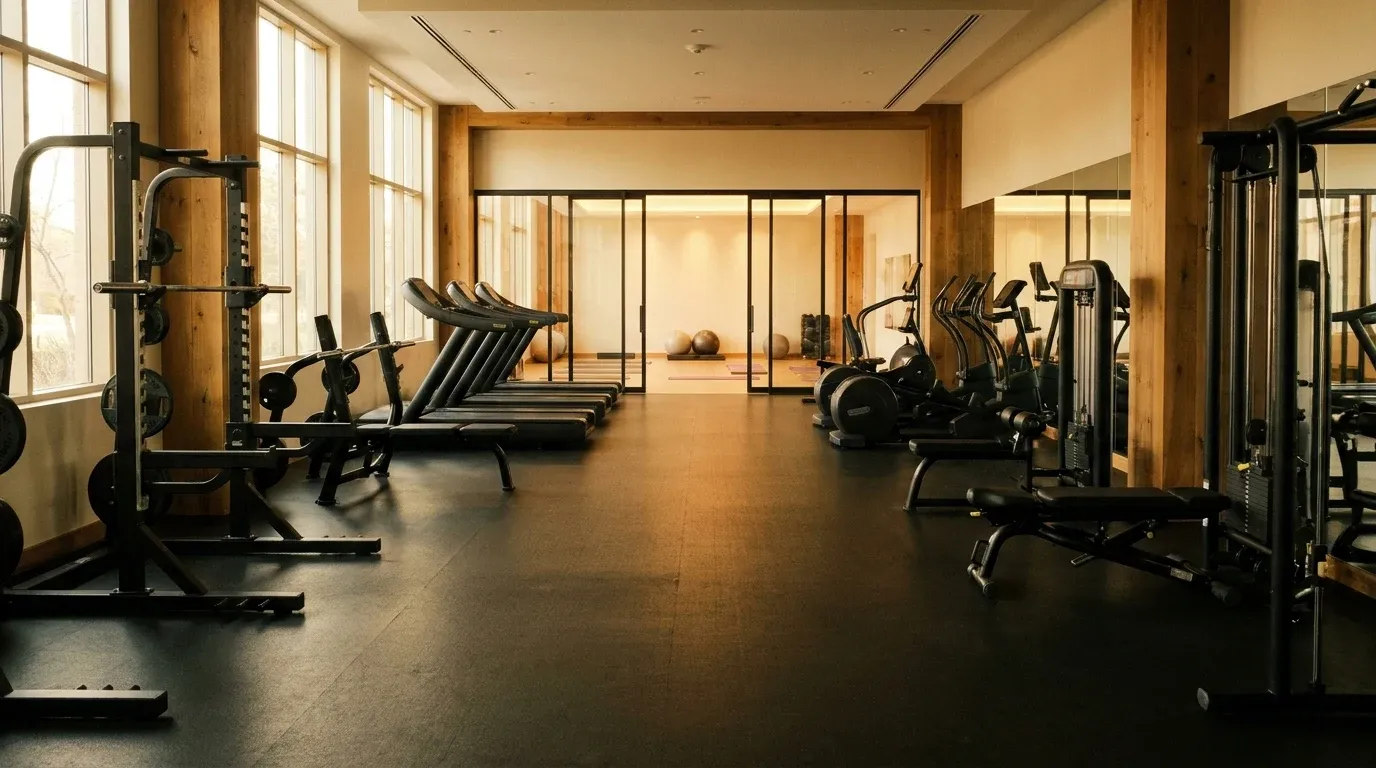
When One Playground opened its Zetland facility in Sydney on November 14, 2026, it wasn't positioning itself as just another premium gym. At 2,500 square metres, the site is a deliberate structural argument: that the fitness industry's bifurcation problem has a physical solution, and that solution requires significant square footage to work.
The format has a name now. Industry observers are calling it the superboutique. And Zetland is currently the clearest live test of whether it holds.
What the Format Actually Looks Like
The Zetland site combines high-performance equipment across a commercial gym footprint with curated group class programming, recovery spaces, and a dedicated APEX performance running studio. That last element matters more than it might appear. A standalone running studio, embedded within a broader facility, signals that One Playground isn't trying to be everything to everyone in a vague, diluted sense. It's trying to serve distinct member need-states under one roof, with enough depth in each vertical to satisfy people who previously went elsewhere for that specific experience.
Three need-states, clearly: performance training with premium equipment, structured group class community, and recovery or run-specific programming. The architectural bet is that enough members carry two or three of those needs simultaneously to justify combining them rather than fragmenting them across separate memberships.
That's not an obvious bet. For the last decade, the industry consensus was that specialization wins. Build one thing, build it deeply, charge accordingly.
Why the Market Created This Opening
The specialization thesis still holds at the extremes. High-volume low-price chains, often called HVLP operators, have continued to expand aggressively by stripping the offer to its functional core: access to equipment, low monthly friction, no commitment pressure. At the other end, boutique studios have held pricing power by selling community, programming identity, and instructor-led experience at $30 to $45 per class or $150 to $250 per month in most US and Australian urban markets.
What's collapsed is the middle. Mid-tier gyms that tried to do both without committing fully to either have faced sustained membership erosion. The member who wants a coached group class on Tuesday and open-floor strength work on Thursday doesn't want to pay two memberships. And increasingly, they won't.
The global boutique fitness market has reached $60.9 billion, a figure that reflects genuine demand for experience-led training rather than just access. But boutique-only models carry their own structural fragility: high class-by-class revenue that disappears when the format trend shifts, instructor dependency, and limited ability to serve members whose training needs change over time. If a member picks up running seriously, or starts prioritizing recovery, a single-discipline studio can't follow them. A superboutique can.
The same competitive dynamics reshaping gym business models more broadly, including the pressure from how GLP-1 drugs are reshaping gym business models, are accelerating member demand for facilities that can serve evolving health needs rather than locking them into one training identity. Members whose fitness goals shift medically or physiologically want a facility that adapts with them. That flexibility is a retention argument as much as an acquisition one.
The Economics Are Unforgiving
None of this works at a low price point. A 2,500 square metre facility in a Sydney inner-suburb carries real estate costs that are categorically different from a 300sqm boutique studio. Staffing a running studio, recovery area, and group class schedule simultaneously requires instructor depth that compounds payroll. The superboutique format is only economically logical if average revenue per member is high enough to justify the cost base, and if occupancy across all three service verticals is consistent rather than peaking only in group classes.
That's a harder yield problem than it looks. Pure boutique operators optimize for revenue per class, with relatively low fixed costs. HVLP operators optimize for membership volume at $20 to $30 per month, accepting thin margins at scale. The superboutique sits in neither optimization zone. It needs premium membership pricing, sustained utilization across multiple facility zones, and a member base that actually uses more than one service vertical.
For operators thinking about their own footprint decisions, the question isn't whether the superboutique concept is appealing. It clearly is. The question is what the minimum viable version looks like. What's the smallest footprint that can still deliver credible depth across equipment, programming, and recovery? What service mix is required to sustain yield per square metre above both HVLP and pure boutique benchmarks? One Playground's Zetland build is one data point, not a template. And 2,500sqm may not be the floor.
Operational intelligence matters here too. Tracking utilization across distinct zones, understanding which member segments use which services, and correlating that with retention is a more complex analytics problem than most gym management software is built to handle. The gap in gym business intelligence that's driving investment in dedicated analytics platforms becomes especially acute at superboutique scale, where misreading zone performance can lead to staffing or programming decisions that quietly erode yield.
The Member Acquisition Argument
One Playground's Zetland format is implicitly targeting two distinct acquisition pools that traditional operators treat as separate markets. The first is HVLP dropouts: members who cancelled cheap gym memberships not because they couldn't afford them, but because they stopped feeling like the facility was doing anything for them. Research consistently shows that gym attrition is driven less by price sensitivity and more by perceived irrelevance. A member who never uses more than two machines and never speaks to a staff member will cancel eventually, regardless of how low the monthly fee is.
The second pool is boutique loyalists who are functionally locked into a single-studio membership because there's no credible alternative that covers their full training picture. A runner who takes two Pilates classes a week and wants structured strength work on the side is currently solving that problem with multiple memberships, apps, and improvisation. A superboutique that covers all three removes the patchwork.
Converting both pools requires the facility to be legible to people coming from very different reference points. The HVLP dropout needs to feel that the equipment floor is serious and well-maintained, not just a backdrop for the group class business. The boutique loyalist needs the group programming to feel as intentional and community-driven as what they're leaving behind. Getting both right in a single physical space, with a single brand and a single price point, is the execution challenge that makes or breaks the format.
Staff quality becomes central to this. The member who's come from a boutique studio has experienced high instructor standards. If the group class experience at a superboutique feels generic by comparison, the acquisition argument fails. Understanding what distinguishes excellent coaching from adequate coaching matters here, and operators who haven't built structured hiring and vetting processes are exposed. The fundamentals covered in resources like how to vet a personal trainer on certs, insurance, and red flags apply equally to the institutional side of hiring.
Programming Depth as the Real Differentiator
Equipment and space are replicable. Programming depth, and the culture that surrounds it, is harder to copy. One Playground's bet on a dedicated APEX running studio isn't just a service add-on. It's a signal that the facility takes run-specific performance seriously enough to give it its own branded environment. That kind of commitment creates a category of member who self-identifies around that programming rather than just around the building.
The same logic applies to how recovery is integrated. If recovery spaces function as a passive amenity, they add cost without building loyalty. If they're programmed, explained, and connected to member outcomes, they become a retention tool. The difference is staff protocol and member education, not square footage. Facilities that treat recovery as a sales point rather than a training component miss the opportunity to build the habitual usage that drives retention.
Group class programming sits at the intersection of both concerns. Research on training frequency and intensity, including work on HIIT frequency and its effects on VO2max and fat loss, gives operators real data to build programming around rather than relying on trend cycles. Members who understand why the programming is structured the way it is are more likely to trust it and stick to it.
What One Playground Is Actually Testing
The Zetland facility isn't just a new gym. It's a live experiment in whether the superboutique format can hold its economics at scale, convert members from two structurally different backgrounds, and sustain the programming quality that justifies premium pricing across all three of its service verticals.
If it works, the format becomes a template that other operators will study seriously. If the zone utilization data shows that members cluster in one or two service areas while others underperform, the case for smaller, more focused builds gets stronger.
Either way, the fitness industry gets a real answer to a question it's been asking theoretically for years: how big does a gym have to be before it's big enough to be everything a serious member needs. And how much does that cost to run well.