
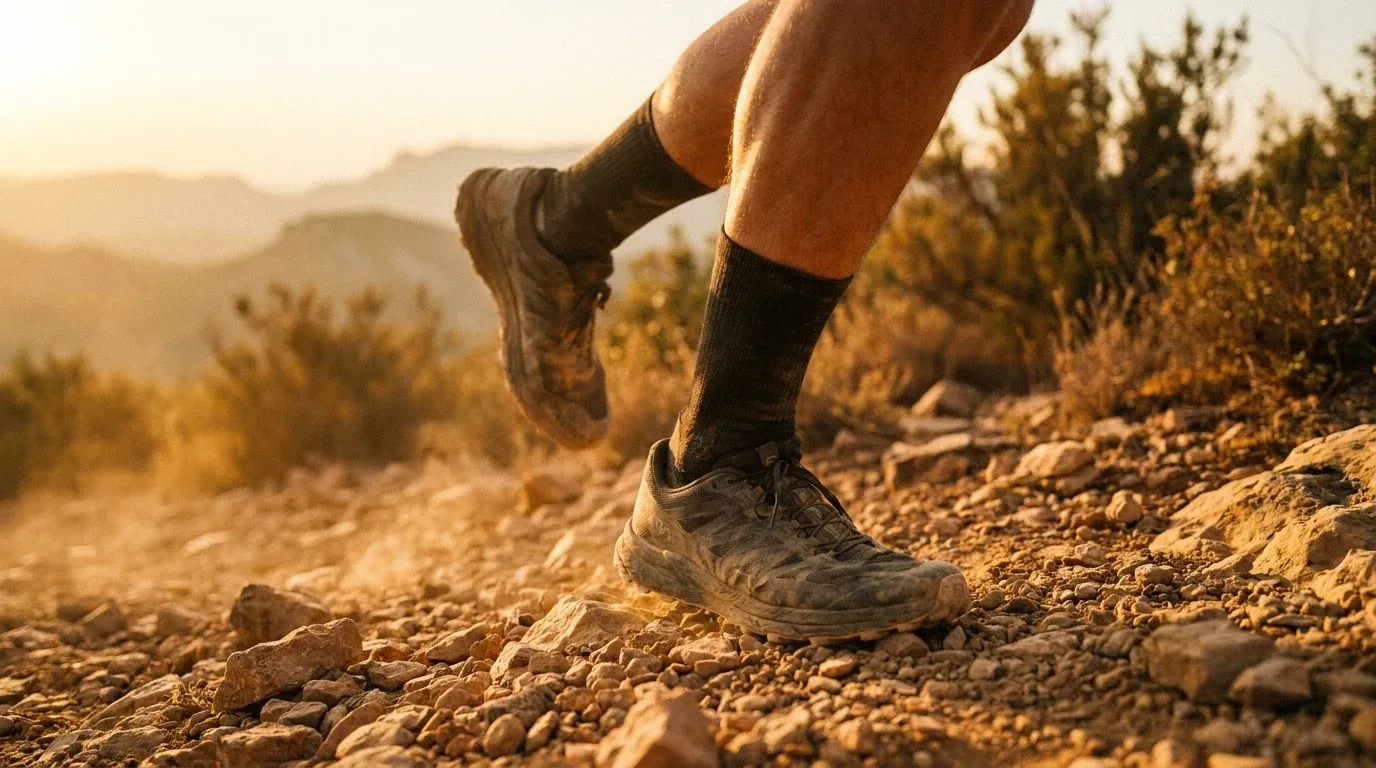
Ultra-trail running has always sorted competitors by training, nutrition, and mental resilience. But as race distances push past 200 and 300 miles, a quieter variable is increasingly deciding who crosses the finish line and who doesn't: what's on your feet.
The announcement that Mount to Coast will serve as the official technical footwear partner for Trail Cat The Race 2026 puts a sharp focus on that reality. Trail Cat The Race is a 300-mile ultra-trail event staged across Southern Europe's most demanding terrain. It's not a race that forgives poor shoe choices.
What Trail Cat The Race Actually Demands
Trail Cat The Race covers approximately 300 miles of mixed terrain, including high-altitude ridgelines, technical rocky descents, forested singletrack, and coastal approach sections. Competitors face cumulative elevation gain measured in tens of thousands of feet, often running through multiple consecutive nights with minimal sleep.
At that scale, the event isn't just physically different from a 100-mile race. It's physiologically different. Foot volume increases significantly after sustained effort. Research in sports medicine consistently shows that foot swelling in ultra-distance events can increase foot length by half a size and width by a full size within the first 24 to 48 hours. At 300 miles, that process cycles and compounds across multiple days.
This is precisely why Mount to Coast's involvement goes beyond branding. The brand specializes in biomechanics and applied footwear innovation, and its partnership with Trail Cat The Race is structured around athlete data, terrain mapping, and multi-stage fit analysis rather than simple product placement.
Why Shoe Selection at Extreme Distances Is a Medical Decision
Most trail runners think about footwear in terms of cushioning preference. Softer or firmer. Maximal or minimal. That framework works reasonably well up to marathon and even 50-mile distances. Beyond 100 miles, it breaks down.
"At extreme distances, shoe selection transitions from a comfort question to an injury-prevention and performance variable that's as significant as training volume," the Mount to Coast technical team noted in materials released alongside the Trail Cat The Race partnership announcement. That framing is worth taking seriously.
The compounding factors at 200-plus miles include foot swelling that can render a properly fitted shoe dangerously tight. They include terrain transitions that may require grip profiles suitable for wet limestone in the morning and dry gravel by evening. They include cumulative impact patterns that shift as a runner's gait deteriorates under fatigue, loading tendons and joints in ways that a shoe's midsole geometry either accommodates or aggravates.
DNF rates at events like Trail Cat The Race frequently trace back to podiatric issues: blistering severe enough to halt movement, black toenails caused by toe box compression during descents, or plantar stress injuries exacerbated by inadequate midsole support over days of continuous loading. These aren't bad luck. They're often predictable and preventable with better shoe selection upstream.
The Technical Factors That Actually Matter
If you're building toward longer ultra distances, here's what the evidence and elite practitioner experience suggest you should actually evaluate when selecting trail shoes.
Drop
Heel-to-toe drop is one of the most consequential variables in long-distance trail footwear, and it's frequently misunderstood. A lower drop (4mm or less) encourages a midfoot or forefoot strike, distributing load differently across the Achilles and calf complex. A higher drop (8mm or more) reduces Achilles strain but can shift load toward the knee over time.
For extreme distances, the key isn't finding your preferred drop for a 50K and sticking with it. It's understanding how your gait degrades under fatigue and selecting a drop that accommodates that degradation rather than accelerating injury risk. Most runners' form becomes less efficient and more heel-dominant as exhaustion accumulates. A moderate drop in the 4-6mm range often offers the best compromise across multi-day events.
Stack Height
Stack height matters more at extreme distances than most runners realize. Higher stacks offer more cushioning and impact absorption, which sounds universally positive until you account for proprioception and lateral stability. A very high stack can reduce ground feel to the point that technical terrain becomes genuinely hazardous on tired legs.
The current generation of high-stack trail shoes used at elite ultra level typically pairs maximum cushioning with structured heel counters and wider base geometries to preserve stability. If you're looking at shoes in the 35-40mm stack range, check the base width and torsional rigidity. Cushioning without structure is a liability at distance.
Fit and Sizing Strategy
Elite ultra runners don't buy a single pair of shoes for a 300-mile race. They plan their footwear across checkpoints, building in size progressions to account for swelling. For most runners targeting extreme distances, this means sizing up half a size or even a full size from your standard fit, and ensuring there's a thumb's width of space between your longest toe and the end of the toe box from the start of the event.
Width matters as much as length. A shoe that fits perfectly fresh may become a compression device by hour 36. Brands are increasingly offering wider last options in their ultra-specific lines. If your foot is at all wide or tends to spread under load, that's not a detail to ignore.
Outsole and Terrain Matching
Lug depth and pattern should reflect the terrain you're covering, not just the terrain that sounds most dramatic. Deep aggressive lugs perform brilliantly in mud and soft soil but increase fatigue on hard-packed surfaces because they create an uneven contact platform. Moderate lugs in the 4-5mm range with multidirectional placement handle terrain variety more consistently across a race like Trail Cat The Race, where conditions shift across hundreds of miles.
What the Ultra Scene Is Teaching General Trail Runners
You don't need to be planning a 300-mile race for this information to be useful. The biomechanical principles that make footwear critical at extreme distances apply on a smaller scale to anyone running trails regularly.
The same logic driving decisions at Trail Cat The Race applies to the runner training for a 50-mile event, or even a runner who logs consistent 20-mile weekends and wants to stay injury-free over years of training. Footwear degradation, terrain mismatch, and poor fit are responsible for a disproportionate share of running injuries at every level.
This is relevant context alongside broader research on training load. Studies consistently show that volume and intensity must be balanced against recovery capacity, and footwear is part of the load management equation in ways the sport has historically undervalued. The same body of research that shows how more training sessions don't automatically produce better results applies here: doing more miles in the wrong shoes doesn't build fitness. It builds injury.
The mental side of ultra preparation is equally important to get right, and knowing how to mentally prepare before a major race can be as decisive as physical readiness. But none of that mental preparation compensates for feet that fail you at mile 180.
The Broader Shift in Ultra Footwear Innovation
The Trail Cat The Race and Mount to Coast partnership reflects a genuine industry shift. The ultra-trail space is increasingly attracting brands whose competitive advantage is technical specialization rather than mass-market distribution. That's producing better shoes for serious distance runners, but it also means the product landscape is harder to navigate without a clear framework.
Participation in trail and ultra events continues to grow significantly. Marathon participation is breaking records in 2026, and ultra-distance interest is tracking upward alongside it. As more runners push into longer distances, the commercial and technical incentive to develop better footwear grows accordingly.
The athletes at the front of that shift are worth following. Elite voices like Maya Rayle are shaping how the sport understands training and gear at the highest level, and the information filtering down from elite ultra competition is increasingly practical for amateur runners making real decisions about what to put on their feet.
Building Toward Longer Distances: Practical Starting Points
If you're currently running 50Ks or 50-mile events and building toward longer distances, here's a simplified checklist to guide your footwear decisions:
- Size up from your road shoe size. Trail shoes should be a half size to full size larger than your street shoe, with room to account for swelling on long efforts.
- Test your shoes at race distance conditions. Don't evaluate a shoe on a 5-mile shakeout. Use it on your longest training days and check for pressure points, heel lift, and toe box compression after two or more hours.
- Match drop to your gait under fatigue. If possible, film yourself running at mile 15 or 20 of a long training run. Your gait at that point is what your shoes need to support, not your gait at mile one.
- Don't ignore width. Wide-fit options are increasingly available across the major trail brands and the difference in long-run comfort and blister prevention is significant.
- Plan multiple pairs for events over 100 miles. A single shoe cannot optimally serve every terrain and fatigue condition across a 300-mile race. Learn from how elite ultra runners approach checkpoint gear strategy.
- Replace shoes proactively. Most trail shoes have a functional midsole lifespan of 300 to 500 miles. Running high weekly volume in degraded shoes is a common and avoidable injury cause.
Trail Cat The Race represents the outer edge of what human endurance sports currently demand of footwear. But the questions it forces, about fit, terrain matching, drop, and durability under prolonged stress, are the same questions every trail runner should be asking before their next pair of shoes.
The technology is improving. The research is clearer than it's ever been. Whether you're targeting a 300-mile finish or trying to stay healthy through a consistent trail season, the shoe on your foot is doing far more work than most runners give it credit for.