
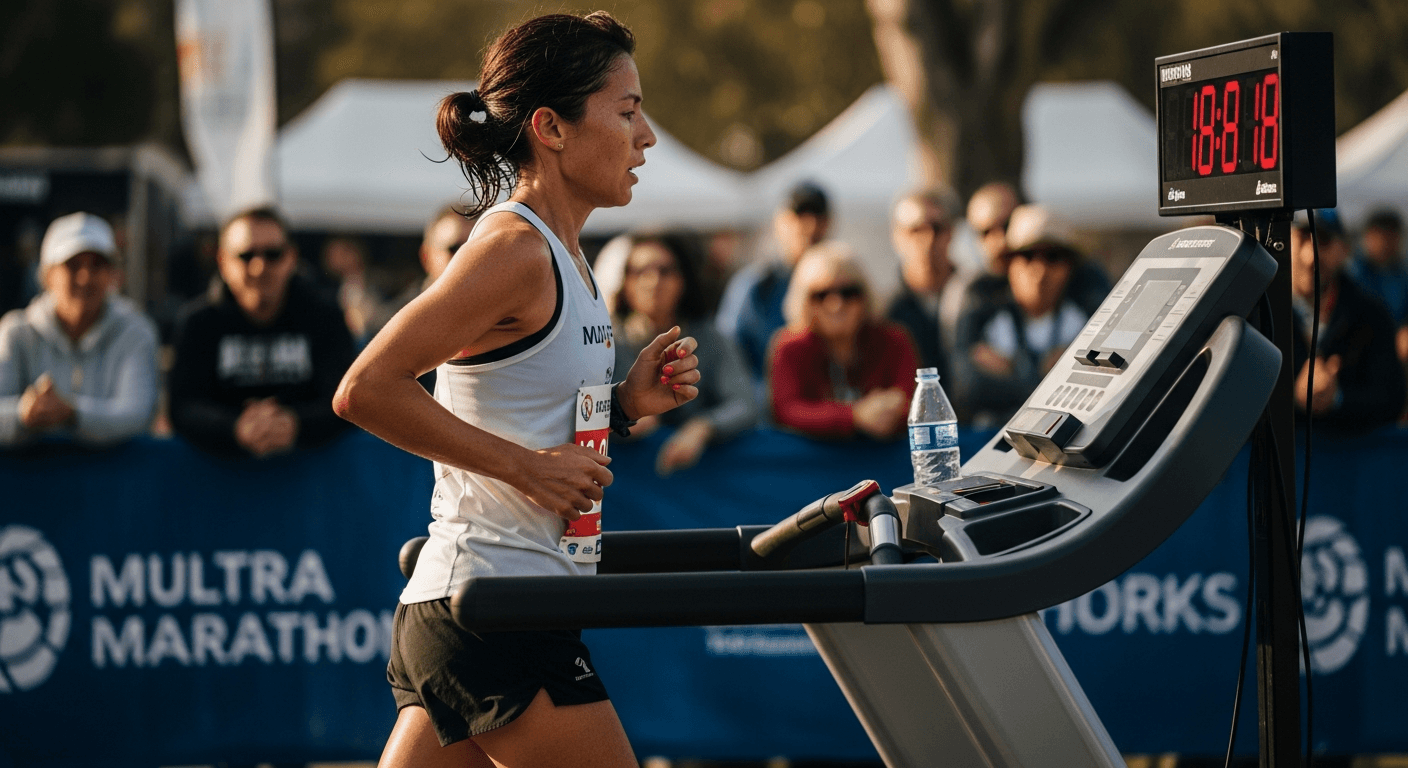
100-Mile Treadmill Record Attempt Live at Boston Marathon Expo
Most runners visiting the Boston Marathon Expo on April 18, 2026, will be picking up their race bibs, testing new shoes, and trying not to blow their legs out on the vendor floor. Ashley Paulson will be doing something considerably more demanding. The elite ultramarathoner is attempting to set the women's world record for the fastest 100-mile treadmill run, live, in front of the marathon community's largest annual gathering.
It's a bold collision of extreme endurance and mainstream running culture, and it's happening at exactly the right moment.
What Paulson Is Attempting
Running 100 miles on a treadmill is not simply a longer version of a marathon. It's a physiological and psychological undertaking that demands meticulous pacing, nutrition strategy, and a tolerance for monotony that borders on meditative. Elite ultramarathoners train for years to handle the compounding fatigue that sets in well past mile 50, when the body begins negotiating with the mind over whether to continue at all.
Paulson is targeting the women's world record for the distance, which means she's not just trying to finish. She's racing against the clock with every mile logged. The attempt will be conducted entirely on a treadmill, in a public space, surrounded by thousands of recreational and competitive runners who will themselves be preparing for 26.2 miles the following Monday.
The contrast is intentional. Standing next to a runner toeing up to their first Boston qualifier while another athlete grinds through her 70th consecutive treadmill mile puts the spectrum of human endurance into sharp relief. That's the point.
Why the Boston Expo Makes Sense as a Venue
The Boston Marathon Expo is one of the most attended running expos in the world. Held at the Hynes Convention Center in the Back Bay, it draws tens of thousands of runners, coaches, media, and industry professionals over three days leading up to race day. If you want to put endurance athletics in front of the most engaged running audience on the planet, there is no better room to be in.
For context on what surrounds this event, Boston Marathon 2026: Everything to Know Before Race Day breaks down the full race-week experience for the 30,000-plus athletes converging on the city. This year's event also introduces a significant structural change that will affect how the entire field moves through Hopkinton. Boston Marathon 2026's New Six-Wave Start: What Runners Need to Know explains the updated format and what it means for your race-day planning.
Against that backdrop, Paulson's attempt isn't a sideshow. It's a statement about what running looks like across its full range of expression, from the front-of-pack qualifier chasing a personal best to the ultramarathoner who treats 26.2 miles as a warm-up distance.
Buzz Bomb Caffeine Company Steps In as Sponsor
Paulson is a brand ambassador for Buzz Bomb Caffeine Company, which is backing the record attempt. The sponsorship fits. Caffeine is one of the most studied and consistently effective legal performance aids in endurance sports, with research repeatedly confirming its role in reducing perceived exertion and improving sustained output over long efforts. For a 100-mile treadmill run, that science matters at a very practical level.
Buzz Bomb's involvement also signals something broader about how specialty supplement brands are positioning themselves within the running world. Rather than buying banner ads at a race finish line, they're investing in live spectacle events that generate real-time engagement and long-form content across social platforms. A record attempt that runs for 14 to 20-plus hours creates sustained media attention that a 30-second booth interaction simply cannot replicate.
It's a savvy play, and you're likely to see more brands follow this model as the line between endurance sport, content creation, and live entertainment continues to blur.
The Broader Shift: Ultra-Endurance Meets the Mainstream
What's happening at the Boston Expo reflects a genuine cultural shift in how endurance sport is consumed and celebrated. Ultramarathon participation has grown steadily over the past decade. Is Trail Running Actually Growing? Here's What the Data Says examines the numbers behind that expansion, and the trend lines are consistent: more runners are pushing beyond the marathon distance, and more mainstream audiences are paying attention to them when they do.
Part of this is driven by social media and long-form content, where documented suffering tends to perform exceptionally well. Part of it is structural, as traditional marathon participation has plateaued in several markets while ultra events continue to attract new entrants. And part of it is simply that the stories available at 100 miles are different in kind from those available at 26.2. The physical and mental terrain is richer, stranger, and harder to look away from.
Staging a 100-mile record attempt at the expo rather than in an isolated venue strips away the remoteness that typically insulates ultra events from general audiences. You don't need to drive to a mountain trailhead or stay up until 3 a.m. tracking a tracker dot on a race website. You walk past the treadmill on your way to the Asics booth and suddenly you're watching someone on hour 16 of their run. That accessibility matters for growing the sport's visibility.
What It Takes to Run 100 Miles on a Treadmill
Treadmill ultras carry their own specific demands that differ from road or trail versions of the same distances. The surface consistency removes the terrain variability that typically helps distribute muscular load across a run. On a treadmill, the same muscles absorb impact in nearly the same pattern for every single mile, which accelerates localized fatigue and increases injury risk in the later stages.
Athletes attempting treadmill records typically vary their speed and incline deliberately throughout the effort, not just to manage pace strategy but to shift load patterns across muscle groups. Nutrition and hydration logistics are also simplified in a treadmill setting compared to trail, but cognitive engagement becomes a more significant variable when there's no changing scenery to anchor attention.
Sleep deprivation compounds everything. Depending on Paulson's target pace, the attempt could extend well beyond 16 hours, pushing into territory where motor control, decision-making, and emotional regulation all begin to degrade in measurable ways. Managing those variables is as much a part of the performance as the running itself.
What to Watch For During the Attempt
If you're attending the Boston Expo on April 18, here's what to keep in mind when you stop to watch:
- Pacing strategy in the first 40 miles. A record attempt lives or dies on how controlled the early effort is. Paulson going out too fast relative to her target splits is the clearest early warning sign of a difficult finish.
- Crew efficiency. The speed and organization of her support team during nutrition and hydration stops directly affects total time. Every unnecessary second off pace compounds over 100 miles.
- Miles 60 to 80. This is statistically where most 100-mile attempts encounter their deepest difficulty. Watching how an elite athlete navigates that window is genuinely instructive about human performance at its edge.
- Crowd interaction. The expo environment means Paulson will be running in front of a rotating audience of strangers for the entire effort. How that energy affects her performance is an open variable, and it cuts both ways.
Why This Matters Beyond the Record
Whether Paulson sets the record or falls short, the attempt accomplishes something that race results alone don't. It puts the act of extreme endurance in front of people who may never have considered what 100 miles of running looks like in real time.
For a sport that's actively working to expand its audience and deepen the connection between elite performance and recreational participation, that visibility is valuable. The runners picking up their bibs at the expo are already invested in the culture. Showing them what's possible at the furthest edge of that culture doesn't diminish their achievement. It extends their understanding of what the human body can do when it's trained and pushed with genuine intention.
That's the best version of what events like this can be: not spectacle for its own sake, but a window into an extreme that makes the full range of running feel more vivid and more worth pursuing.
Boston Marathon weekend already delivers that feeling in concentrated form. On April 18, Ashley Paulson and Buzz Bomb Caffeine Company are adding another dimension to it, one mile at a time.