
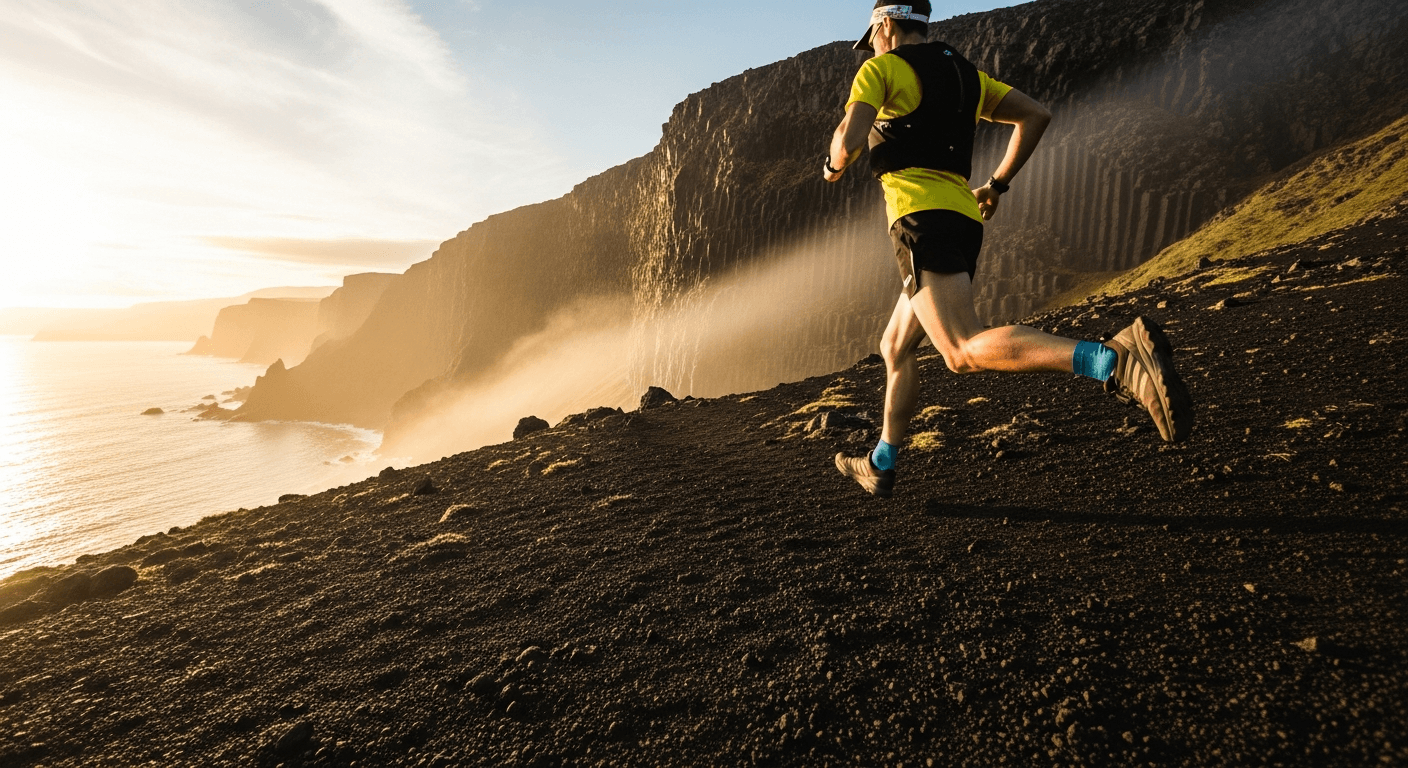
The Madeira Island Ultra-Trail has never been an easy race to crack. Carved across volcanic Atlantic terrain, it throws technical ridge lines, coastal descents, and relentless elevation at anyone bold enough to enter. This year, Canadian athletes arrived not as tourists but as genuine contenders, and the results are turning heads across the global trail running community.
Their performances at MIUT signal something broader than a single strong showing. North American trail runners are increasingly targeting marquee European races, and the podium results from Madeira suggest that ambition is now backed by real preparation and world-class fitness.
What Makes MIUT One of Europe's Toughest Tests
The Madeira Island Ultra-Trail runs across the rugged interior and coastline of Madeira, a Portuguese archipelago sitting roughly 1,000 kilometers off the coast of Morocco. The flagship 115-kilometer race packs approximately 7,400 meters of positive elevation gain into its route, combining steep basalt climbs with technical descents toward the ocean.
Madeira's terrain is unlike anything you'll find on a North American training circuit. Levada trails, ancient irrigation channels carved into cliffsides, narrow to single-track width with dramatic exposure. The volcanic rock demands precise footwork at all times. That Canadian runners navigated this environment competitively is a meaningful benchmark for any athlete with European ambitions.
The race also carries significant qualification weight in the global ultra-trail ecosystem. With the UTMB Index updating its qualifying criteria in 2026, results at MIUT carry points that matter for access to Chamonix and other prestige events. Finishing well here opens doors.
Canadian Performances That Stood Out
Canadian athletes placed competitively across multiple distances at this year's edition, with top-ten finishes in the flagship 115-kilometer race and podium-level performances in the 60-kilometer category. The depth of the Canadian contingent, rather than a single standout result, is what made the showing noteworthy.
What separates a strong MIUT finish from a lucky day is pacing discipline over the back half of the course. The race's most punishing section comes after kilometer 70, when accumulated fatigue meets the steepest technical terrain. Canadians who placed well held their form through those late kilometers, which is exactly the kind of performance that earns respect from European competitors and race directors alike.
Several Canadian finishers credited structured heat preparation in the weeks before the race. Madeira's spring climate is mild but humid, and acclimatizing beforehand makes a measurable difference. If you're targeting a European destination race, understanding how to turn heat exposure into a performance edge is not optional preparation. It's essential.
A Growing North American Presence on the European Trail Circuit
Five years ago, North American runners showing up at European ultra-trail events were largely treated as adventure tourists. That's changing fast. The 2026 season has seen a notable uptick in US and Canadian athletes registering for races like MIUT, CCC, and Transvulcania. Entry rosters that once skewed heavily European now include a consistent North American cohort.
Several factors are driving this shift. Trail running participation in Canada and the US grew sharply during the pandemic years and hasn't reversed. A generation of athletes who started running on local trails now have five or six years of base fitness and are looking for bigger goals. European destination races offer exactly that: a competitive field, a verified course, and an experience that doubles as legitimate travel.
Coaching infrastructure has also matured. The US trail coaching market, which barely existed as a formal industry a decade ago, now supports athletes preparing specifically for technical European terrain. Working with a coach who understands how MIUT's elevation profile differs from, say, a 50-miler in the Pacific Northwest is a real competitive advantage.
Nutrition strategy has kept pace with that professionalization. Long-course trail runners now approach fueling with the same seriousness as marathon elites. Understanding how protein timing affects recovery and performance isn't just for road runners chasing world records. It applies directly to athletes managing 20-plus hours of effort across volcanic terrain.
What the Course Profile Demands From Athletes
To understand why a top Canadian finish at MIUT carries weight, you need to understand what the course actually asks of you. It's not a runnable race in the traditional sense. The elevation profile is brutal even by ultra-trail standards, and the terrain underfoot is loose, wet in sections, and technically demanding throughout.
The coastal descents are deceptive. They look like relief on the elevation chart but require quad strength and balance that fatigued legs struggle to deliver. Athletes who blow up their quads on the descents in the first 40 kilometers pay for it in the final third. Managing effort across terrain this varied takes both experience and a well-structured taper.
- Total distance (flagship): 115 kilometers
- Elevation gain: approximately 7,400 meters positive
- Terrain type: volcanic basalt, levada trails, coastal paths, ridge line technical
- Cutoff time: 36 hours
- UTMB Index points: qualifying race for major ultras including UTMB
Gut health is a non-trivial issue at this distance. At 20-plus hours of racing, most athletes will experience some degree of gastrointestinal stress. Knowing what your gut can handle, and training it systematically in the months before the race, is as important as your long runs. What actually works for athletic gut health is worth understanding before you're at hour 15 and your fueling strategy is falling apart.
What This Means for North American Trail Runners in 2026
The Canadian performances at MIUT aren't a one-off. They fit into a pattern that's becoming hard to ignore. North American runners are showing up at European destination races, placing competitively, and coming home with UTMB points and hard-earned credibility. The gap between European trail running culture and North American ambition is narrowing quickly.
If you're a trail runner in Canada or the US with two or three years of consistent racing behind you, MIUT represents exactly the kind of goal that reshapes your training. It's specific enough to structure a full build around, significant enough to justify the investment, and scenic enough that finishing itself is worthwhile even if the podium stays out of reach.
Entry fees for the flagship 115-kilometer race run in the $200 to $250 range, which is competitive with comparable North American ultras of similar prestige. Factor in flights, accommodation, and race week logistics in Madeira, and a full budget for a solo trip sits somewhere around $2,500 to $3,500 depending on your base city and how far in advance you book.
Recovery after a race this demanding also deserves more planning than most athletes give it. The physiological debt from 20-plus hours on technical terrain is significant. A structured approach to the weeks after the race, rather than jumping back into training too quickly, protects the fitness you've built. A week-by-week recovery framework built for long-course efforts applies directly here, even if the race format differs from a marathon.
The Bigger Picture for Global Trail Running
MIUT's growth as a marquee event reflects a broader expansion of trail running as a global discipline. What was once a niche sport dominated by European mountain runners has become genuinely international. North American, East African, and Asia-Pacific athletes are now regular fixtures on European start lines, and the competitive depth across all these regions is rising year over year.
For Canadian athletes specifically, Madeira represents a proof of concept. The volcanic terrain, the humidity, the technical demands, none of it was a barrier when the preparation was right. That's the message coming home from this year's race, and it's the kind of result that will bring more Canadian runners to European start lines in 2027 and beyond.
Trail running's rise has also paralleled a broader shift in how endurance athletes think about their overall preparation, from nutrition protocols to recovery systems to mental performance. The sport is more sophisticated than it was even five years ago, and the Canadians who showed up at MIUT this year reflect that sophistication. They didn't just run hard. They raced smart.