
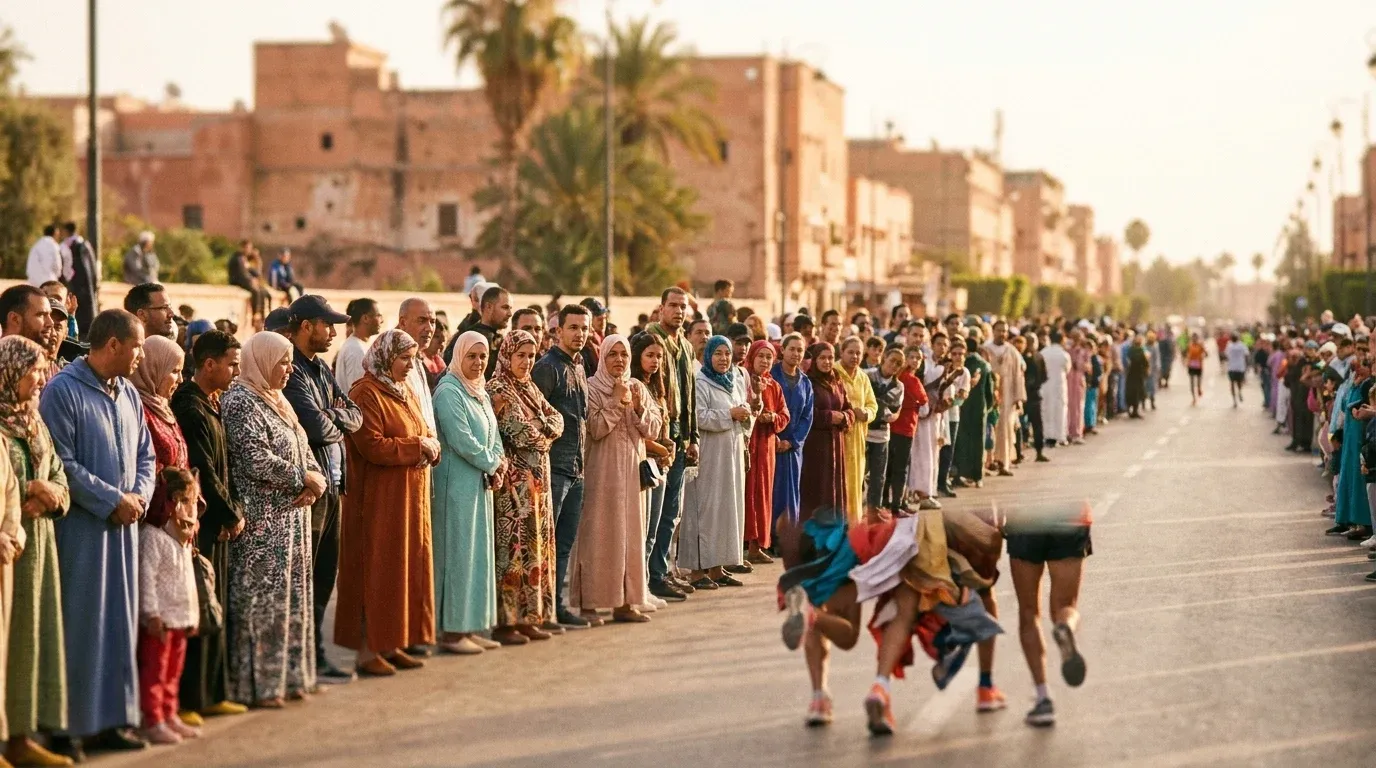
Most marathons sell themselves on course records, elite start lists, and finish-line times. Casablanca is trying something different. Under the direction of Bouchta El Fadel, the Casablanca Marathon is being deliberately repositioned as a civic event that happens to have runners in it, rather than a running event that happens to take place in a city.
It's a subtle but meaningful distinction, and it reflects one of the most interesting shifts happening in African distance running right now.
What El Fadel Is Actually Building
El Fadel has been clear in public statements about his vision: the race should function as a gathering point for the entire city, not just for the running community. That means engaging families, spectators, local businesses, schools, and neighborhoods that the course passes through. The marathon route becomes a temporary public stage, not just a measured road.
This approach treats the race weekend as a cultural calendar event. Residents who have never laced up a running shoe are meant to feel that the marathon belongs to them too. That's not marketing language. It's a structural decision that shapes everything from route planning to community programming to how the city's government and sponsors are involved.
It also reflects a practical reality. Elite-only prestige is expensive and fragile. Prize money, athlete appearance fees, and broadcast rights can consume budgets while leaving local communities largely uninvolved. A marathon that has deep roots in its city is harder to displace, easier to fund through local partnerships, and more resilient when elite performance cycles shift.
Africa's Marathon Moment
Casablanca isn't operating in isolation. Across the African continent, marathon culture is accelerating at a pace that isn't yet fully reflected in global running media coverage. Events in cities like Lagos, Nairobi, Accra, and Kigali have been growing their participation numbers by targeting recreational runners, corporate teams, and community groups rather than narrowing their focus to competitive athletes.
This isn't a compromise strategy. It's a recognition that the recreational runner market is where marathon growth actually happens. Mass-participation events with strong local identities consistently outperform elite-focused races in long-term sustainability. The data from global marathon participation trends supports this: races with robust amateur and first-timer programs retain higher year-on-year registration rates and generate more local economic activity per edition.
The Casablanca approach fits neatly into that pattern. By designing the event to welcome participants at every level, including people who might be running their first 10K as part of a marathon weekend program, the race builds a wider base. And a wider base compounds over time.
If you're curious about what motivates people to start running in the first place, the evidence around health outcomes is striking. Research consistently links regular aerobic activity to significant reductions in long-term disease risk. One analysis found that just 22 minutes of running per day can meaningfully extend life expectancy, even among people with otherwise sedentary lifestyles. That kind of data is quietly reshaping how African cities think about public health and how marathons can serve as entry points to active living.
The NYC Blueprint and What It Actually Means
To understand where Casablanca is pointing, it helps to look at what civic marathon integration looks like at scale. The New York City Marathon is the clearest example. In its 50th edition in 2026, the race raised over $100 million for charity across its participating runner fundraising networks. That figure isn't just a headline. It represents decades of deliberate community infrastructure built around a running event.
The NYC Marathon doesn't succeed primarily because it attracts the world's fastest runners. It succeeds because millions of New Yorkers feel personally connected to it. Neighborhoods compete to host the loudest cheer sections. Local schools send kids to watch. Charities build year-round engagement programs around marathon fundraising. The race is genuinely woven into the city's civic fabric in a way that no amount of elite performance alone could achieve.
That's the model El Fadel appears to be studying. Not to replicate New York, which would be neither realistic nor appropriate, but to apply the underlying logic: a marathon that a city feels it owns is a marathon that a city will protect, fund, and grow.
The London Marathon has followed a comparable path, and London 2027's designation as a British Olympic marathon trial shows how civic credibility and elite ambition can coexist when community foundations are solid. Casablanca doesn't need to choose between the two. But it makes sense to build the base first.
What Community-First Design Looks Like in Practice
A marathon that positions itself as a civic gathering requires different design decisions than a race optimized for fast times. Here's what that typically involves:
- Route selection that prioritizes visibility. Courses that pass through dense residential neighborhoods, markets, and public spaces generate organic spectator participation. People watch because the race comes to them, not because they've traveled to a finish-line grandstand.
- Multi-distance programming. Offering 5K, 10K, and half-marathon distances alongside the full marathon brings in runners at every level, including beginners who will return as full-marathon participants in later years.
- School and youth integration. Engaging local schools in race weekend programming creates the next generation of participants and embeds the event in family calendars. The long-term benefits of physical activity established in childhood are well-documented. Research shows that being physically fit as a child can reduce adult depression risk by up to 20%, which gives marathon organizers a genuinely compelling public health case for youth engagement.
- Local business activation. When restaurants, shops, and vendors along the course are incorporated into the event, rather than closed off or bypassed, the race generates economic energy that makes those businesses advocates for its return.
- Charity and fundraising structures. Building formal charity partnerships gives participants a reason to run that extends beyond personal performance. It also opens funding streams that aren't dependent on ticket sales or elite sponsorship.
The Broader Stakes for African Running
African distance running has a global reputation built almost entirely on elite performance. Kenya and Ethiopia dominate world marathon rankings. That dominance is real and remarkable. But it has also created a narrative gap: the story of recreational running culture on the African continent is almost entirely untold in international media.
Events like the Casablanca Marathon, when they succeed as civic institutions, help fill that gap. They demonstrate that African cities can host world-class mass-participation events that serve their own populations first, rather than positioning themselves primarily as showcases for global sponsors or international runners seeking destination race experiences.
That matters for how the running industry evolves on the continent. As participation grows and local running clubs expand, the infrastructure around recreational running, including coaching, gear, nutrition, and event access, will develop in response. The marathon is often the anchor around which that ecosystem forms.
It also matters for the runners themselves. Anyone who has crossed a marathon finish line knows the experience is more than physical. The recovery process alone is significant. Understanding when you can safely return to running after a marathon is a question that thousands of new finishers will be asking, and it's a sign of a maturing running culture that people are asking it at all.
What Makes Casablanca's Position Interesting
Morocco sits at a particular intersection. It's a country with deep athletic tradition, a rapidly urbanizing population, a growing middle class with disposable income and health awareness, and a government that has invested significantly in sports infrastructure ahead of co-hosting the 2030 FIFA World Cup. Casablanca, as the country's economic capital, is the natural stage for a flagship mass-participation event.
El Fadel's vision for the marathon aligns with those broader forces. A race that draws tens of thousands of participants from across Morocco and the wider region, that activates city neighborhoods, and that generates measurable public health and economic outcomes is a race that fits neatly into the kind of soft-power and civic development story that Moroccan institutions are actively telling right now.
That convergence of local ambition, continental running growth, and civic design thinking makes Casablanca worth watching. Not because it will become the next New York overnight, but because it's applying the right framework at the right moment. The marathons that grow into institutions don't do it by chasing prestige. They do it by making themselves genuinely useful to the places they call home.
That's the race El Fadel is building. And if the broader African marathon trajectory holds, he won't be the only one.