
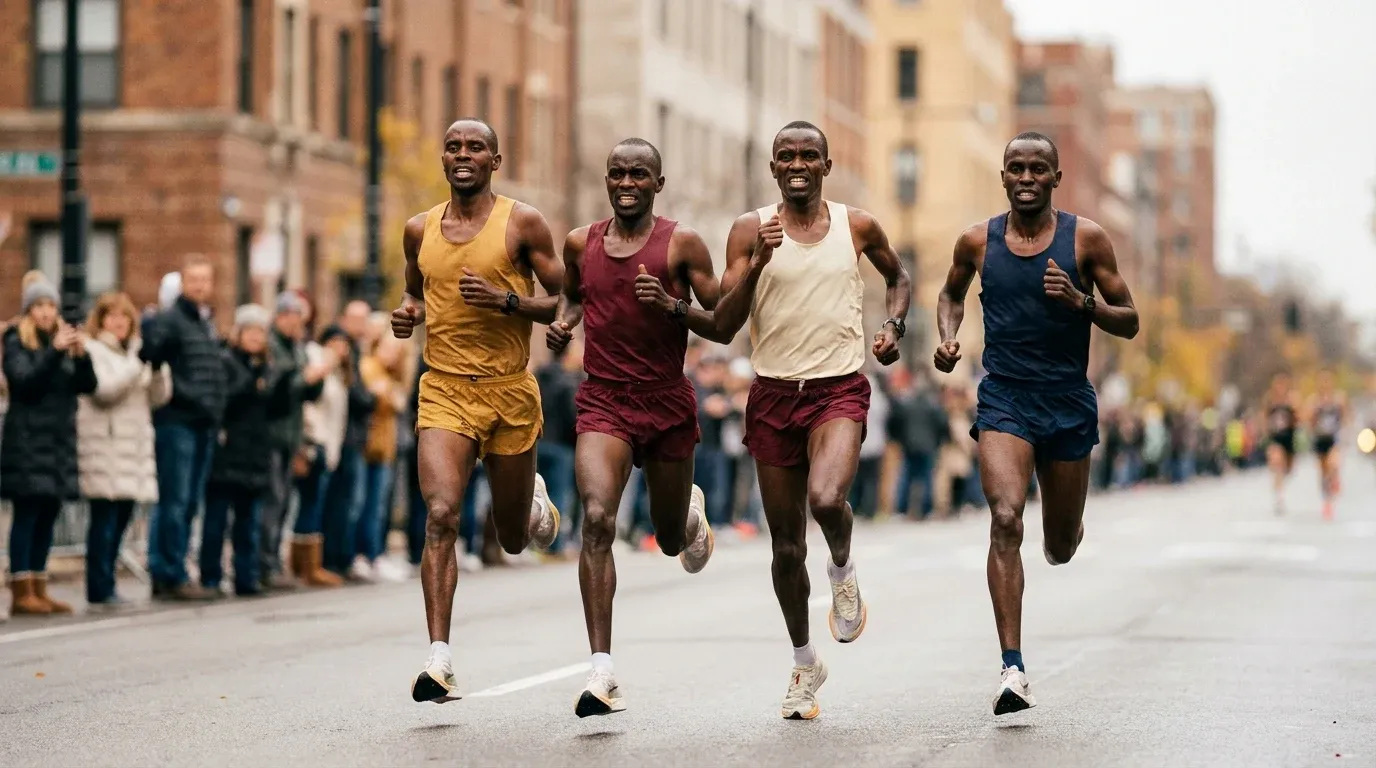
Berlin is done. The drama has settled, the records have been debated, and the running world is already looking west. Chicago is next on the World Marathon Majors calendar, and this year's race carries more weight than most. After one of the more emotionally charged Berlin Marathons in recent memory, the elite fields heading to Grant Park have something to prove.
Whether you're traveling to race, watching from home, or just tracking the fall marathon season, here's what matters this weekend.
The Berlin Hangover and What It Means for Chicago
It's hard to overstate how much Berlin shaped the conversation heading into October. Tigst Assefa crossed the finish line for a third consecutive win despite what turned out to be a serious physical setback. If you haven't followed the full story, the details are striking. Assefa wins Berlin with a torn Achilles tendon is a sentence that would sound implausible in fiction, but it happened on the road through the Brandenburg Gate.
That performance raises the question every serious fan is now asking: who fills the void if Assefa doesn't line up in Chicago, and who rises to the level of that narrative on a different course? Chicago doesn't need Berlin's drama to be compelling. But this year, Berlin has raised the bar for what counts as a memorable performance.
For elites who raced Berlin and came close but didn't break through, Chicago offers a second shot within the same fall window. That's the unique structure of the World Marathon Majors fall cycle. Berlin typically falls in late September, Chicago in mid-October, giving athletes roughly three weeks. Some use that gap to target a second peak effort. Others treat Chicago as a reset after a conservative Berlin. Either way, the start list tends to include motivated, experienced athletes who know exactly what they want from the day.
Why Chicago Is Built for Fast Times
The Chicago course is one of the flattest in major marathon racing. It loops through the city's neighborhoods. It starts and finishes in Grant Park. Elevation change is minimal throughout. That's not an accident. It's one of the reasons the race has produced so many personal bests at every level, from the elite front to the back half of the pack.
October weather in Chicago is historically cooperative for distance running. Average temperatures on race morning typically sit between 40°F and 55°F, which lands in the optimal range for marathon performance. Wind can be a factor depending on the year, but the urban course design offers some protection. The conditions this weekend look favorable again, with forecasts suggesting cool, dry air and manageable wind speeds at the time of writing.
If you're curious how the Achilles tendon situation playing out in Berlin factors into injury risk and race-day decision-making at the elite level, the physiological context is worth understanding. What every runner needs to know about Achilles tendon rupture breaks down the recovery timeline and the structural demands that make this kind of injury so significant for high-mileage athletes.
The Elite Fields: Who to Watch
Chicago historically attracts a different profile of elite than Boston or New York. It's a time-chaser's course. Athletes who come here are often targeting a specific time, not just a placement. That makes the race strategically different. Pacing groups, tactics, and the willingness to go out hard all reflect that orientation toward the clock.
On the women's side, the conversation starts with who is willing to take the front early and commit to aggressive splits. The flat profile rewards that approach more than a hilly course would. Given what happened in Berlin, there's also a story around depth. Several women who have run sub-2:18 in the past two seasons have the fitness to contend, and Chicago's course suits that range well.
On the men's side, the watch list includes athletes coming off strong half-marathon performances in September and those who raced conservatively at Berlin or skipped it entirely to peak specifically for Chicago. The men's course record has stood under pressure for a few years now. Whether this weekend produces another attempt at historic territory depends heavily on how the early pacing unfolds and whether the lead pack stays together past the halfway point.
For context on how the broader global running scene is evolving as races like Chicago continue to attract international elites, the global running boom on display at Life 2026 captures how participant interest and elite investment are growing in parallel.
Mass Participation: 40,000 Finishers and Counting
Chicago is not just an elite race. It's one of the largest running events on earth. The field regularly exceeds 40,000 finishers, drawn from dozens of countries. The international participation has grown steadily over the past several years, with runners from Europe, Asia, South America, and Australia representing a meaningful share of the field alongside North American participants.
That scale creates a race-day experience unlike almost anything else in the sport. The neighborhood sections of the course double as a tour through Chicago's distinct communities. Pilsen, Chinatown, Lincoln Park, and the South Loop each bring their own crowd energy. If you've run Chicago before, you know the crowd support doesn't thin out the way it does on some other big-city courses. It holds through mile 20, which matters when your legs don't.
The lottery system reflects that demand. Entry into the 2026 race required either a guaranteed entry time standard, charity fundraising, or a lottery draw that saw application numbers well into the six figures. That kind of interest sustains itself because the race consistently delivers on its promises: fast conditions, strong organization, and a finish line in one of the most recognizable urban parks in the world.
For runners thinking about destination races beyond the Majors, the debut of the Avignon Marathon in 2026 is worth a look as the international calendar continues to expand with new options for travel-focused runners.
What the Fall Season Needs From Chicago
The fall marathon season carries weight beyond individual results. World Marathon Majors points, national team qualifying standards, and sponsor visibility all converge in October. Chicago is where the season's story often gets its clearest chapter.
After Berlin produced its headline moments, Chicago needs to hold its own as a sporting event. The conditions are there. The fields are credentialed. What remains is the unpredictable human element that makes marathon racing worth watching in the first place.
Elite athletes preparing for races at this level pay close attention to recovery nutrition and supplementation in the final weeks before competition. Research into compounds like urolithin A, derived from pomegranate, has drawn interest for its potential role in mitochondrial function and muscular endurance. What new research found about urolithin A and heart function is relevant context for anyone thinking seriously about performance-level recovery support.
It's also worth noting that recovery windows between races like Berlin and Chicago are brutally short by most training standards. Three weeks is not enough for full physiological recovery from a hard marathon effort. Athletes who raced Berlin and are toeing the line in Chicago this weekend have made a calculated decision. Some will be fresher than their Berlin time suggests. Others will be carrying more fatigue than their confidence implies.
How to Follow the Race This Weekend
Coverage of the Chicago Marathon 2026 will be available through the Bank of America Chicago Marathon's official broadcast partners, including live streaming options for international viewers. The elite wave starts early in the morning local time, with lead runners typically finishing before the bulk of the mass field reaches the halfway point.
If you're on the course, the spectator experience is worth planning in advance. Crowd access varies by section, and some of the loudest neighborhoods require arriving early to secure a good position. The finish area in Grant Park fills quickly. The race's app provides live tracking for individual runners, which is the most practical tool if you're following specific athletes or friends in the field.
Chicago has earned its reputation as one of the best-organized marathons in the world. This weekend, it gets its chance to close the fall season's opening act on its own terms.