
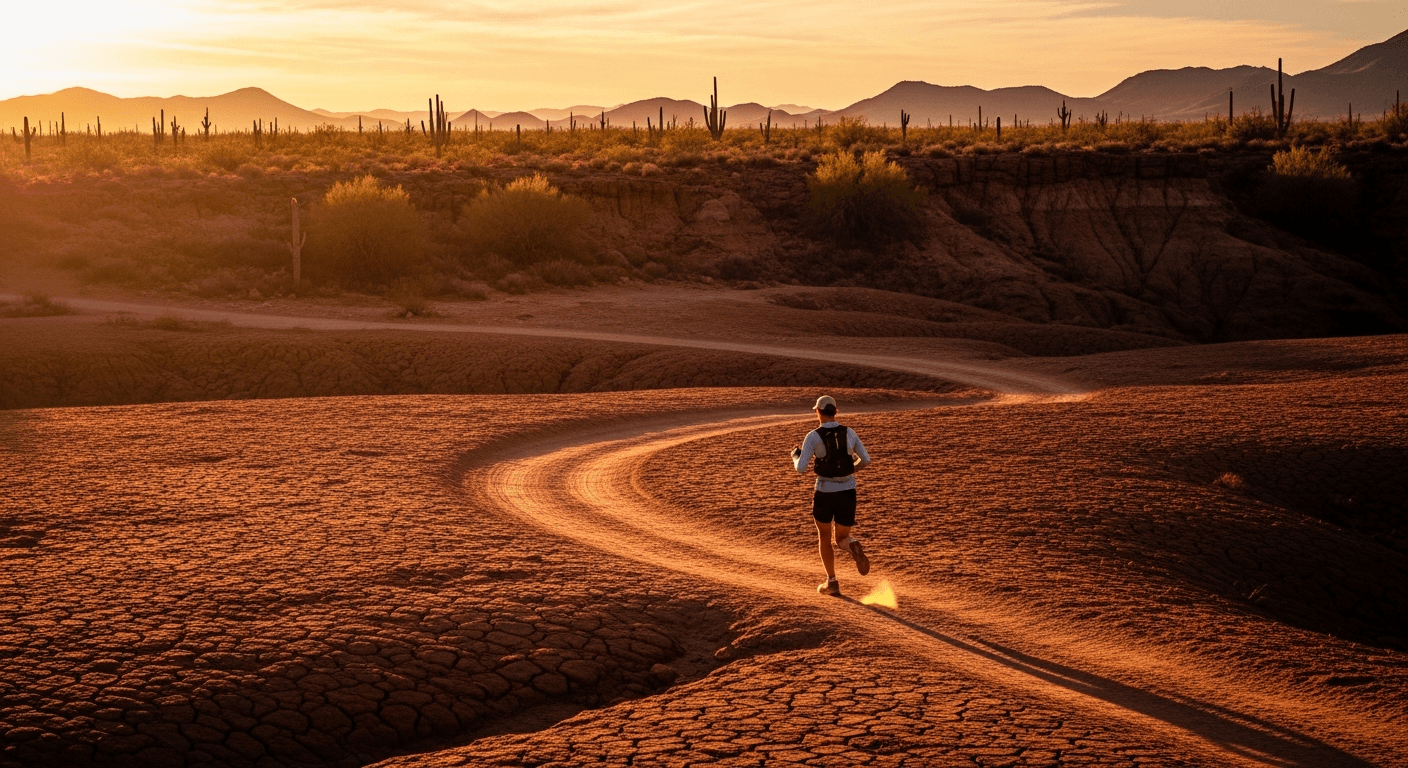
If you follow ultra running seriously, the Cocodona 250 needs no long introduction. It's roughly 250 miles of Arizona desert terrain, run point-to-point through some of the most unforgiving landscape in North America. The 2026 edition is shaping up to be one of the most competitive and closely watched in the race's short but already storied history.
Here's what you need to understand before the start gun fires.
What the Cocodona 250 Actually Is
The Cocodona 250 starts in Black Canyon City, Arizona, and finishes in Flagstaff. That's a point-to-point route covering approximately 250 miles with around 40,000 feet of elevation gain, winding through saguaro cactus corridors, exposed ridgelines, and high desert singletrack. It's one of the longest point-to-point ultras on the North American calendar, and unlike many multi-day formats, it's run continuously. No staged cutoffs that let you reset. You manage your own sleep, your own pacing, your own survival.
The course passes through multiple ecosystems, from low desert around 2,000 feet to ponderosa pine forests near Flagstaff at roughly 7,000 feet. That elevation swing alone creates enormous logistical and physiological complexity for competitors. Add April heat on the lower sections, potential cold at elevation overnight, and the race becomes a legitimate stress test on every system in your body.
The 2026 Field: Who's Worth Watching
The 2026 edition has drawn a deep field across both the men's and women's divisions. The race has historically attracted specialists in multi-day formats alongside crossover athletes from 100-mile backgrounds looking to push into longer distances. That crossover trend is accelerating, partly driven by the broader boom in trail running participation worldwide over the last several years.
On the men's side, expect contenders who combine disciplined pacing with strong heat adaptation. Cocodona rewards runners who respect the early miles. Several athletes with strong Western States and Leadville pedigrees have entered, bringing a level of 100-mile credibility that will be tested by the additional 150 miles the Cocodona demands beyond that familiar distance.
The women's field is particularly compelling in 2026. The race has produced some of its most dramatic finishes in the women's division, where experience in managing multi-day sleep schedules and nutrition logistics often outweighs raw speed in the early going. Athletes with backgrounds in multi-day adventure racing have historically performed well here, and several names in the 2026 field fit that profile. For a closer look at one of the sport's rising international names heading into a big race year, the profile of Azara Garcia's signing with Kailas and what it means for trail running offers useful context on how the global elite landscape is shifting.
The Three Core Challenges
Every ultra has its defining difficulty. Cocodona has three that stack on top of each other in ways that make the race genuinely brutal.
Heat Management
The lower desert sections in April can hit temperatures well above 90°F during the day. For runners already 36 or 48 hours into the race when these hot stretches arrive, the physiological cost is compounded. Experienced competitors pre-hydrate aggressively, use ice bandanas, and schedule their movement to minimize exposure during peak afternoon heat. Sweat rate studies in endurance athletes suggest that even modest dehydration of 2 percent body weight can measurably impair performance, and in a 250-mile race, that margin matters enormously.
Sleep Deprivation Strategy
This is where Cocodona separates itself from single-day ultras. Most finishers take between four and six days to complete the course. That means you're navigating three to five nights of sleep management. The strategy varies. Some runners take planned 90-minute sleep blocks at crew points. Others push to hallucination onset and take shorter emergency naps on trail. Neither approach is universally superior. What's consistent among finishers is intentionality. Those who wing their sleep strategy rarely make it to Flagstaff.
Technical Terrain Over Multiple Days
The Cocodona course includes significant sections of technical desert singletrack that demand genuine foot placement focus. Running technical trail on fresh legs is one thing. Running it on day four, sleep-deprived, with feet that have covered 180 miles, is a fundamentally different cognitive and physical task. Falls and ankle injuries are a meaningful attrition factor. The 2025 edition saw a finish rate well below 60 percent, consistent with prior years.
Nutrition at 250 Miles: A Different Calculation
Fueling a 250-mile effort is not a scaled-up version of fueling a 100-miler. Gut issues that are manageable over 24 hours become race-ending over 100-plus hours. The most successful Cocodona runners cycle between real food at crew points and portable calories on trail, giving the gut variety and reducing the nausea that comes from relying on gels and chews across multiple days.
Sodium strategy is equally critical in the desert heat. Hyponatremia risk is real when runners over-hydrate without matching electrolyte intake. Caloric needs during sustained multi-day efforts are estimated to run between 5,000 and 8,000 calories per day depending on conditions and individual metabolism. Practical guidance on how to structure fuel across extended trail efforts is covered in detail in the Trail Running Nutrition in 2026: The Complete Practical Guide, which is worth reading before you set your own crew strategy.
Recovery between aid stations also involves considering what's actually going into your body at the ingredient level. With a race this long, you can't afford to experiment with supplements mid-race. The new app that scores supplement ingredient credibility in real time is one tool that's gaining traction among ultra runners who want confidence in what they're carrying on course.
Why Cocodona Is Growing in Significance
The Cocodona 250 is relatively young by ultra running standards. The race launched in 2021 and has built its reputation quickly, largely because the format is extreme enough to be genuinely compelling even to people who don't run. The 250-mile distance with no mandatory stages sits in a category occupied by very few events globally, which gives it immediate standing in any serious conversation about endurance sport.
It's also growing at exactly the right moment. Trail running participation has surged over the past five years. Trail race registrations in the US have increased substantially since 2020 across all distances, and interest in the longer end of the distance spectrum has grown disproportionately. Platforms like YouTube and podcasts dedicated to ultra running have brought events like Cocodona to audiences who would never have encountered them a decade ago. That visibility matters for sponsorship, for prize money, and for the quality of field it attracts.
The race also benefits from its location. Arizona's outdoor recreation infrastructure is strong. Crew access points are generally well-organized. The start and finish cities are accessible by major airports. For international runners looking at North American 250-milers, the logistics are manageable in a way that some remote ultras are not.
What It Takes to Finish
You don't need to be an elite runner to attempt Cocodona. The race has entry qualifications, but the cutoff times are generous enough that experienced ultra runners in the 100-mile range can legitimately target a finish. What you do need is multi-day experience, a crew that understands the logistics of a 250-mile race, and a willingness to reframe what suffering means to you.
Training for an event of this length requires a different approach than standard ultra preparation. Long back-to-back runs are essential. So is heat acclimation if you're coming from a colder climate. Sleep deprivation training, deliberately running fatigued, is something more Cocodona-specific coaches recommend integrating in the final eight to twelve weeks before race day.
Cross-training for structural durability is worth considering too. Runners who've built solid strength foundations tend to hold their form better in the final hundred miles, reducing injury risk when fatigue peaks. The principles behind balancing cardio and strength training apply directly here, even if the race format is nothing like HYROX. The underlying physiology of maintaining output under cumulative fatigue is the same.
The Bottom Line on 2026
Cocodona 250 in 2026 is worth your attention whether you're a competitor, a fan of ultra running, or someone trying to understand where the outer edges of human endurance performance actually sit. The field is strong. The course is uncompromising. And the race format forces runners into decisions that no training run can fully simulate.
For those tracking the broader ultra and trail landscape heading into 2026, it's one of the clearest signals of where the sport is going. Longer, harder, and increasingly competitive at every level of the field. That's not a trend that's slowing down.