
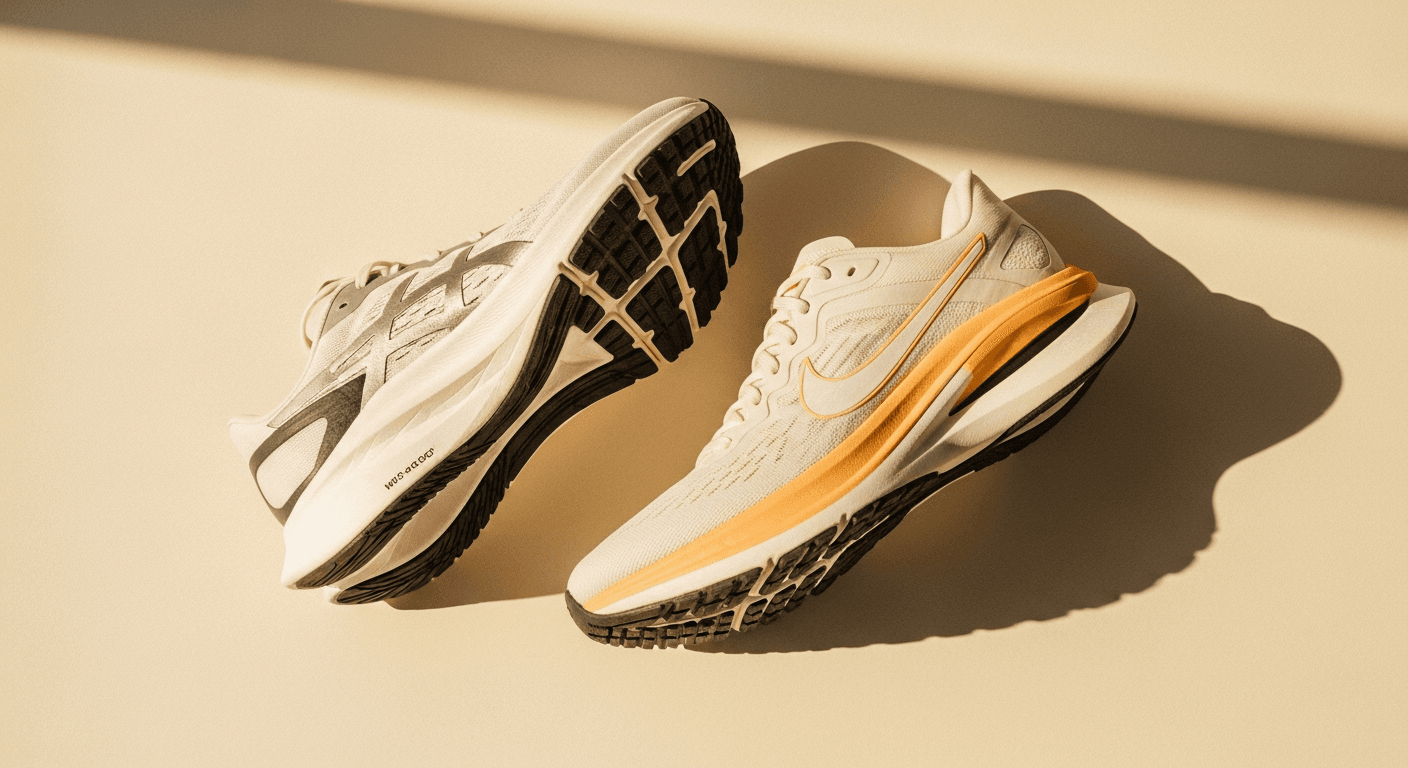
The running shoe market has never been more exciting or more overwhelming. Brooks just posted its strongest sales quarter on record. Nike, Adidas, ASICS, and a dozen challenger brands are all releasing carbon-plated updates at a pace that would have seemed absurd five years ago. And the price ceiling for performance footwear keeps climbing, with elite racing shoes now regularly sitting above $250.
Here's the good news: you don't need to follow every launch to make a smart choice. The framework for picking the right shoe hasn't changed. What's changed is how much technology is now available at every price point, and how much better the tools are for matching that technology to your actual body and training habits.
The Carbon-Plated Revolution Has Hit Every Price Point
Three years ago, carbon-fiber plates were the exclusive territory of $200-plus race shoes. That's no longer true. In 2026, you can find carbon-plated options from reputable brands starting around $130, and the foam technology that surrounds those plates has gotten meaningfully better at every tier.
What that means practically: a runner who wouldn't have considered a carbon shoe for a local 10K can now use one without breaking the bank. The stiffness and energy return that used to be reserved for Boston qualifiers are now accessible to weekend racers and fitness runners alike.
But here's where most buyers go wrong. Carbon-plated shoes are designed to go fast, not go often. Their stack heights, aggressive geometries, and stiffer rides make them poor choices for daily training. Using a super shoe for every run increases injury risk, accelerates foam breakdown, and trains your foot and calf muscles to do less work over time. The performance gains you see on race day depend partly on your muscles being fresh. If you've trained in a maximally cushioned, propulsive shoe six days a week, those muscles won't be.
The takeaway is straightforward: carbon-plated shoes belong in your rotation, not at the center of it. Daily trainers still do essential work. They build the strength, proprioception, and resilience that make race-day shoes effective in the first place.
Fit Science Has Gotten Serious
Historically, getting fitted for running shoes meant standing on a flat piece of paper and having a store employee look at your arch. That process wasn't useless, but it was limited. In 2026, it's been replaced by something considerably more sophisticated.
Several major brands now offer biomechanics-based shoe matching tools both in specialty running stores and through online platforms. These systems analyze your gait via short video clips or in-store treadmill assessments, map your foot shape in three dimensions, and factor in data like your weekly mileage, typical surface, and recent injury history. The output is a ranked shortlist of models, not a single prescription.
ASICS has expanded its digital fit tools significantly across its North American retail partners. Brooks has built biomechanics assessments into its in-store experience at key specialty retailers across the US and UK. New Balance has pushed similar technology into its direct-to-consumer channels. The tools aren't perfect, but they're substantially better than intuition alone.
If you're shopping online, most of these platforms now let you upload a short video of yourself running and receive a fit recommendation within minutes. It's not a replacement for a proper in-person assessment, but it's a genuine upgrade over guessing your pronation type from a wet footprint.
One thing to keep in mind: these tools are designed to match you with a shoe category, not necessarily the newest or most expensive model within that category. A gait analysis that points you toward a stability trainer is pointing you there for a reason. Don't override it because a carbon shoe looks faster on paper.
Training Volume and Surface Type Still Trump Everything Else
No fit tool, no brand reputation, and no price point matters more than answering two questions honestly: how much are you running, and where are you running?
If you're running less than 20 miles per week on roads, almost any well-fitted shoe from a reputable brand in the $110 to $160 range will serve you well. You don't need maximum cushioning, and you probably don't need a carbon plate. A versatile daily trainer with moderate stack height and a responsive foam will hold up fine, protect your joints, and give you enough feedback to develop as a runner.
If you're running 40-plus miles per week, the equation changes. Higher mileage runners need shoes that retain their cushioning properties over hundreds of miles, which typically means spending more on quality foam compounds. The cheapest shoes often use foam that degrades fast. What feels cushioned in the store feels flat after 200 miles. At higher volumes, it also makes sense to rotate two or three pairs with different characteristics, letting each one decompress fully between runs.
Surface type is equally decisive. Trail running places completely different demands on a shoe than road running. You need grip, lateral stability, and protection from rocks and roots. A road shoe on technical trail is not just a performance compromise; it's a safety issue. Trail shoe categories have also expanded in 2026, with more brands offering distinct shoes for soft terrain, hardpack, and mixed-surface running. Match the shoe to the ground you actually run on, not the ground you aspire to run on.
For runners tackling events like ultra-distance races, surface specificity becomes even more critical. If you're interested in how elite athletes handle the surface and footwear demands of extreme events, Cocodona 250 2026: What You Need to Know breaks down how top competitors are approaching gear selection for one of the toughest courses in North America.
What the Sub-2 Era Means for Recreational Runners
The barrier-breaking performances at the 2026 London Marathon sent a clear message: elite footwear technology has reached a new ceiling. Three athletes finishing a marathon under two hours in a single race is the kind of result that filters down through the market within months. Brands accelerate their innovation timelines, retail prices on last-season elite shoes drop, and recreational runners end up with access to genuine performance technology faster than ever.
But there's a trap here that's worth naming. Watching historic performances at the front of the pack can make even sensible runners reach for shoes that don't match their training reality. Three Sub-2 Marathons at London: What It Actually Means for You makes a useful point: the shoe is a fraction of the performance equation. The training, the volume, the consistency, and the recovery all carry more weight than the carbon plate underfoot.
That doesn't mean you shouldn't use the best available shoe for race day. It means you should use it strategically, as a finishing tool on a foundation built by smarter daily training choices.
A Practical Buying Framework for 2026
Here's a simplified decision process you can use regardless of your level:
- Define your primary use case. Is this shoe for daily training, long runs, speed work, racing, or trail? A shoe that tries to do everything usually does nothing particularly well.
- Audit your weekly volume. Under 20 miles per week: prioritize fit and comfort in the $110-$160 range. Over 40 miles per week: invest in durable foam and consider a rotation of two to three pairs.
- Match the surface. Road, trail, and track each have distinct shoe categories. Don't compromise on this point.
- Use the fitting tools available to you. If a specialty running store near you offers a treadmill gait assessment, use it. If you're buying online, use the brand's fit platform before defaulting to your usual size.
- Reserve carbon plates for racing or targeted speed sessions. A super shoe worn twice a week for key workouts and races is an asset. A super shoe worn every day is an expensive mistake.
- Replace on miles, not months. Most running shoes are designed to last between 300 and 500 miles depending on foam quality and your body weight. Track your mileage. Running on a dead shoe is one of the most common causes of preventable injury.
Recovery and Support Matter Too
Shoe selection doesn't exist in isolation. How well you recover between runs affects how your feet and lower legs respond to any shoe. Runners who underinvest in nutrition or sleep consistently report more discomfort and more injury, regardless of what's on their feet.
If you're training seriously and want to support your performance from the ground up, it's worth looking at the full picture. How to Use Summer Heat to Run Faster in the Fall covers how smart training in warmer months builds the aerobic base that your fall race-day shoes will eventually express. And for runners paying attention to what fuels their training, Protein for Women: The No-BS Practical Guide is a useful reference for understanding how protein intake supports muscle repair and adaptation across training blocks.
The shoe you choose matters. But it matters most when everything else is already in place.
The Bottom Line
Choosing the right running shoe in 2026 is genuinely easier than it was five years ago, because the tools available to you are better and the technology is more accessible. It's also more confusing, because there are more options at every price point and more marketing noise to cut through.
Your best decision starts with honest answers about your training volume and your surface. It runs through a proper fit process, whether that's in-store or online. And it ends with a realistic match between shoe function and how you actually train, not how you imagine you train.
Get those three things right, and the brand on the side of the shoe matters a lot less than you'd think.