
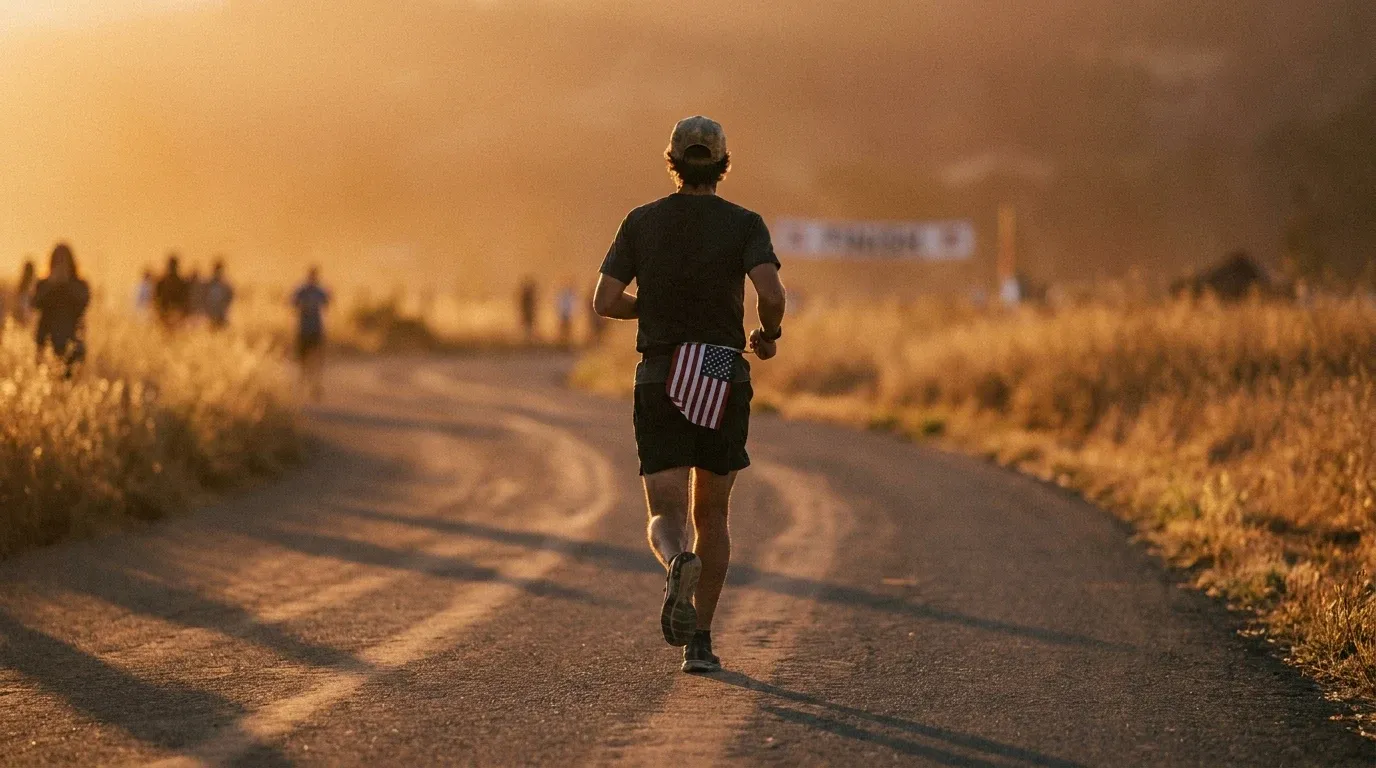
Two gold medals. One country. A result that few in the ultrarunning world saw coming with this kind of authority. At the 2026 IAU 100K World Championships, Courtney Olsen and Charlie Lawrence both stood on the top step of the podium for the United States, delivering a sweep that signals something larger than a good day on the roads.
This wasn't a fluke. It was the product of structured preparation, disciplined pacing, and a growing national infrastructure around ultra endurance running that's finally showing up where it counts most: at the world level.
What the IAU 100K Worlds Actually Is
If you're not deep in the ultrarunning world, you might not know the IAU 100K World Championships by name. You should. Organized by World Athletics and the International Association of Ultrarunners, the event is one of the most technically demanding team and individual championships in distance running. Athletes compete as national representatives, running 100 kilometers on a certified road course, with full timing, team scoring, and official world rankings on the line.
Unlike trail ultras, where terrain variation can mask fitness gaps, the IAU 100K is brutally flat and honest. There's nowhere to hide. The clock is the only judge, and it doesn't care about your training volume or your Instagram splits. What matters is whether your preparation translates over 62.1 miles of road at race pace, from the gun to the finish.
The event draws national teams from across Europe, Asia, and the Americas. Japan, in particular, has historically dominated the women's field. France and Germany have produced consistent podium finishes on both sides. A US double win is not something the record books have seen often, which makes what Olsen and Lawrence accomplished in 2026 worth examining in detail.
Courtney Olsen's Race: Patience as a Weapon
Olsen's winning performance was defined less by early aggression and more by exceptional discipline in the first 40 kilometers. She ran conservatively through the opening quarter, holding a pace that looked cautious against the early leaders. By kilometer 60, the field had fragmented. By kilometer 75, she was leading.
That approach reflects an understanding of the 100K distance that separates it from both the marathon and the 100-mile. In a marathon, you can push from kilometer 30 and survive on reserves. In a 100-mile, the ultra-slow opening pace protects you from mid-race collapse. The 100K sits in a harder middle ground. Go out too fast, and you blow up before you hit the halfway mark. Go out too slow, and you give away time you can't reclaim on tired legs.
Olsen's coaches have reportedly structured her build-up around polarized training, with the bulk of her weekly volume at genuinely easy effort. That approach aligns with what exercise science has consistently shown about aerobic base development: the more efficiently you can run at low intensity, the more ceiling you have at race pace. Why your easy runs are your most important runs is a concept that elite 100K racers now take as seriously as any track session.
Charlie Lawrence's Win: When Strength Meets Structure
Lawrence's performance on the men's side told a slightly different story. He's known for a background that blends high road mileage with structured strength work, an approach that's becoming more common among American ultra coaches who've watched European competitors maintain form late in races where US athletes historically faded.
His final 20 kilometers were the fastest of any male competitor in the field. That's not a fueling story. That's a training story. Late-race speed at the 100K distance comes from muscular durability built over months of consistent work, not from a gel protocol in the last hour. Lawrence's ability to negative split the back half of a world championship is the kind of result that coaches will be pulling apart for the next two years.
It's also worth noting the role of training environment. Lawrence has been vocal about working within a group setting, where consistent effort is maintained through shared accountability. Training with others makes you more consistent, and at the elite level, that consistency compounds into something that shows up at kilometer 90 of a world championship.
What the 100K Demands That Other Distances Don't
Here's what makes the 100K particularly unforgiving. The fueling window is long enough that you need a real nutrition strategy, but the pace is fast enough that your gut is under more stress than it would be in a slower 100-mile effort. You're running at roughly 80 to 85 percent of your lactate threshold for six to eight hours. Digestion slows. Absorption gets complicated.
Most elite 100K runners consume between 60 and 90 grams of carbohydrate per hour, using a mix of glucose and fructose sources to maximize intestinal uptake. Sodium replacement runs around 500 to 1,000 milligrams per hour depending on conditions and sweat rate. Get either of those wrong, and you don't just slow down. You stop.
Pacing strategy is equally non-negotiable. Research on ultra-endurance events consistently shows that athletes who run the first half within two to three percent of their goal pace perform significantly better in the final quarter than those who go out hot. Olsen's race was a textbook execution of that principle. Lawrence's was too, with the added dimension of a late surge that suggested he may have left something in the tank through the middle miles intentionally.
A Deeper Talent Pool, Not Just Two Good Days
The double win at the 2026 IAU 100K Worlds doesn't exist in a vacuum. It reflects a broader shift in how American runners and their coaches are approaching ultra distance. For years, the US ultra scene was defined largely by trail racing, with road 100K performance treated as secondary. That's changing.
A growing number of American runners are now training specifically for the IAU format, with periodized programs, altitude camps, and road-specific long run structures built around the demands of certified 100K courses. Coaching fees for elite ultra programs in the US typically run between $200 and $500 per month, and a full competition-year coaching contract can reach $4,000 to $6,000. More athletes are making that investment, and results like Olsen's and Lawrence's are part of why.
There's also a gear dimension worth acknowledging. Footwear technology has shifted the math on long-distance road performance, and the same carbon-plated advances that reshaped the marathon have filtered into the 100K. The conversation around how footwear tech defines who finishes in ultra distances is relevant here too, even on roads. Cushioning durability and forefoot responsiveness matter differently at hour seven than they do at hour two.
What This Means for the Global 100K Landscape
Japan remains a powerhouse. Their women's program in particular produces athletes with extraordinary metabolic efficiency and pacing precision. European teams, especially from Germany and the Netherlands, continue to field deep rosters. The US double win doesn't mean American runners have taken over the event. It means they've arrived as a consistent force at the top of it.
That distinction matters. A single outlier performance can happen anywhere. Two gold medals from two different athletes at the same championship, using different strategies that both worked, suggests depth. It suggests the American approach to ultra training is producing replicable results, not just isolated breakthroughs.
For runners further down the performance spectrum, the lessons from 2026 still apply. The 100K demands that you treat your aerobic base as your primary asset, your fueling as a technical skill, and your pacing as a discipline rather than a feeling. What record-breaking 100-mile performances teach us about building and executing at ultra distances carries directly into how you'd approach a 100K build, whether you're targeting a national championship or a local certified event.
What to Watch Next
The 2026 result puts pressure on the international field to respond, and they will. Japan's coaching staff will have already started dissecting Olsen's split data. European programs will look hard at Lawrence's final 20 kilometers. The IAU 100K Worlds may be entering a more competitive era than it's seen in a decade.
For American runners, the takeaway is clear. The investment is working. The structure is producing results. And the 100K distance, long undervalued in a US running culture obsessed with trail epics and hundred-milers, is now a legitimate arena where American athletes don't just compete. They win.