
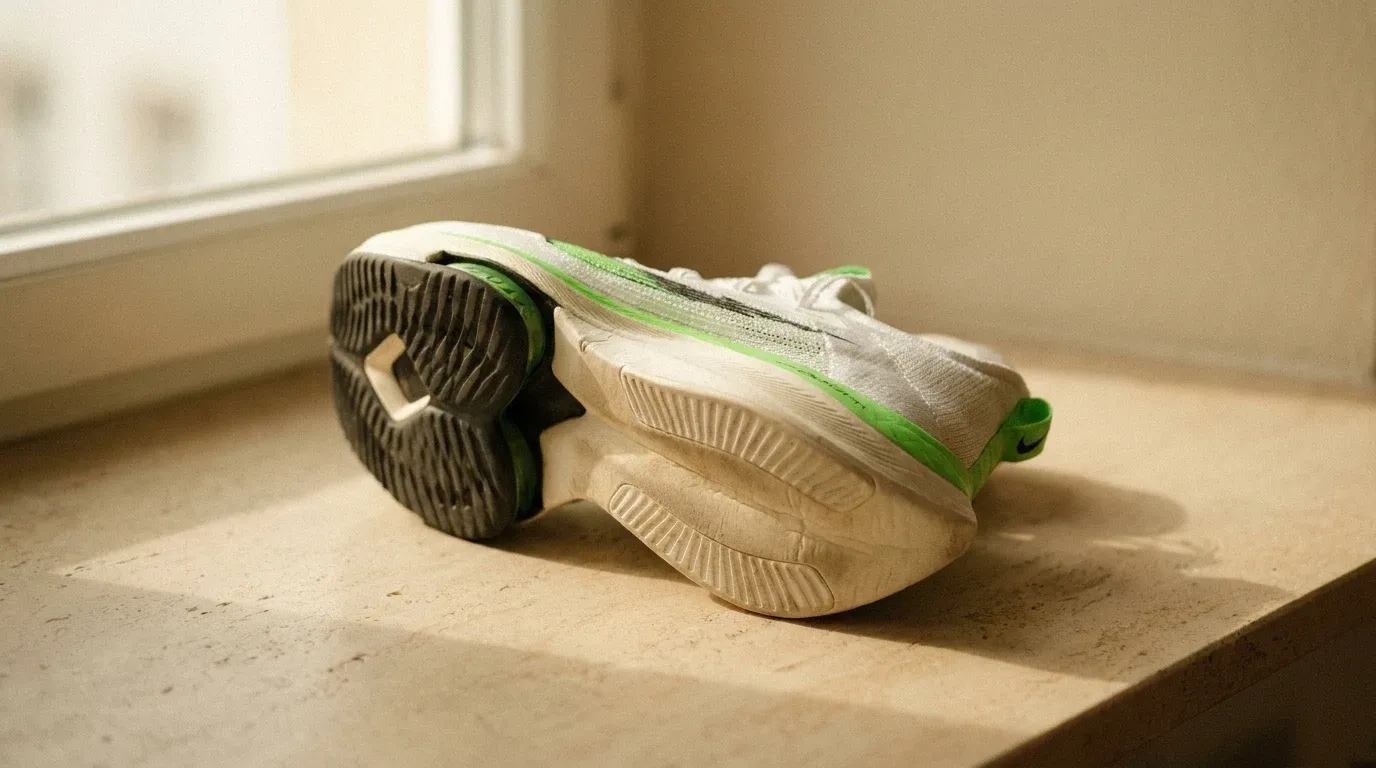
Nike made a lot of promises at its 2026 Investor Day. The Vaporfly 5 was the one that runners actually cared about.
Unveiled as part of a sweeping product reveal designed to signal a broader innovation reset, the Vaporfly 5 arrives at a moment when Nike's dominance in the super-shoe market is genuinely under pressure. Here's what the announcement tells us, what we still don't know, and why it matters if you're racing this season.
The Context: Nike's Innovation Reset
Nike has spent much of the past two years on the defensive. ASICS, Adidas, and New Balance have all closed the performance gap in the super-shoe segment, with the ASICS Metaspeed Sky Paris, Adidas Adizero Adios Pro Evo 1, and New Balance SC Elite v4 each earning serious credibility from elite and sub-elite runners alike.
Meanwhile, Nike's own product pipeline stalled. The Alphafly 3, well-regarded by many marathoners, didn't feel like the leap forward the brand needed. Reports of organizational restructuring and a slowdown in R&D investment filtered into the running press throughout 2024 and 2025.
The Investor Day announcement was partly a financial story. Nike needed to reassure shareholders that its innovation engine wasn't broken. But the product reveals, led by the Vaporfly 5, were the clearest signal that the brand is trying to reclaim its position as the definitive name in race-day footwear.
What Nike Actually Announced
Nike confirmed the Vaporfly 5 is in development and that it represents a meaningful update to the platform. The company stopped short of releasing full technical specifications, but the announcement included enough detail to give runners and analysts something to work with.
Three areas were highlighted: a revised carbon fiber plate geometry, a new foam stack formulation, and a redesigned upper. Nike described the shoe as targeting personal best performances across the 5K to marathon distance range, which is consistent with the Vaporfly's traditional positioning as the lighter, faster sibling to the Alphafly.
Pricing has not been confirmed, but the Vaporfly 4 retailed at $260. Industry expectations place the Vaporfly 5 somewhere between $260 and $285, in line with how competitors have priced their flagship updates.
Carbon Plate and Foam: What the Changes Could Mean
The carbon plate revision is arguably the most technically significant part of what Nike disclosed. Current super-shoe carbon plates are largely full-length and relatively flat in their geometry, with brands differentiating through curvature, stiffness tuning, and integration with the foam stack beneath.
Nike's indication that it has changed the plate geometry suggests a possible shift in how energy return is distributed through the gait cycle. Some competitors have experimented with multi-layer or angled plate configurations to improve forefoot energy return without increasing weight. It's plausible Nike is pursuing something similar, though nothing has been confirmed.
The foam stack update is equally consequential. Nike's ZoomX foam, a Pebax-based formulation, has been the gold standard since the original Vaporfly 4%. But Adidas's Lightstrike Pro 3.0 and New Balance's FuelCell foam variants have both been measured at competitive or superior energy return percentages in independent lab testing. If Nike has reformulated ZoomX, that's a direct response to being outperformed on paper.
Race Legal Status Under World Athletics Rules
This is the question that will determine whether the Vaporfly 5 becomes the shoe you actually see at major races, or just a well-marketed product that sits in a gray area.
World Athletics currently mandates that road running shoes worn in sanctioned competition must have a maximum stack height of 40mm and may contain no more than one rigid embedded plate or blade. Any shoe that exceeds these thresholds can't be used in record-eligible races or World Athletics-sanctioned events.
The Vaporfly 4 is race legal. The Vaporfly 5 will almost certainly be designed to meet those same standards, given Nike's commercial interest in having its flagship shoe eligible for every major marathon and track event. But until World Athletics formally approves the shoe after submission, its legal status remains technically unconfirmed.
Nike has historically been diligent about submitting shoes for approval ahead of launch. If the Vaporfly 5 hits its expected release window, formal World Athletics certification should follow standard timelines. Runners targeting qualifier races or world record attempts will want to confirm that approval before race week.
How the Vaporfly 5 Fits Into Nike's Broader Running Strategy
The Vaporfly 5 wasn't the only running product Nike flagged at Investor Day. The company also referenced updates to the Alphafly line and a renewed push into training footwear. But the Vaporfly announcement carried the most weight, because it speaks directly to competitive runners who have been quietly switching allegiances.
Sub-elite runners, the kind who finish marathons between 2:30 and 3:30 and care deeply about marginal gains, have been among the most willing to experiment with alternatives. Many have landed on the ASICS or New Balance options after finding comparable or superior performance at similar or lower price points. Getting those runners back is a commercial priority for Nike.
It's also worth noting the broader performance running landscape is expanding. Prize money structures in road and trail ultras are professionalizing rapidly, as covered in our piece on how prize money is turning ultra-running pro. More runners at more levels are treating their footwear choices with the same rigor as their training plans, which raises the stakes for every major brand release.
What You Should Watch For Before Launch
Nike has not confirmed a specific release date, but Investor Day reveals of this nature typically precede a commercial launch by three to six months. That would place the Vaporfly 5 somewhere in the second half of 2026, potentially timed to coincide with the fall marathon season in Chicago, Berlin, and New York.
Here's what to track in the lead-up to launch:
- World Athletics approval: Check the World Athletics approved shoe list once Nike submits. This is the definitive confirmation of race-legal status.
- Independent lab testing: Third-party energy return and stack height measurements will tell you more than Nike's own marketing claims. Look for peer-reviewed biomechanics studies or credible independent footwear testing once review units are available.
- Elite athlete testing results: Nike's sponsored athletes will likely debut the shoe at major races before the public launch. Early results from that cohort will be meaningful data points.
- Retail pricing: If Nike prices this above $280, it needs to justify that premium against the ASICS Metaspeed at $250 and the New Balance SC Elite v4 at $225. Value positioning will matter.
- Weight specifications: The Vaporfly line has historically been the lighter option compared to the Alphafly. Any regression in weight would be a significant concern for runners prioritizing speed over cushioning.
Should You Wait for the Vaporfly 5?
If you're racing this season and your current shoes are working, don't put your training cycle on hold waiting for a shoe that doesn't have a confirmed launch date. The Vaporfly 4 remains a competitive option, and the existing generation of super-shoes from ASICS, Adidas, and New Balance are genuinely excellent.
If you're planning for a fall 2026 goal race and you're considering a shoe upgrade, then yes, it makes sense to wait and see what the Vaporfly 5 delivers. The timing aligns reasonably well, assuming Nike hits the second half of 2026 window that most observers expect.
What the Investor Day announcement confirms is that Nike is treating the super-shoe race as a priority again, not as a legacy advantage they can coast on. For competitive runners, that's the most significant takeaway. More competition at the top of the market means better products across the board, regardless of which brand you ultimately choose.
Your race performance depends on training, nutrition, and consistency far more than footwear. But when marginal gains matter, as they do for anyone chasing a qualifying standard or a personal best, having a credible, up-to-date option from Nike back in the conversation is good news for the whole field. Speaking of fueling those marginal gains, it's worth reviewing how ultra-processed foods are quietly wrecking your recovery, because even the best shoes can't compensate for a compromised recovery stack.
Keep an eye on official channels from Nike and World Athletics over the coming months. When the technical specs and approval status are confirmed, that's when the real evaluation begins.