
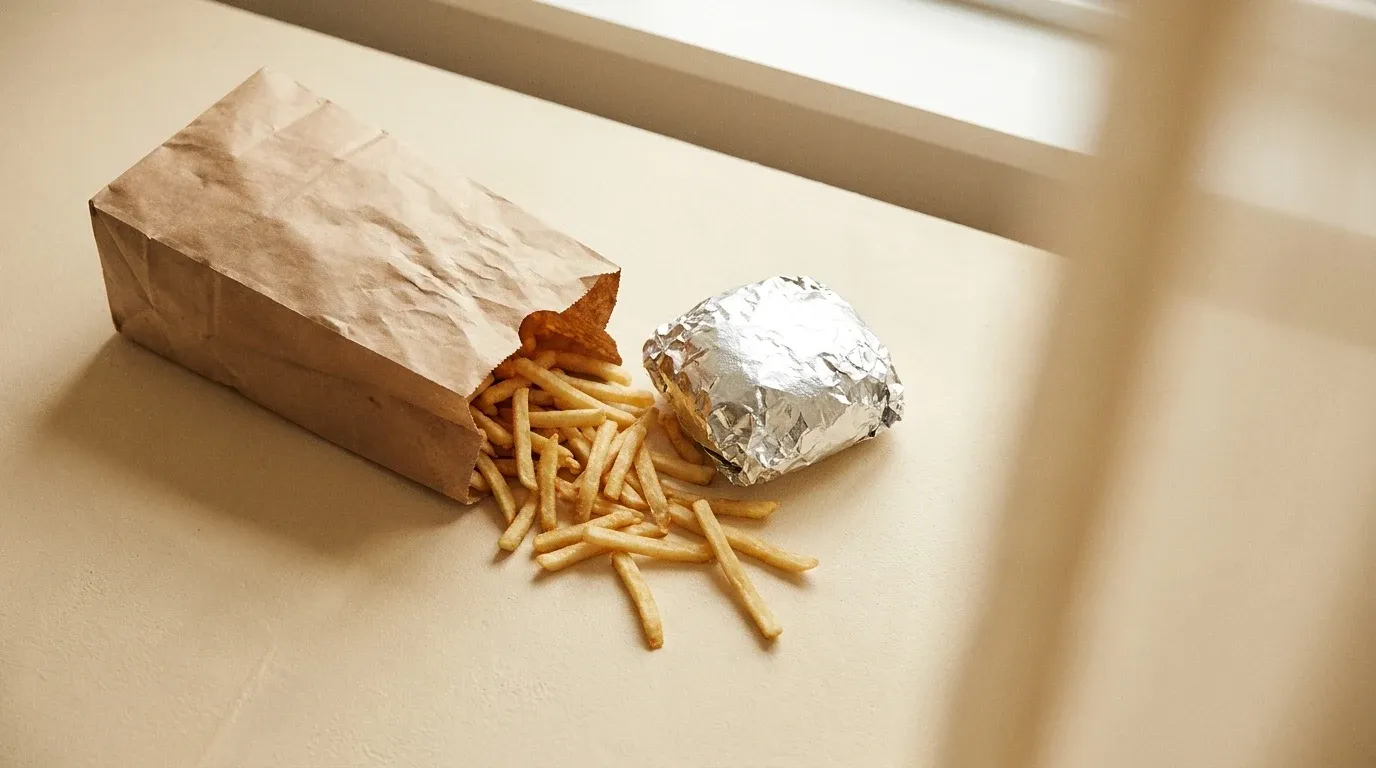
You train consistently. You show up, you push hard, and you assume that effort earns you some dietary latitude. A protein bar here, a frozen meal there, maybe a bag of chips after a long session. It's a reasonable assumption. It's also wrong.
Emerging research is drawing a sharper line between ultra-processed food (UPF) consumption and impaired recovery, not just long-term chronic disease risk. For active people, that distinction matters. The issue isn't only what you're eating in general. It's what happens inside your body in the specific window when it needs to rebuild.
The Baseline Problem: Most Athletes Are Already Eating This Way
Ultra-processed foods now account for more than 50% of daily caloric intake in several high-income countries, including the United States, the United Kingdom, Canada, and Australia. That figure comes from large-scale dietary surveillance data, and it covers the general population. But recreational athletes aren't exempt.
In fact, surveys of active adults consistently show that training frequency doesn't reliably predict diet quality. Someone running four days a week is just as likely to rely on packaged snacks, protein-fortified cereals, flavored yogurts, and fast food as someone who doesn't exercise at all. The halo effect of physical activity is real: people who work out tend to overestimate how well they eat.
Ultra-processed foods, as defined by the NOVA classification system, go well beyond junk food. They include most commercially produced breads, breakfast cereals, flavored nuts, sports drinks, protein powders with long additive lists, and meal replacement shakes. If a product contains ingredients you wouldn't find in a standard kitchen, like carrageenan, polysorbate 80, or maltodextrin in quantity, it qualifies.
What's Actually in These Foods and Why It Matters Post-Workout
The recovery window, roughly the two to four hours after training, is when your body is most sensitive to nutritional input. Muscle protein synthesis ramps up. Glycogen stores need replenishment. Inflammatory signaling triggered by exercise begins resolving. This is a tightly orchestrated process, and it depends on clean, bioavailable inputs.
Two categories of UPF additives are drawing increasing research attention: emulsifiers and refined seed oils high in omega-6 fatty acids.
Emulsifiers, which are used to extend shelf life and improve texture, include compounds like polysorbate 80, lecithin derivatives, and carboxymethylcellulose. These have been shown in animal and early human studies to disrupt the gut mucosal lining and alter microbiome composition. The concern for active people is specific: a compromised gut barrier impairs amino acid absorption. If your intestinal transport is degraded, the leucine from your post-workout meal is less effectively shuttled into muscle cells. Glycogen resynthesis, which depends on glucose uptake through a similarly sensitive absorptive process, may also be blunted.
This is not a theoretical concern. Research published in peer-reviewed gastroenterology journals has linked regular emulsifier exposure to measurable increases in intestinal permeability and shifts in microbial diversity. The microbiome's role in nutrient uptake, inflammation regulation, and even protein metabolism is now well established. For a deeper look at how gut health intersects with active aging and performance, Online Workouts Over 60: The Missing Ingredient outlines how nutrition is often the variable that separates adaptation from stagnation.
Refined Oils, Omega-6 Imbalance, and the Inflammation Loop
Refined seed oils, including soybean, sunflower, canola, and corn oils, are the dominant fat source in ultra-processed foods. They're cheap, shelf-stable, and ubiquitous. They're also very high in linoleic acid, an omega-6 polyunsaturated fatty acid that, when consumed in excess relative to omega-3s, shifts the body's baseline toward pro-inflammatory signaling.
Exercise itself produces a controlled inflammatory response. Muscle damage from training triggers cytokine release, which is part of the adaptation signal. The process is supposed to resolve within 24 to 72 hours, depending on training intensity and volume. That resolution depends on a favorable omega-6 to omega-3 ratio, ideally around 4:1 or lower. In populations eating predominantly ultra-processed foods, that ratio is often closer to 20:1.
At that ratio, the resolution phase of exercise-induced inflammation is compromised. Studies examining dietary fat composition and recovery markers show that high omega-6 intake is associated with elevated circulating interleukin-6 and C-reactive protein that persists beyond expected recovery windows. In practice, this means more prolonged muscle soreness, slower strength return, and reduced adaptation signal clarity.
The assumption that exercise neutralizes this effect doesn't hold up. Some data suggests the opposite: post-exercise, when inflammatory pathways are already activated, a dietary environment rich in pro-inflammatory lipids may amplify rather than dampen the response. That's a meaningful distinction for anyone training more than three times per week.
Training Harder Does Not Cancel Out Dietary Noise
There's a persistent belief in fitness culture that volume and intensity compensate for dietary shortcomings. The logic is intuitive but physiologically incomplete. Exercise improves insulin sensitivity, cardiovascular efficiency, and metabolic flexibility. What it doesn't do is override the downstream signaling effects of a consistently poor dietary environment.
Consider the specific case of muscle protein synthesis. Research shows that even when total protein intake is adequate, the matrix in which that protein arrives matters. A high-UPF diet creates a background of gut dysbiosis and low-grade systemic inflammation that may reduce anabolic sensitivity. Older adults are especially vulnerable to this effect, since muscle protein synthesis rates are already lower at baseline. For context on what that actually means for visible outcomes, Toned Arms After 50: What Science Actually Says breaks down how protein bioavailability and inflammation interact to shape results.
Beyond muscle repair, training adaptation is itself a function of inflammatory resolution. The signaling cascade that tells your body to build more mitochondria, strengthen connective tissue, and increase neuromuscular efficiency depends on the inflammatory response being appropriately acute and then resolved. When dietary patterns keep background inflammation elevated, the signal-to-noise ratio degrades. Adaptation slows.
Practical Markers to Watch
You don't need a lab panel to notice signs that your diet is impairing recovery. The most common patterns in people eating high-UPF diets while training include:
- Slower strength return between sessions. If you're still noticeably weaker 72 hours after a hard session, recovery is lagging.
- Persistent low-grade soreness. Some DOMS is normal. Soreness that doesn't resolve within three days consistently is a red flag.
- Energy variability. Glycogen storage and blood sugar regulation are both affected by gut health. Erratic energy during workouts often reflects the prior 48 hours of eating, not just the pre-workout meal.
- Sleep quality degradation. High-UPF diets are independently associated with disrupted sleep architecture. Poor sleep compounds recovery failure significantly, since the majority of muscle repair happens during slow-wave sleep. Why Deep Sleep Cleans Your Brain Less as You Age explains the downstream consequences of this in detail.
- Gut discomfort around training. Bloating, cramping, or irregular digestion on training days often reflects microbiome disruption from additive-heavy eating patterns. Fiber Supplements and IBS: What the Science Says offers context on how fiber type and gut health connect for people managing this.
What to Actually Do About It
The goal isn't dietary perfection. It's reducing the additive load in the windows that matter most: the meals and snacks surrounding your training sessions.
Prioritize whole food protein sources in your post-workout meal. Eggs, plain Greek yogurt, legumes, fish, or minimally processed meat provide amino acids without the emulsifier and refined oil load of most packaged protein products. For specific guidance on how to structure pre-training nutrition for performance, What to Eat Before Combat Sports Training offers a practical framework that applies broadly to strength and conditioning work as well.
Shift your fat sources toward omega-3-rich options. Fatty fish two to three times per week, walnuts, flaxseed, and olive oil as your primary cooking fat will move your dietary ratio in the right direction without requiring full elimination of other foods.
Treat the gut as a training organ. Fermented foods like kefir, sauerkraut, and plain yogurt support microbial diversity. Adequate dietary fiber from vegetables and whole grains supports the mucosal lining that determines how well you actually absorb what you eat.
And critically, don't rely on supplements to paper over a high-UPF diet. A gut compromised by emulsifiers and poor fiber intake will absorb your creatine and BCAAs less efficiently than one that's functioning well. The substrate matters as much as the input.
The Bottom Line
Exercise is one of the most powerful tools you have for long-term health and performance. But it isn't a metabolic override switch. If you're training seriously and not recovering well, your diet deserves more scrutiny than your program does. The foods that dominate most Western diets don't just carry empty calories. They carry a payload of additives that your gut, your inflammatory system, and your muscle repair machinery all have to process. That processing has a cost, and right now, most active people are paying it without knowing it.
You don't have to eat perfectly. You have to eat better in the windows when it counts most.