
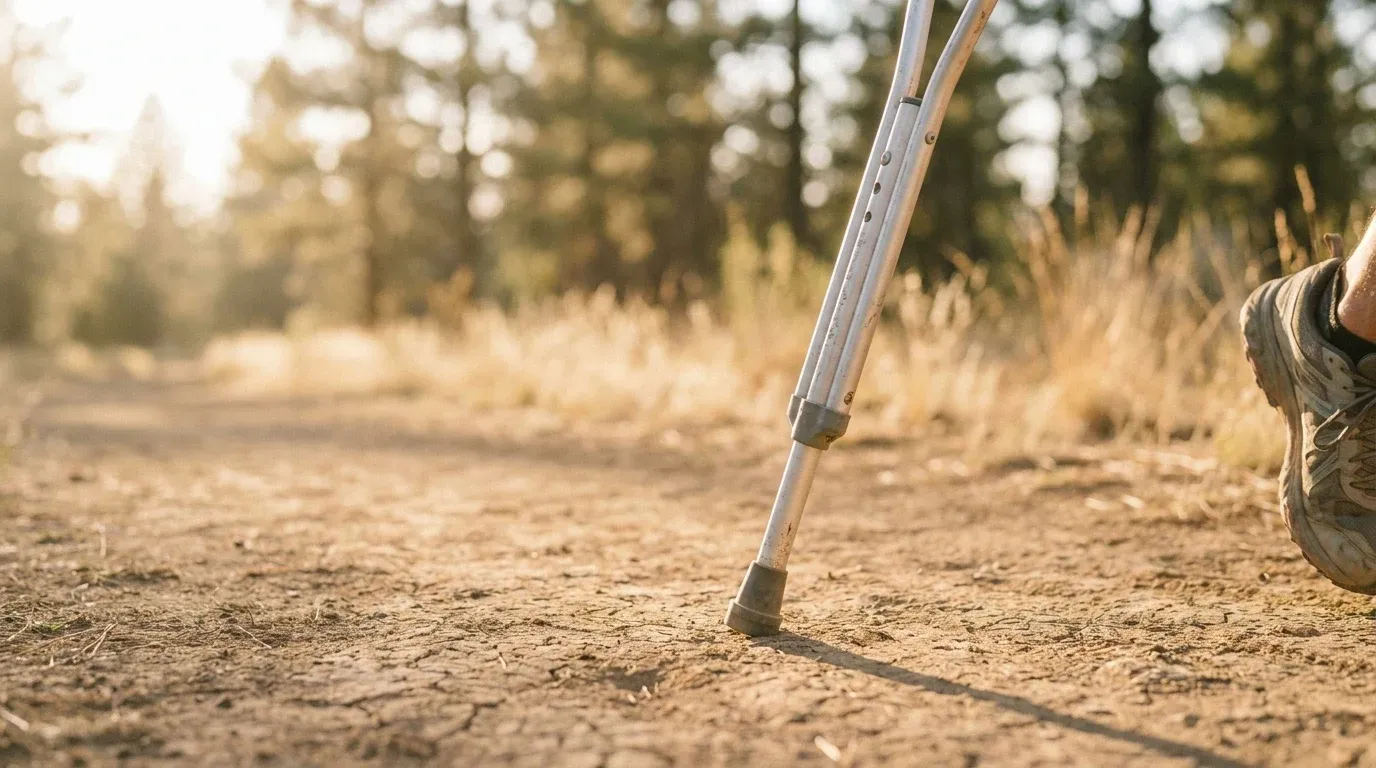
Paul Wilson crossed the finish line of a 160-kilometer ultramarathon on crutches. He's 51 years old. His leg was reconstructed after a car accident so severe that doctors described the bone as being "in millions of pieces." And he finished.
That sentence alone should stop you. Not because it's inspirational in a vague, poster-quote kind of way. But because it raises real questions about what the human body can actually tolerate, what medical teams can help athletes achieve, and what happens when ambition simply refuses to negotiate with injury.
What Happened to Paul Wilson
Wilson's story begins with a car accident that left his leg catastrophically damaged. The reconstruction surgery that followed wasn't a clean fix. It was the kind of intervention that puts surgeons in a difficult position and leaves patients facing an uncertain future. The bone, described as fragmented beyond normal repair thresholds, required extensive surgical work just to restore basic function.
For most people in that situation, the goal is walking without pain. The goal is getting back to work. The goal is not 160 kilometers on foot.
Wilson set that goal anyway. And he completed it. Using crutches to manage the load on his reconstructed leg, he covered the full distance of the race. That's roughly the equivalent of running nearly four back-to-back marathons, except across ultramarathon terrain, at age 51, with a leg that medical professionals would reasonably describe as non-race-ready.
Why This Is Medically Remarkable
Orthopedic recovery timelines exist for good reasons. When bone is severely fractured and surgically reconstructed, the healing process involves not just bone knitting back together but also soft tissue repair, nerve function restoration, and the gradual reloading of the musculoskeletal system. Rushing that process creates real risks: stress fractures, implant failure, joint deterioration.
What makes Wilson's completion genuinely unusual isn't just the mental toughness it required. It's that the physical demands of a 160K race, even managed with crutches, place enormous strain on the entire kinetic chain. His shoulders, wrists, core, and intact leg would have absorbed forces far beyond normal training loads. His cardiovascular system still had to sustain effort across what typically takes elite competitors 20-plus hours to finish.
The fact that he completed it without documented medical emergency speaks either to the quality of his adaptive preparation, the robustness of his surgical outcome, or both. Likely both.
The 2026 Context: Older Athletes Are Rewriting Recovery
Wilson's story doesn't exist in isolation. It fits squarely into a broader pattern that's become one of the defining narratives in endurance sport this year. Older athletes, particularly those in their late 40s and 50s, are consistently defying conventional timelines for what recovery looks like and what post-injury performance means.
The ultra boom among athletes over 45 is well documented at this point. Participation data from major trail and ultramarathon events shows that the 50-plus age bracket has grown faster than any other demographic over the past decade. These aren't casual joggers completing a 5K. These are athletes taking on 100-mile events, multi-day stage races, and technical mountain courses.
The reasons are partly physiological. Research suggests that endurance capacity declines more slowly with age than power and speed. A 51-year-old can still be a formidable ultramarathon competitor. But the trend also reflects a cultural shift. Older athletes today have better access to sports medicine, physical therapy, strength and conditioning programming, and nutrition science than any previous generation. They're using those tools to compete longer and recover smarter.
If you've been following the rise of ultramarathon racecations as a travel format for endurance athletes, you've already seen how the ultra world is expanding its reach and its demographic base. Wilson represents the edge of that expansion.
Adaptive Training: What It Actually Looks Like
The practical questions Wilson's story raises are worth taking seriously. How do you train for a 160K race when you can't run? How do you work with a medical team to set a goal that they consider irresponsible while still getting the support you need?
Adaptive training for injured athletes isn't a single protocol. It's a negotiation between what the injured structure can tolerate and what the cardiovascular and muscular systems need to stay conditioned. For Wilson, training almost certainly involved a combination of upper body conditioning, aquatic work to maintain aerobic capacity without skeletal loading, and progressive weight-bearing exercises as his reconstruction allowed.
Crutch-based movement is not passive. It's a full-body effort that demands serious shoulder and core strength. Athletes preparing for crutch-assisted distance events have to treat their upper body as the primary engine, not a support system. That means strength work matters enormously, and the research on resistance training supporting both physical and mental resilience during injury recovery is increasingly clear.
Studies on even low-intensity strength training have shown meaningful effects on mood and psychological well-being during difficult physical periods. As research on light lifting and its impact on depression and anxiety has shown, you don't need high loads to get meaningful mental health benefits from resistance work. For an athlete navigating a catastrophic injury, that psychological dimension isn't a side benefit. It's central to staying in the process.
The Mental Architecture of an Unreasonable Goal
There's a version of this story that frames Wilson as simply "determined" or "inspiring" and leaves it there. That framing doesn't do the story justice.
What Wilson demonstrated is something more specific than general toughness. It's the ability to hold a long-term goal during a period when every short-term signal is telling you the goal is unreachable. That's a cognitive and emotional skill, not just a personality trait. And it's one that can be developed.
Athletes who successfully return from serious injury tend to share certain mental habits. They break large goals into process-oriented milestones. They maintain identity as an athlete even when they can't train in conventional ways. They manage the relationship with their medical team as a partnership rather than an authority structure. And they tolerate uncertainty without letting it become paralysis.
Wilson's training environment during recovery would have mattered more than many athletes realize. Research on how physical surroundings affect training output and mental state suggests that where and how you do your rehabilitation work shapes both your effort and your recovery psychology. Your training environment affects your results more than most people account for, and that's doubly true when motivation is already under pressure from injury and pain.
Working With Your Medical Team on a Bold Goal
One of the most underreported aspects of stories like Wilson's is what happens in the conversation between athlete and medical professional. A surgeon's job is to restore function and minimize risk. An ultramarathon athlete's goal is, almost by definition, high risk. Those two orientations don't always align easily.
Athletes who successfully push the boundaries of post-injury performance tend to be transparent with their medical teams rather than evasive. They share their goals early, invite honest risk assessment, and work with specialists who have experience in sports medicine rather than general orthopedic care. They also accept modifications. Wilson's use of crutches is itself a modification. It's not the race he might have planned before the accident. It's the race his body could do after it.
That kind of pragmatic adaptation is increasingly common at the elite and competitive amateur level. If you're planning a race in a recovering state, the October 2026 trail racing calendar has options across a wide range of distances and terrain types that might allow for a staged return to competition. Not every comeback has to be 160 kilometers on crutches.
What You Can Take From This
Wilson's story isn't a template. Most people recovering from serious leg reconstruction aren't going to complete a 160K ultra. That's not failure. That's a reasonable response to the reality of injury.
But the principles his story illustrates are transferable. Set a goal that demands more than your current condition suggests is possible. Build a support system that includes medical professionals, not just training partners. Treat adaptive training as legitimate preparation, not a consolation prize. And understand that the mental work of staying in the process is as trainable as the physical work.
The ultra world has always attracted people who don't accept the first answer they're given about their limits. Dozens of ultras run on any given weekend across the globe, and a growing number of the people finishing them are doing so after injuries, surgeries, and setbacks that would have ended athletic careers in a previous era.
Paul Wilson is 51 years old. His leg was in millions of pieces. He finished a 160-kilometer race on crutches. Whatever your current limitation is, it's worth sitting with that for a moment before you decide what you can and can't do.