
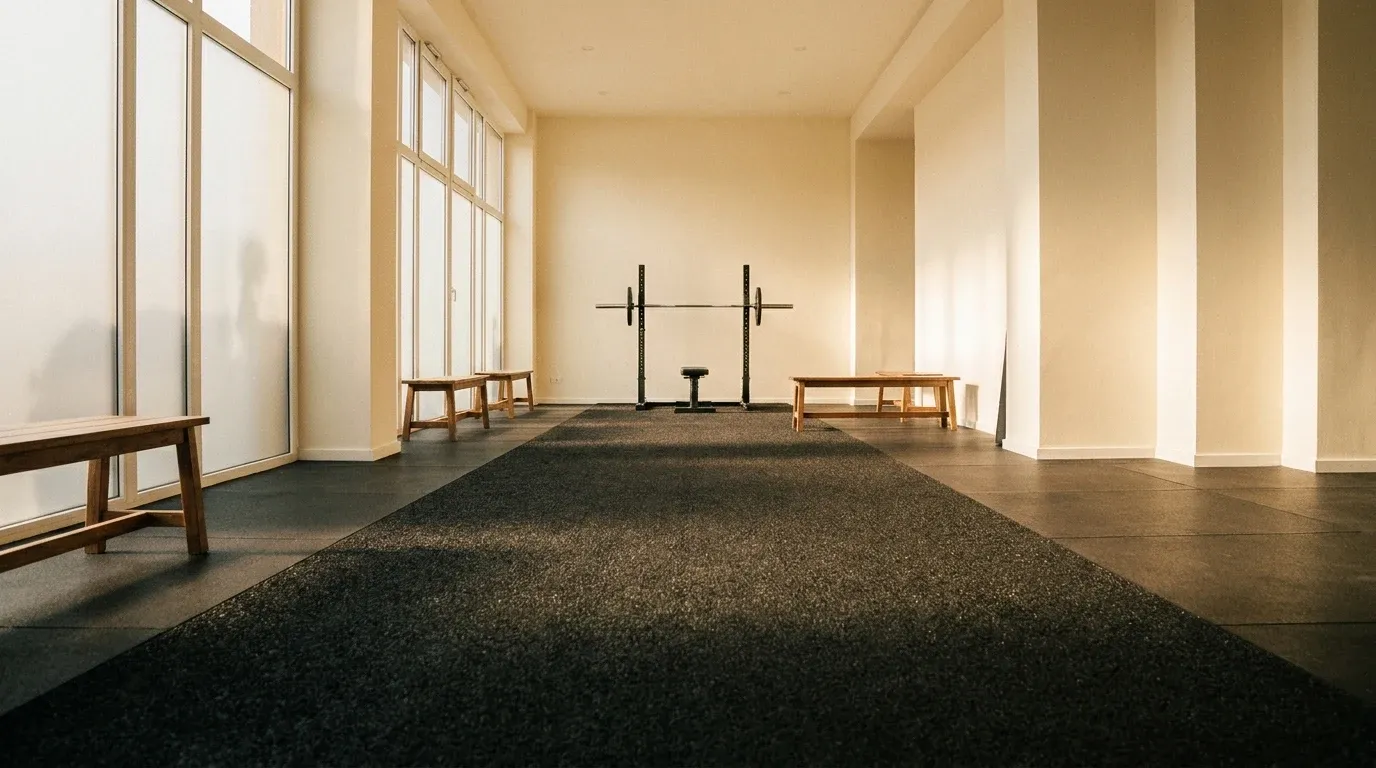
When Al-Hilal unveiled their new performance hub, the coverage focused on the price tag and the star names attached to it. What got less attention was the detail underneath: the controlled ambient temperature in the weight room, the acoustic design of the training floor, the deliberate layout of equipment zones. None of that was accidental, and none of it was about comfort.
Elite clubs treat the training environment as a performance variable. The same logic applies to you, whether you're working out in a $200-per-month facility or a spare bedroom with a barbell and a mat.
Why Elite Facilities Engineer Their Environments
Professional sports organizations allocate serious budget to ambient conditions. Temperature control systems, acoustic panels, lighting rigs calibrated by zone, flooring that reduces fatigue and injury risk. These aren't luxury additions. They're infrastructure investments tied to measurable output.
The reasoning is straightforward: if an environment reduces perceived exertion, increases focus, and keeps athletes in optimal physiological states for longer, the cumulative training volume over a season compounds into a meaningful performance edge. The same principle scales down to recreational training. The variables don't stop mattering because you're not a professional.
Research consistently shows that environmental factors influence not just comfort but actual performance metrics: reps completed, time under tension, session duration, and rate of perceived exertion. Most gym-goers optimize their nutrition and sleep before they ever think about the room they're training in. That's leaving results on the table.
Temperature: The Variable You're Probably Getting Wrong
Resistance training performance peaks within a specific thermal window. Studies point to an ambient temperature range of roughly 18 to 22 degrees Celsius (64 to 72 degrees Fahrenheit) as optimal for strength work. In that range, core temperature rises appropriately during effort, muscles contract efficiently, and the body's thermoregulatory load stays manageable.
Train in a room that's too warm and your cardiovascular system starts competing with your muscles for resources. Blood is redirected to the skin for cooling. Perceived exertion climbs at lower intensities. You fatigue faster and, critically, you tend to stop sets earlier without realizing that heat is the reason.
Train too cold and you're dealing with the opposite problem. Muscle viscosity increases, the risk of soft tissue strain goes up, and the warm-up phase needs to be longer to get joints and muscles to a functional working temperature. Most commercial gyms run warmer than they should. Most home gyms in winter run colder.
If you're doing serious work at home, a basic room thermometer costs under $15. Knowing what temperature you're actually training in is the first step to controlling it.
Sound and Music Tempo: More Than Motivation
Music during training isn't just psychological wallpaper. The tempo of what you're listening to has a measurable effect on rep cadence, perceived effort, and output. Research in exercise science has linked music above 130 BPM to higher performance in strength training contexts, with subjects completing more repetitions and reporting lower perceived exertion compared to slower-tempo or no-music conditions.
The mechanism isn't fully understood, but it likely involves a combination of entrainment (where movement synchronizes with rhythm), arousal modulation, and distraction from discomfort signals. Practically, this means your playlist is a training tool, not a background feature.
Fast tempo matters during sets. Between sets, lower-tempo music or silence may actually support better recovery by allowing heart rate to drop more efficiently. Building a playlist with intentional tempo shifts, rather than hitting shuffle on whatever's in your library, gives you a simple lever to pull on effort and recovery.
Noise pollution works the other way. Unpredictable, intrusive sound, whether it's a TV playing in the background, construction outside, or a phone buzzing with notifications, creates cognitive load that competes with focus during training. It's not just annoying. It fragments attention in ways that affect execution quality.
Clutter, Cognitive Load, and Time Under Tension
There's a direct line between a disorganized training space and reduced performance. It sounds trivial until you examine what's actually happening neurologically. A cluttered environment generates low-level cognitive load, a constant, background processing demand that competes with the attentional resources you need to maintain form, hit depth, and stay present during hard sets.
Between sets, your brain needs to shift into a partial recovery mode. If you're stepping over plates, scanning for a missing band, or navigating around equipment that isn't where it should be, you're extending the cognitive effort of the session without adding any training value. Research on attention and environment consistently shows that visual disorder correlates with reduced task focus and higher stress markers.
For compound movements that require genuine technical attention, like hip thrusts, Romanian deadlifts, or overhead pressing, this matters more than it does for simple isolation work. If you're trying to apply the kind of technique detail covered in resources like Hip Thrust Technique: The Coaching Cues That Actually Work, you need a mental environment that supports that level of focus. A cluttered room works against you before you've touched a weight.
Commercial gym members deal with this differently than home lifters. In a busy gym, you can't control the layout. But you can control your zone: clearing the area around your station, setting up everything you need before starting, and avoiding the habit of scrolling your phone between sets, which is its own form of focus fragmentation.
Lighting Matters More Than You'd Expect
Lighting is the environmental variable that gets almost no attention in recreational fitness, yet it's one of the most heavily engineered features in elite facilities. Bright, cool-spectrum lighting in training areas increases alertness and arousal. Dimmer, warmer lighting in recovery zones supports the shift toward parasympathetic activity after intense effort.
Most commercial gyms are brightly lit by default, which is appropriate for training. Home gym setups are more variable. If your home gym is in a basement with poor overhead lighting, you're training in conditions that suppress alertness. If you're training in a room with warm, ambient household lighting, you're doing the same. A simple, inexpensive LED strip with a cool daylight setting can change the feel and function of a home training space significantly.
The interaction between lighting, consistency, and long-term adaptation is also worth noting. Training consistency matters more than intensity over time, and environmental factors that make sessions feel better and flow more smoothly contribute to the kind of adherence that drives real results across months and years.
Equipment Layout and Flow
Professional facilities design equipment flow deliberately. Warm-up zones are positioned away from heavy lifting areas. Racks face mirrors or open space. Cardio equipment is acoustically separated from the strength floor. None of this is arbitrary. It's built around the way sessions unfold and the cognitive transitions between phases.
In a home gym, you have the unusual advantage of being able to design your own layout completely. If you're building or upgrading your setup, the equipment arrangement is a real decision, not an afterthought. Products like the Decathlon smart bench represent a growing category of connected home gym equipment designed with space efficiency and training flow in mind. The underlying logic of good layout applies regardless of budget.
Position your most-used equipment so it's immediately accessible. Keep the floor clear around your primary lifting zone. Store accessories at the periphery, not in the middle of your working space. These are small decisions with consistent, session-to-session payoffs.
The Pre-Session Reset: A Practical Protocol
You don't need to renovate your gym or spend thousands on equipment to apply these principles. What you need is a pre-session routine that treats environment setup as part of training preparation, not an afterthought.
Here's a practical protocol for home lifters and anyone with control over their training space:
- Clear your floor space. Remove anything that isn't being used in today's session. You're reducing visual clutter and eliminating the physical obstacles that interrupt flow between sets.
- Set the temperature. Aim for 18 to 22 degrees Celsius before you start. If your space tends to run warm, start cooling it 15 to 20 minutes before you begin. If it runs cold, start warming it earlier and plan for a longer movement-based warm-up.
- Queue your playlist intentionally. Build or select a playlist where the high-tempo tracks (130 BPM and above) align with your working sets, not your warm-up. Apps like Spotify show BPM data for most tracks if you look for it.
- Eliminate phone notifications. Put your phone on Do Not Disturb before your first set. If you use your phone for music, that's fine. But notifications between sets are a focus tax you're paying every session.
- Check your lighting. If you're in a dim or warmly lit space, switch to a brighter, cooler light source before starting. If you're in natural light, position yourself to benefit from it rather than squinting into it.
This protocol takes three to five minutes. The cumulative effect across weeks of training is significantly larger than that investment suggests. Environment shapes effort, and effort shapes adaptation. That chain runs in both directions.
The Broader Picture
Training adaptation is not just a product of what you do inside each session. It's a product of how consistently and how fully you can execute over time. Environmental factors that seem minor in isolation, a room that's too warm, a disorganized floor, a phone buzzing every four minutes, compound into meaningful friction against quality training.
Elite facilities know this. They invest in controlled environments because the return is measurable. You have access to the same principles, even if your budget is a $15 thermometer and a smarter playlist. The science doesn't change based on the size of the facility. The room you train in is already affecting your results. The question is whether you're directing that effect or just absorbing it.