
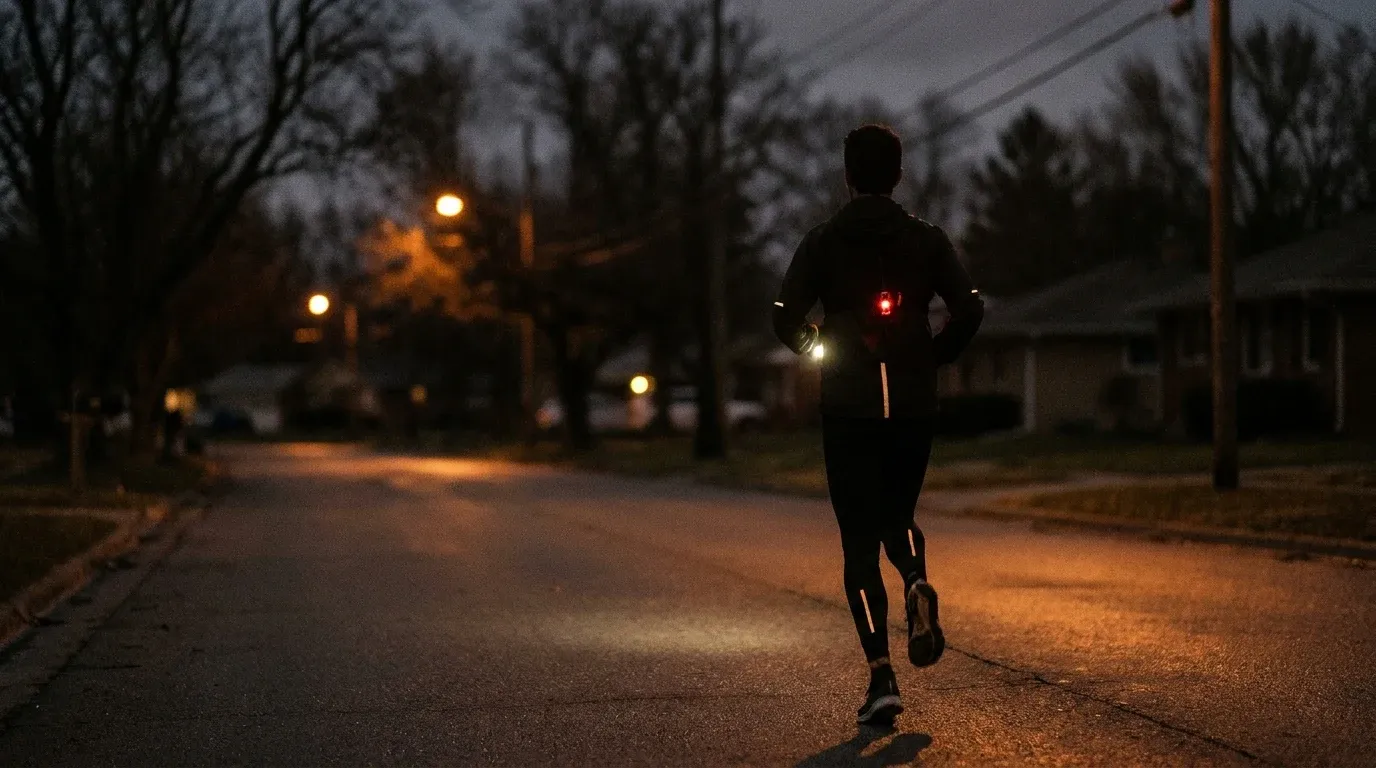
November hits differently for runners. The clocks go back, the evenings collapse, and suddenly the route you've been running in daylight for six months is now pitch black by 5pm. Most runners scramble to adapt. The ones who get it right treat darkness as a system to manage, not just an inconvenience to tolerate.
This guide covers what actually keeps you safe when you're out there before sunrise or after sunset. That means lights, route strategy, and solo safety habits built into a framework you can use from day one of winter training.
Why Reflective Gear Alone Is No Longer Enough
Reflective material works by bouncing light back toward its source. The problem is that a car's headlights typically illuminate a reflective vest at around 500 feet under good conditions. At 60 mph, that gives a driver roughly five seconds of reaction time. At 40 mph on a suburban road, it's slightly better, but still marginal when you factor in distraction, wet roads, or glare.
Active lighting changes the equation entirely. A runner wearing a chest-mounted LED light is visible to drivers at distances of up to 1,500 feet in dark conditions. That's the difference between a driver having time to react and a driver not seeing you until it's too late.
The standard has shifted. Reflective strips on your jacket are still worth having, but they are now the backup layer, not the primary one. If you're running any road miles in darkness, active lighting is the minimum. Full stop.
Entry-level running lights start around $25 to $30 for a clip-on rear blinker. A solid chest light or headlamp with 200+ lumens runs $45 to $80. Quality waist-mounted light rigs from brands like Noxgear sit closer to $60 to $90. These aren't luxury purchases. They're the cost of running safely in winter.
Front-Facing vs. Rear-Facing: The Placement Detail Most Runners Get Wrong
Here's where most runners make a consistent, fixable mistake. They put on a headlamp and assume they're covered. They're not.
If you're running on roads and following the standard rule of running against traffic, you need lighting that works in both directions. Your front-facing light helps you see the road and signals oncoming drivers. But cars approaching from behind, which is the direction you can't see, need a rear-facing light that's specifically designed to be seen from that angle.
A headlamp facing forward does almost nothing for drivers behind you. A rear blinker clipped to your waistband or pack does. This distinction matters most on roads without sidewalks, where you're sharing space with moving traffic in both directions.
The recommended setup for road runners: a headlamp or chest-mounted light facing forward (200 lumens minimum), and a red flashing rear light clipped to your back or waistband. Run the rear light on flash mode, not steady. Flashing lights attract more attention from drivers at distance. That's the system. Both directions, always.
Trail Running at Night Is a Different Problem Entirely
Trail runners face hazards that road runners don't. Roots, drop-offs, uneven terrain, water crossings, and low branches all become genuinely dangerous when your visibility drops. But the solution isn't simply more lumens on your head.
The beam angle matters as much as brightness. A narrow, high-intensity beam is useful for spotting technical terrain ahead, but it creates contrast shadow that can actually make roots and rocks harder to read when they're right at your feet. A wide-angle or flood beam gives better overall terrain awareness at close range. The best trail headlamps offer both modes, letting you switch depending on whether you're picking your way through roots or running a wider fire road.
Trail runners also don't have traffic visibility to worry about in the same way, but they face a different risk: getting genuinely lost or injured far from help. That changes your gear list. A headlamp with at least four to six hours of battery life at running brightness is essential. Carry a backup light, even a small keychain light. Know what your headlamp's battery indicator looks like at half charge, because it always dims faster than you expect in cold weather.
Cold temperatures can reduce lithium battery performance by 20 to 30 percent compared to warm-weather conditions. If you're heading out for 90 minutes, plan your lighting as though you have less battery than the specs suggest.
If you're building toward trail events and want to understand what elite performance looks like in this environment, the analysis in "Chris Myers Breaks a Trail Record: What It Means for the Sport" is worth your time, particularly the sections on terrain-specific pacing.
Route Planning for Dark Conditions
Your summer route is not automatically your winter route. Terrain that's easy in daylight can be hazardous in the dark, and roads that feel safe with traffic at 7pm might feel different at 5:30am before the morning commute starts.
When you're redesigning routes for winter, prioritize these factors:
- Street lighting coverage. Run routes where streetlights are consistent. A well-lit two-mile loop is safer than a four-mile route with half a mile of unlit road.
- Traffic volume and speed limits. Lower-traffic streets with 25 to 30 mph limits reduce exposure. Avoid high-speed arterials where drivers aren't expecting pedestrians.
- Surface predictability. Familiar surfaces are safer than new terrain at night. Save route exploration for daylight runs.
- Proximity to populated areas. Especially for solo runners, routes that keep you near residential streets or businesses give you options if something goes wrong.
If you're in a training block building toward a winter race, your route selection might also be partly structured around goal-specific work. "How to Prep for Your Winter Race Season the Right Way" breaks down how to structure your training phases when racing in November through February.
Solo Runner Safety Protocols That Actually Work
Solo running in darkness carries real risk, and no amount of visibility gear eliminates it completely. What you can do is build habits that significantly reduce the consequences if something does go wrong.
Share your route before you leave. Tell someone your planned route and expected return time before every solo dark run. This doesn't need to be elaborate. A quick text with a screenshot of your map and "back by 7:15" is enough. If you're not back, they know where to look.
Use a live tracking app. Apps like Garmin LiveTrack, Strava Beacon, or Apple's location sharing let a contact follow you in real time. Set this up once and use it every time. The inconvenience is minimal. The benefit is significant.
Run with your phone, not just a watch. Your GPS watch can track you, but it can't call for help. Keep your phone accessible, not buried in a pack.
Vary your routes and timing. Running the exact same route at the exact same time every day creates predictability that can attract unwanted attention. Small variations are a sensible habit for regular solo runners.
Know when to skip the trail entirely. If you haven't run a trail in daylight recently, don't run it alone at night for the first time. If conditions are icy, the technical difficulty of trail terrain increases dramatically. If you're significantly sleep-deprived or not feeling right, your reaction time and judgment are compromised. The trail will be there tomorrow.
Trust your instincts. If a situation feels wrong, it probably is. Abort the run, change direction, enter a business, call someone. No workout is worth overriding a genuine safety instinct.
Layering Your Safety System
The right approach to winter running safety isn't any single tactic. It's a layered system where each element covers for the gaps in others.
Your visibility gear handles the traffic dimension. Your route selection reduces overall exposure to risk. Your communication habits ensure that if something goes wrong, someone can respond. Each layer is weak on its own. Together, they create a genuinely robust approach to dark running.
If you're also thinking about how to maintain your fitness base through winter rather than just surviving it, the approach outlined in "HYROX Running Makes Up Half Your Race. Train It That Way." offers useful structure for keeping your aerobic engine sharp during months when motivation and conditions both work against you.
And don't overlook the nutritional side of training through winter. Your immune system takes additional strain during cold-weather training, and your energy needs shift. "Winter Immunity for Athletes: What You Should Actually Eat" is a practical reference for making sure your diet supports the training you're putting in.
The Standard Has Changed. Meet It.
Running in the dark used to mean throwing on a reflective vest and hoping for the best. That standard is outdated. Active lighting is now the baseline for anyone training on roads after sunset. Rear-facing lights are non-negotiable if you're running against traffic. Trail runners need a gear setup built for terrain, not traffic. And solo runners need communication habits that mean someone always knows where they are.
Winter doesn't have to interrupt your training. It just requires a more deliberate approach to the conditions you're running in. Build the system once, and it runs in the background every time you head out the door.