
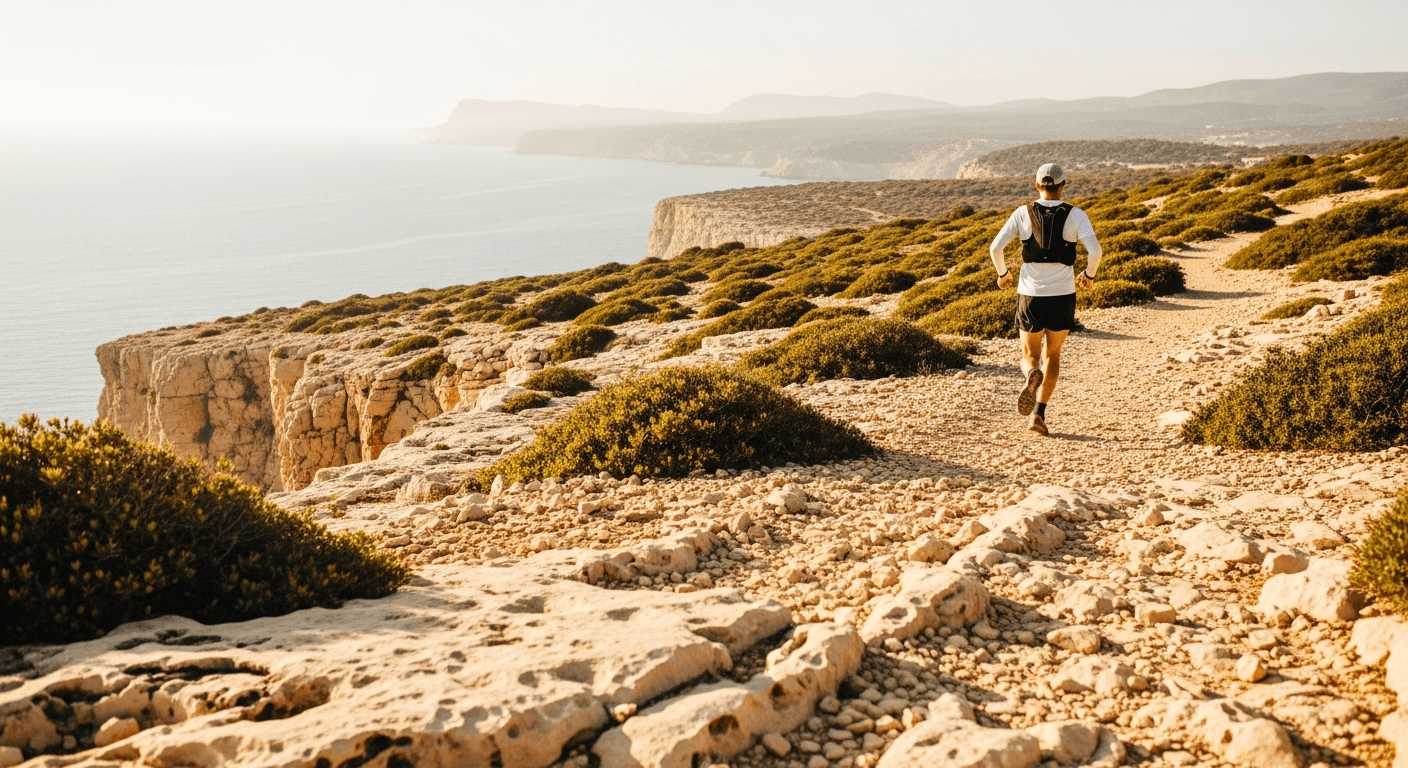
The XTERRA Trail Run World Championship is heading somewhere genuinely different in 2026. The race is set for Gozo, the small sister island of Malta sitting in the central Mediterranean, and if you're a trail runner with competitive ambitions, this is a destination worth putting on your radar well before registration opens.
Gozo isn't a soft introduction to destination racing. It's rocky, technical, exposed, and hot. That combination is going to filter the field in ways that a standard mountain trail race won't. Here's what you need to understand about what's coming.
What Gozo Actually Looks Like Underfoot
Gozo covers roughly 67 square kilometers, which makes it one of the smaller island venues in world championship trail history. Don't let the size mislead you. The island is built almost entirely on limestone karst, a terrain type that punishes runners who don't respect it. The rock fractures unpredictably, surfaces shift from grippy to glass-smooth depending on moisture and age, and the trails rarely give you flat ground for long enough to settle into a rhythm.
The island's defining geographic features are its coastal cliffs, particularly along the northwestern and western edges. The Azure Window, which collapsed in 2017, used to be the island's most photographed landmark. What's left around that coastline is raw escarpment and dramatic elevation change packed into short distances. XTERRA course designers tend to exploit exactly this kind of terrain, so expect climbs that punch above their length in terms of effort.
Gozo's highest point sits at around 195 meters above sea level. That's modest by alpine standards, but on a technical limestone island where elevation gain is repeated in loops and the descents are unforgiving, the cumulative vertical load across a world championship distance will be significant. If your trail running has been mostly soft-surface forest paths, investing time in the right trail running gear for technical rocky terrain before your preparation starts is a practical first step.
XTERRA Trail: Not Just for Professionals
One of the things that makes XTERRA Trail World Championships genuinely interesting is the structure of the event itself. Unlike many world-level running championships that are functionally closed to anyone outside an elite development pathway, XTERRA operates a qualification model that pulls in competitive amateurs from dozens of countries.
Runners qualify through the XTERRA Trail Run World Series, a global circuit of regional races that distributes qualification slots across age groups and gender categories. That means a 44-year-old age group runner from Brisbane or a competitive recreational runner from Toronto has a legitimate pathway to the same starting line as full-time professionals. The field in Gozo will likely reflect that range, with elites at the front and several thousand age group competitors behind them.
This accessibility is part of what makes XTERRA Trail a meaningful goal race in a way that, say, a major marathon qualifier often isn't. The barrier is still real. You need to race well enough at a qualifier event to earn your spot. But the door is open, and that matters. It's a model not entirely unlike what's happened in obstacle and fitness racing formats, where events that were once niche have broadened their appeal by welcoming competitive amateurs alongside elites. If you've followed the growth of accessible competitive formats, you'll recognize the same pattern here.
The Mediterranean Heat Factor
XTERRA Trail World Championships have historically been held in late autumn. In Gozo, late-season Mediterranean conditions are not the same as autumn in the Alps or the Pacific Northwest. October temperatures on Gozo regularly sit between 22 and 28 degrees Celsius. Humidity off the sea adds physiological load that a temperature reading alone won't capture. And the coastal wind, which can arrive with very little warning, creates a pacing and hydration variable that most runners from northern climates aren't trained to manage.
Heat adaptation is not optional preparation for this race. It's a core training block. Research consistently shows that deliberate heat acclimation over two to three weeks before a hot-weather competition improves plasma volume, reduces core temperature during exercise, and lowers heart rate at equivalent workloads. If you're training through summer in a temperate climate and planning to compete in Gozo, the gap between your normal conditions and race-day conditions will need active management. Training through summer heat without losing fitness covers the practical side of building that adaptation into your schedule rather than treating it as an afterthought.
Coastal wind on Gozo deserves its own consideration. The island sits exposed in the central Mediterranean with no significant landmass to its north or west. The Tramontane and Majjistral winds are local features that shift direction and intensity during the day. On an exposed cliff-top section, you could be pushing into a 30-kilometer-per-hour headwind, then turning onto a sheltered descent. That variability disrupts pacing and makes negative-split racing harder to execute. The case for negative splits as a race strategy is strong under controlled conditions. In Gozo, applying it will require real-time adjustment rather than a fixed plan.
Fueling a Technical Island Race
Gozo's terrain and climate combine to create a specific nutritional challenge. Technical trail running burns more glycogen per kilometer than smooth-surface running because of the constant micro-adjustments your muscles are making to stay balanced on uneven ground. Add heat stress on top of that, which accelerates carbohydrate oxidation and increases sodium losses through sweat, and you're looking at a race where under-fueling mid-event will cost you far more than it would on a flat course.
Carbohydrate timing matters on courses like this. The evidence behind intra-race fueling for trail and ultra distances has continued to develop, and the principles around glycogen management are well established enough to shape your race-day strategy. What the current science says about trail nutrition and carbohydrate timing gives you a grounded place to start building a fueling plan that fits the demands of a technical Mediterranean race.
Sodium replacement is often underestimated by runners who haven't competed in Mediterranean heat before. Sweat sodium losses in hot, humid conditions can reach levels that plain water cannot compensate for. This is a practical logistics issue as much as a physiology one. Know what electrolyte products will be available on course, carry your own if the supply is uncertain, and test your strategy in training before you rely on it on race day.
How to Structure Your Preparation
If Gozo is on your target list for 2026, your preparation window from now gives you real time to build properly. A few priorities stand out.
- Technical terrain time. If you don't have regular access to limestone or rocky coastal trails, find the most technical surface available to you and prioritize it. Ankle stability, foot placement decisions, and downhill confidence on broken ground all take time to develop and don't transfer quickly from soft trails.
- Elevation-specific work. The climbs in Gozo will be short and punchy. Train for that specifically. Long, steady mountain climbs are useful base work, but repeated short steep efforts better replicate what the course will ask of you.
- Heat adaptation block. Build this into the final four weeks before travel, not the week before. Sauna sessions, deliberate training in the hottest part of your day, and reduced cooling access during workouts are all established methods.
- Race-day nutrition testing. Do not experiment with fueling on race day in a climate you haven't trained in. Test your full nutrition strategy, including electrolytes and carbohydrate forms, during your hardest training sessions in heat.
The qualification circuit for XTERRA Trail World Series races runs globally across the year. Check the XTERRA Trail official site for the current schedule of qualifier events in your region. Entry windows for qualifier races typically open several months in advance, and some regional qualifiers fill quickly.
Why Gozo Is Worth the Effort
World championship trail events often end up in spectacular but logistically similar mountain venues. Gozo offers something structurally different. It's an island of under 40,000 people with a compact, walkable infrastructure, a deeply local culture, and a race environment where the landscape itself is genuinely unusual.
The Maltese archipelago has been a crossroads of Mediterranean civilizations for thousands of years. Gozo's Ggantija temples are among the oldest freestanding structures on earth. Running trails that cut across that landscape adds a layer to the experience that you don't get on a generic alpine circuit. That's worth acknowledging alongside the tactical and physical demands of the race.
If you're the kind of runner who treats world championship racing as both a competitive goal and a reason to put yourself somewhere remarkable, Gozo in 2026 delivers on both sides. Start your qualification pathway early, build for the conditions honestly, and give the terrain the respect it's going to demand.