
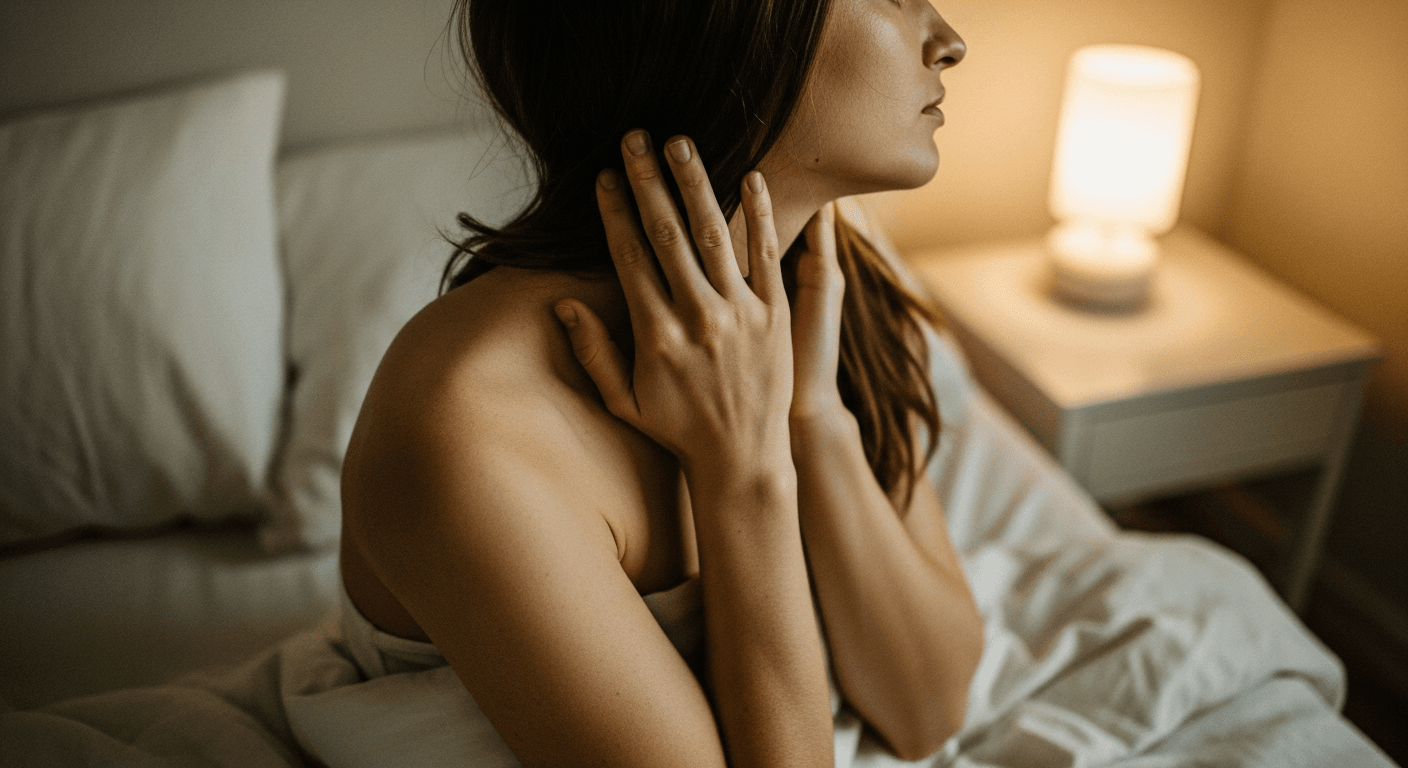
If you've been staring at the ceiling at night, cycling through the usual suspects. Blue light. Caffeine. Stress. You might be overlooking something simpler. A preliminary study suggests that spending just ten minutes on a self-massage as part of your evening skincare routine can meaningfully improve sleep quality and reduce anxiety. No prescription required. No expensive device. Just your hands and a consistent nightly ritual.
The research, while early-stage, points to something worth paying attention to, especially if you're trying to improve your recovery without reaching for sleep aids.
What the Study Actually Found
Researchers studied a group of healthy women who reported experiencing sleep disturbances. Participants followed a structured evening routine that combined self-massage with their regular skincare habits for a defined period. The results showed measurable improvements in both sleep quality scores and self-reported anxiety levels.
That dual benefit matters. Poor sleep and anxiety don't just coexist. They feed each other. Addressing both with one low-effort ritual is a meaningful finding, even if larger trials are still needed to confirm the effect size.
It's also worth noting that the study focused on healthy women with mild to moderate sleep issues, not clinical insomnia. If you're dealing with diagnosed sleep disorders, this kind of routine can complement a treatment plan but probably won't replace it. For deeper sleep diagnostics, understanding the limits of available tools is useful. what your sleep tracker can actually tell you about apnea gives a clear-eyed breakdown of what wearable data can and can't detect.
Why Touch Works on the Nervous System
Self-massage isn't a wellness trend invented on social media. The physiological rationale is grounded in how your autonomic nervous system responds to tactile stimulation. Gentle, sustained pressure activates the parasympathetic nervous system, often called the "rest and digest" state, pulling you out of the sympathetic "fight or flight" mode that dominates during a stressful day.
This shift can lower cortisol, slow your heart rate, and reduce muscle tension. All of which make it easier for your body to cross the threshold into sleep. Some research also points to increased oxytocin release during massage, a hormone associated with calm and social bonding, even when you're the one doing the touching.
The effect isn't magic. It's biology responding to a consistent, low-stimulation cue. And that's exactly why pairing it with skincare makes sense. You're stacking two calming behaviors into one deliberate act.
The Routine Signal Your Brain Has Been Missing
One of the most underrated principles in sleep science is stimulus control. Your brain is extraordinarily good at learning associations. If your bed is where you scroll through social media, argue, or watch intense content, your nervous system starts treating it as an activation zone rather than a rest zone.
A consistent pre-sleep ritual works in the opposite direction. When you repeat the same sequence of low-stimulation behaviors each night at roughly the same time, your brain starts treating that sequence as a countdown to sleep. The self-massage becomes a signal. The skincare routine becomes a signal. Together, they're more powerful than either alone.
This is also why screen habits matter so much before bed. endless scrolling hurts your memory and your ability to recover cognitively. Replacing even fifteen minutes of passive phone use with a physical, intentional routine is one of the highest-leverage swaps you can make for sleep hygiene.
How to Build the 10-Minute Ritual
You don't need special products or training. Here's a simple structure that mirrors what participants in the study followed:
- Minutes 1-2: Cleanse and settle. Wash your face, apply your usual skincare. The act of cleansing itself can signal transition. You're washing off the day.
- Minutes 3-5: Facial massage. Using gentle upward strokes, work from your jaw to your temples and across your forehead. Apply light pressure to tension points around your brow and the base of your skull.
- Minutes 6-8: Neck and shoulder work. Use your fingertips to apply circular pressure along the back of your neck and across the tops of your shoulders. These areas hold a disproportionate amount of daily tension.
- Minutes 9-10: Hand and wrist massage. Work your thumbs into your palms and rotate your wrists slowly. This is often neglected but carries significant accumulated tension, especially if you work at a keyboard.
The key isn't perfection of technique. It's consistency and intention. Doing this at the same time each night, in the same space, with the lights dimmed, compounds the sleep-signaling effect over time.
Non-Pharmacological Sleep Support Is Gaining Ground
The appeal of this kind of approach goes beyond convenience. There's a growing body of research backing non-pharmacological interventions for sleep, including cognitive behavioral therapy for insomnia (CBT-I), mindfulness practices, temperature regulation, and now tactile self-care routines.
Sleep medications, including both prescription options and over-the-counter supplements, carry their own tradeoffs. Dependency risks, morning grogginess, interference with sleep architecture. That last point is particularly relevant. Some aids suppress REM sleep, which is where a significant amount of cognitive and emotional processing happens. A self-massage carries none of those risks.
It also costs nothing. In a wellness market where sleep optimization products can run from $30 white noise machines to $500+ smart mattress pads, a technique that requires only your hands and ten minutes is genuinely accessible regardless of income level.
If you want to contextualize this within a broader recovery strategy, five simple recovery habits that actually work covers complementary practices that are similarly low-cost and evidence-supported.
Who Benefits Most
The study focused specifically on healthy women experiencing sleep disturbances, a population that represents a huge share of people who struggle with sleep but don't meet clinical criteria for insomnia. Women in perimenopause, postpartum periods, or under chronic stress are particularly likely to experience fragmented sleep without a diagnosable disorder.
That said, the underlying mechanisms, parasympathetic activation, cortisol reduction, behavioral cueing, are not gender-specific. The ritual is adaptable for anyone.
If your sleep issues are more complex, involving snoring, gasping, or excessive daytime fatigue, it's worth going deeper. A single screening tool often isn't enough to get the full picture. one night sleep test isn't enough to accurately classify apnea, which is a meaningful caveat if you're trying to rule out obstructive sleep apnea before assuming your issues are purely stress-related.
Making It Stick
Habit formation research is consistent on one point. The easier a behavior is to start, the more likely it is to persist. A ten-minute self-massage wins on almost every metric. No equipment. No scheduling. No financial commitment. The main barrier is the first few nights, when it feels unfamiliar or slightly awkward.
One practical approach is to anchor it to something you're already doing. If you already have a skincare routine, you've already got the hook. You're adding the massage to an existing behavior chain rather than building a new one from scratch. That dramatically reduces the activation energy required.
Give it two weeks before you evaluate whether it's working. Sleep quality tends to shift gradually, and the signaling effect of a new pre-bed routine needs repetition before it becomes automatic.
The Bigger Picture for Sleep Health
Sleep is not a passive activity. It's an active physiological process that requires the right conditions to initiate and maintain. What you do in the sixty minutes before bed shapes the quality of the seven or eight hours that follow.
A ten-minute self-massage doesn't solve everything. It doesn't fix sleep apnea, eliminate shift-work disruption, or replace medical care when it's needed. But for the large majority of people dealing with garden-variety sleep difficulty driven by stress, overstimulation, and poor wind-down habits, it's a legitimate, zero-cost tool with real physiological backing.
You already have the equipment. You already have the time. The only variable is whether you make it a habit.