
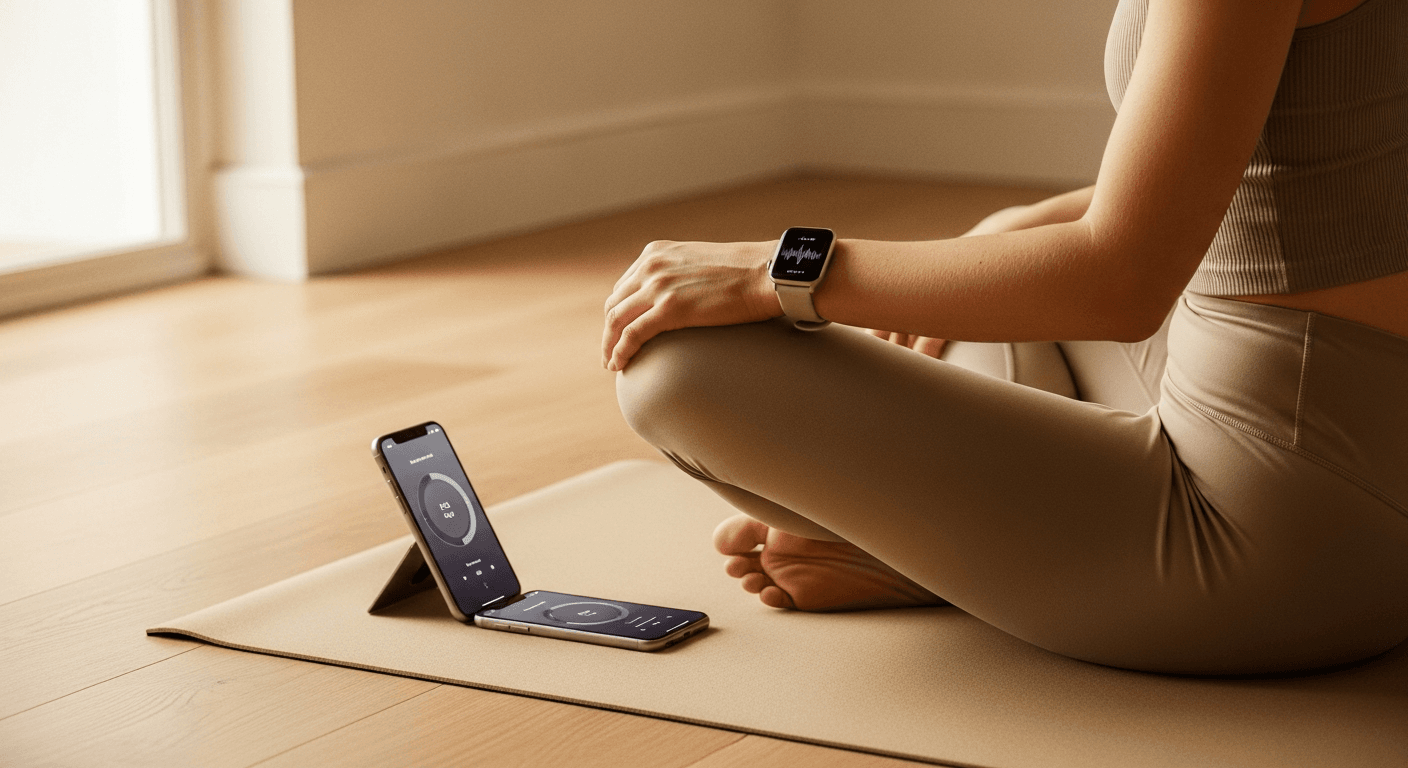
There's a meaningful difference between being told to "take a deep breath" and following a structured breathing protocol that your nervous system can actually respond to. One is a platitude. The other is increasingly backed by clinical data showing measurable drops in cortisol, heart rate, and blood pressure within minutes of practice.
New research from late 2025 and early 2026 is making that distinction impossible to ignore. And it's giving the better breathwork apps a legitimate clinical edge over the generic wellness advice that's cluttered the space for years.
Why Structured Breathwork Works on a Physiological Level
When you breathe in a deliberate, rhythmic pattern, you're not just calming down in a vague sense. You're activating the vagus nerve, the longest cranial nerve in the body and the primary highway of the parasympathetic nervous system. That activation triggers a cascade of measurable responses: heart rate slows, blood pressure drops, and the body reduces its output of cortisol, the hormone most directly associated with chronic stress and anxiety.
What's become clearer from recent research is that this effect is dose-dependent and pattern-specific. A 2025 meta-analysis reviewing 38 controlled trials found that structured breathing interventions, defined as protocols with a fixed inhale-to-exhale ratio or breath-hold component, produced significantly larger reductions in anxiety scores than unstructured deep-breathing instructions. Effect sizes in the structured group were nearly double those in the control group following general relaxation guidance.
The mechanism isn't magic. Slow exhalation, typically longer than inhalation, directly stimulates the vagus nerve via pressure changes in the thoracic cavity. That's the physiological basis behind techniques like box breathing (4-4-4-4), physiological sighs (double inhale through the nose followed by a long exhale through the mouth), and resonance frequency breathing (around 5.5 breaths per minute). Each of these produces a distinct autonomic signature. That specificity matters enormously.
What the 2025-2026 Research Actually Shows
A randomized controlled trial published in early 2026 followed 212 adults with moderate anxiety disorder symptoms over eight weeks. One group used a structured cyclic sighing protocol for five minutes daily. The other group received standard mindfulness guidance, which included no specific breathing instructions. The breathwork group showed a 36% reduction in self-reported anxiety and a statistically significant drop in morning cortisol levels measured by saliva samples. The mindfulness group improved, but modestly, and showed no cortisol change.
A separate 2025 study focused on acute stress response. Participants exposed to a standardized laboratory stressor were randomly assigned to five minutes of box breathing, five minutes of slow diaphragmatic breathing without a set ratio, or no intervention. The box breathing group returned to baseline heart rate variability (HRV) roughly twice as fast as the slow-breathing group, and three times faster than the control group. HRV, the variability between heartbeats, is one of the most reliable real-time markers of nervous system recovery.
These aren't marginal findings. The effect sizes are large enough that several researchers in the 2026 literature have begun calling structured breathwork a first-line adjunctive intervention for anxiety, meaning something that can complement, and in mild cases potentially replace, pharmacological or intensive therapy approaches for some individuals.
It's worth noting that breathwork isn't the only tool showing this kind of evidence. Ashwagandha for Women: Stress, Sleep, and Brain Health covers another evidence-based intervention that's been rigorously tested in stress and cortisol reduction contexts, and combining approaches tends to produce better outcomes than relying on any single method.
The Protocol Problem: Why Most "Breathing Exercises" Don't Work
Here's where the average wellness app fails the test. Most general health apps that include breathing features offer some version of "breathe in for 4 counts, breathe out for 4 counts" with a satisfying animation. That's not a protocol. That's aesthetic guidance, and it doesn't reliably activate the parasympathetic response at the depth that produces measurable cortisol or HRV changes.
What separates a clinically effective breathwork protocol from generic advice comes down to three things:
- Ratio specificity: The inhale-to-exhale ratio determines whether you're stimulating, calming, or balancing the autonomic nervous system. A 1:2 ratio (inhale for 4, exhale for 8) consistently produces parasympathetic dominance. Equal ratios are neutral. A longer inhale can actually increase alertness.
- Breath-hold placement: Holding after an exhale reduces carbon dioxide tolerance thresholds and deepens parasympathetic engagement. Holding after an inhale has the opposite effect. Most apps don't distinguish between these.
- Session duration and consistency: Five minutes of structured breathing daily produces measurable HRV improvements within two weeks. One session doesn't move the needle the way a short daily commitment does.
The apps that get this right aren't necessarily the most popular ones. They're the ones built around identifiable, research-referenced protocols rather than around aesthetics or ambient sound libraries.
Breathwork Apps Worth Taking Seriously
The best breathwork apps in 2025 and 2026 share a core feature: they give you a named, specific protocol and guide you through it with precision, not just a visual cue to breathe faster or slower.
Othership has built an extensive library of guided breathwork sessions that explicitly categorize techniques by their physiological goal, calm, energize, focus, or process emotion. Their protocol design is based on clinical inputs and includes Holotropic-influenced techniques alongside more conservative slow-breathing formats. Subscription runs around $100 per year.
Breathwrk takes a cleaner, more clinical approach. Each exercise in the app is labeled with its physiological function and recommended use case. Anxiety before a presentation? You'll find a specific protocol for acute stress. Trouble sleeping? A different ratio, different breath-hold pattern. The free tier offers enough to get started, and the premium plan is around $60 per year.
Stasis is newer and more data-forward, integrating with wearables to track HRV in real time during sessions. If you're already using an Oura Ring or a Garmin device, Stasis lets you see the physiological response to your breathwork as it happens. That feedback loop is genuinely useful for building habit compliance.
Wim Hof Method app teaches the Wim Hof breathing technique, which is a distinct beast. It's not primarily a parasympathetic protocol. It involves cycles of hyperventilation followed by breath retention and is more appropriate for resilience training and cold exposure preparation than for acute anxiety relief. Understanding the difference matters.
Building breathwork into a broader recovery routine compounds the benefits significantly. How to Build a Real Recovery Routine in 2026 walks through how to layer breathwork, sleep optimization, and other evidence-based recovery practices into something that actually holds across a week.
Integrating Breathwork Into Your Daily Life
The research is clear on one point: consistency beats intensity. Five minutes of box breathing every morning outperforms a 30-minute session once a week by a significant margin in terms of HRV improvement and sustained cortisol reduction.
The most effective integration points for most people are:
- Morning, before screens: Starting the day with a 5-minute parasympathetic protocol sets a lower cortisol baseline for the rest of the day.
- Pre-sleep: A 4-7-8 breathing pattern (inhale for 4, hold for 7, exhale for 8) has been shown in multiple trials to reduce sleep onset latency by an average of 8 to 11 minutes in anxious populations.
- Acute stress triggers: Physiological sighs (two sharp inhales through the nose followed by a long exhale) work in under 90 seconds and can be done anywhere. This is arguably the most practical high-speed intervention the research supports.
If your anxiety has a physiological dimension, and most anxiety does, then your nervous system is a system you can train. The data from 2025 and 2026 makes that clearer than any prior research cycle has. The tools to do it are on your phone, most of them for under $10 a month.
For a broader view of how stress resilience works at the psychological level, The Three C's of Stress Resilience: A Practical Guide is worth pairing with any breathwork practice, because the physiological and cognitive components of anxiety respond better when you address both.
And if you're tracking your health comprehensively, including sleep quality as a downstream indicator of anxiety levels, Stanford AI Reads Your Sleep to Predict Disease Years Before Symptoms covers how sleep data is now being used as a predictive health signal in ways that would have seemed implausible five years ago.
The bottom line is straightforward. Deep breathing is real medicine when it's done with intention and structure. The right app doesn't replace a therapist, but it does give you a clinical-grade tool you can use every day, without a prescription, a referral, or a waiting list.