

Breathwork vs Mindfulness: Which One Actually Helps You Hit Your Goals?
Both breathwork and mindfulness meditation get lumped into the same wellness category. They're presented as interchangeable tools for stress, focus, and performance. But a 2026 randomized controlled trial published in Motivation and Emotion (Springer Nature) suggests they work through completely different mechanisms. And if you're using the wrong one for the wrong problem, you're leaving results on the table.
Here's what the research actually shows, and how to build a simple framework around it.
What the 2026 RCT Actually Found
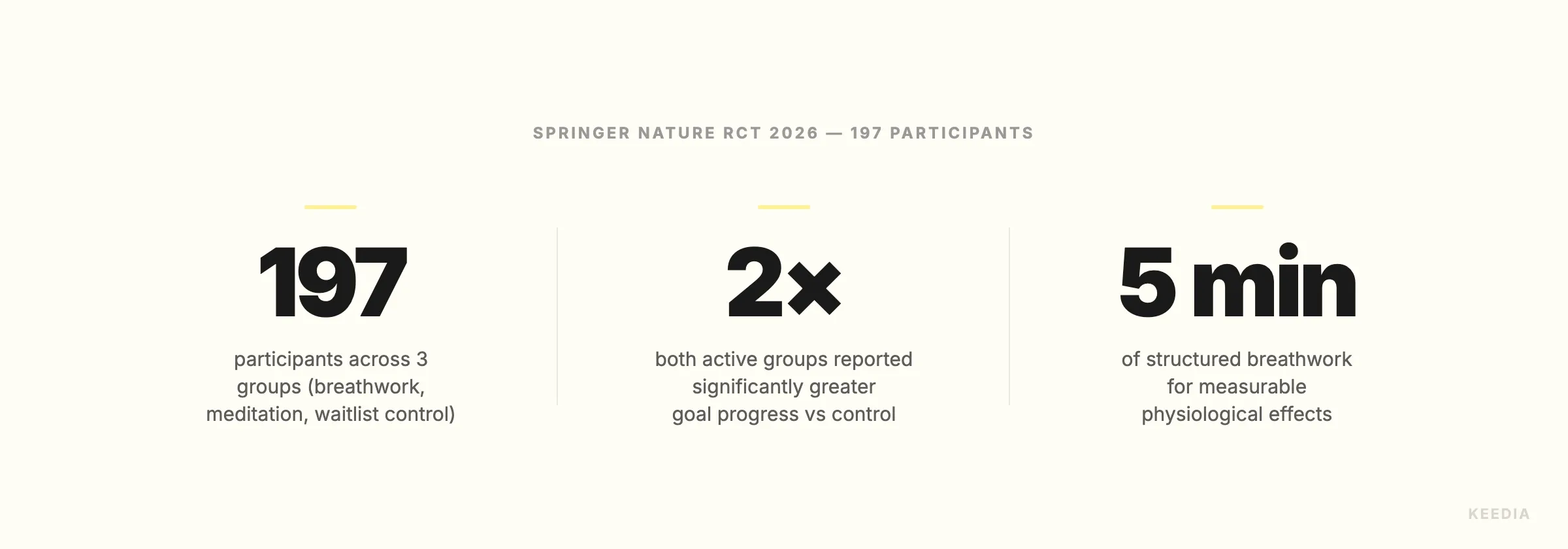
The study recruited 197 participants and assigned them to one of three conditions: a breathwork intervention, a mindfulness meditation intervention, or a waitlist control group. Both active interventions ran over the same study period. Both produced significantly greater goal progress than the control group. So far, that sounds like a tie.
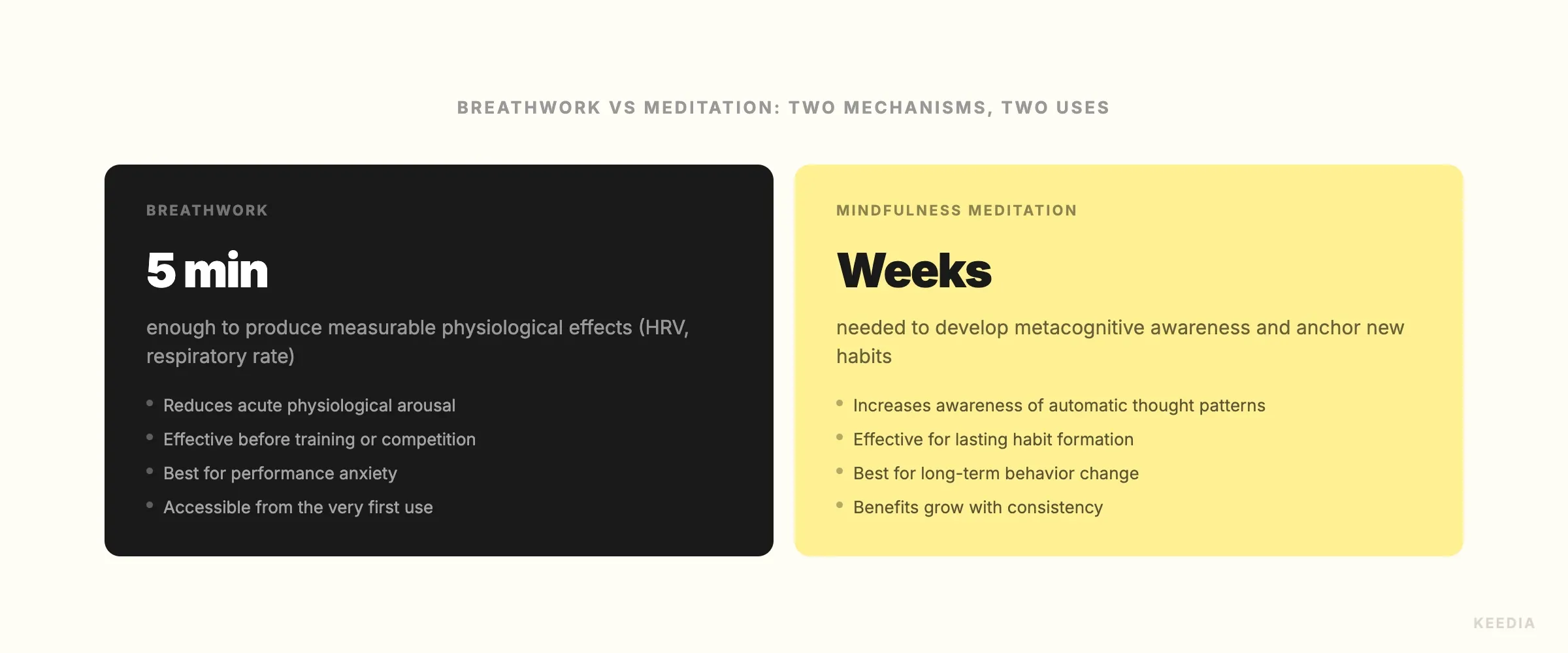
But the mechanisms diverged sharply. Breathwork worked primarily by reducing physiological arousal. Participants in the breathwork group showed measurable decreases in stress-related activation. Mindfulness, on the other hand, worked by increasing metacognitive awareness. That means participants became better at observing their own thought patterns rather than just reacting to them.
Those two outcomes are not the same thing. And they don't solve the same problems.
When Breathwork Has the Edge
If your goal is blocked by performance anxiety, pre-competition stress, or overthinking that freezes execution, breathwork is the more direct intervention. It acts on your nervous system in real time. It reduces the physiological noise that prevents you from accessing what you've already trained.
This is particularly relevant for athletes. The gap between what you can do in training and what you deliver under pressure is largely a nervous system problem. Breathwork addresses that gap directly. Mindfulness, while valuable, doesn't suppress acute arousal the way controlled breathing does.
The research on cyclic sighing makes this point clearly. A double inhale through the nose followed by an extended exhale through the mouth consistently outperforms other breathing patterns for acute mood improvement. It's more accessible than a full mindfulness practice, requires no prior experience, and produces measurable effects within minutes. For a beginner or anyone short on time, it's one of the highest return-on-investment interventions available.
Five minutes of structured breathwork produces measurable changes in heart rate variability and respiratory rate. That's a physiological shift you can track, not just a subjective feeling. For time-constrained athletes who already juggle training load, recovery, and nutrition, that efficiency matters. On that note, if you're optimizing recovery across multiple fronts, the evidence on sauna and cardiovascular health is worth stacking alongside breathwork as part of a broader protocol.
When Mindfulness Has the Edge
Metacognitive awareness is the mechanism behind habit formation and long-term behavior change. When you can observe your own thought patterns without being hijacked by them, you're better positioned to notice the cues that trigger poor decisions, interrupt automatic behavior, and build new patterns deliberately.
That's not what breathwork does. Breathwork calms you down. Mindfulness makes you a more accurate observer of your own mental processes. For goal pursuit that requires sustained behavior change over weeks and months, the mindfulness group's stronger metacognitive effects are directly relevant.
Think about what actually derails long-term goals. It's rarely a single bad decision. It's repeated, automatic behavior running on autopilot. Mindfulness disrupts that autopilot. It's also why mindfulness pairs well with habit tracking and goal review practices. You're not just doing the practice. You're developing the internal monitoring system that catches drift before it compounds.
This kind of sustained behavioral awareness also matters in contexts beyond pure athleticism. If you're trying to build consistency around nutrition, sleep, or training frequency, the metacognitive layer is what keeps you honest over time. For example, pairing mindfulness with optimized sleep strategies, like those explored in the research on magnesium and sleep for athletes, creates compounding consistency rather than isolated fixes.
The Practical Framework: Right Tool, Right Problem
Here's how to apply this in practice.
- Before training or competition: Use breathwork. Specifically cyclic sighing or box breathing (four counts in, four hold, four out, four hold). The goal is to lower acute arousal, reduce overthinking, and allow your trained capacity to express itself without interference. Five minutes is enough. You don't need more.
- As a daily habit for behavior change: Use mindfulness. Ten to fifteen minutes of open awareness or body scan practice builds metacognitive capacity over time. This is where habit formation and long-term goal tracking get their foundation. Consistency matters more than duration here.
- For beginners: Start with breathwork. The barrier to entry is lower, the effects are immediate and measurable, and it builds confidence in the broader practice of intentional mental regulation. You can layer mindfulness in once breathwork becomes automatic.
- For experienced practitioners: Use both, but deliberately. Don't conflate them. Use breathwork pre-performance and post-conflict. Use mindfulness for weekly goal reviews, behavior audits, and habit-building cycles.
The mistake most people make is treating these as alternatives rather than complements with distinct applications. Choosing one because it feels more serious or more popular isn't a strategy. Choosing based on what problem you're actually trying to solve is.
Stacking These Tools With Physical Training
Breathwork and mindfulness don't exist in isolation from your training program. If you're running structured periodization, managing training load, or working through a deload phase, mental regulation is part of the equation. Athletes who use breathwork pre-session often report better session quality not because they're more motivated, but because they're less neurologically cluttered when they start.
If you're thinking about how these practices interact with training structure, the evidence on deload protocols highlights how cognitive and physiological fatigue overlap. Managing one without the other is incomplete recovery.
Mindfulness also has a role in how athletes interpret feedback during training. The metacognitive awareness it builds helps you distinguish between discomfort that's productive and signals that something's wrong. That's a skill that takes time to develop, and it compounds with practice in the same way physical adaptation does.
For athletes also working on aerobic base development, breathwork can complement the low-intensity focus required for effective zone 2 sessions. If you're not sure how to structure that aerobic work, the approach to finding your zone 2 without a lab is a useful starting point.
What This Means for How You Structure Your Week
You don't need to overhaul your routine. The changes here are additive and small.
Five minutes of breathwork before your two or three hardest sessions of the week. Ten minutes of mindfulness three to four mornings per week. That's under forty minutes of total practice, and the evidence supports measurable returns on goal progress, arousal regulation, and metacognitive function from exactly that kind of low-volume, high-consistency approach.
The 2026 RCT didn't find that one practice is better than the other. It found that they do different things. That's the more useful finding. It means you can stop debating which one to adopt and start asking which problem you're trying to solve right now.
Performance anxiety before competition. Use breathwork. Building a training habit that actually sticks. Build mindfulness into your mornings. Both goals at once. Use both practices, on their own schedule, for their own purpose.
That's not a complicated system. It's just using the right tool for the job.