
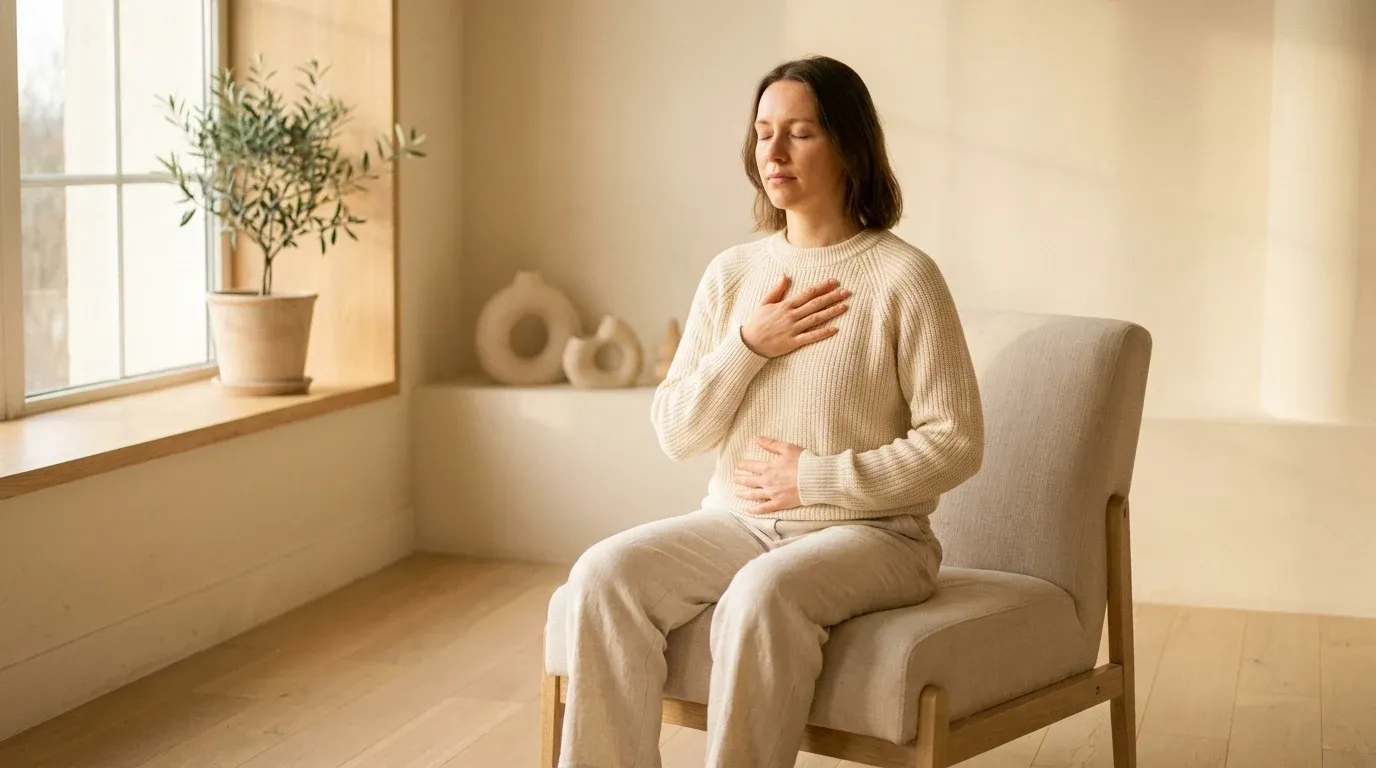
Most stress-reduction tools come with a catch. Meditation apps cost money. Therapy requires time. Even basic mindfulness training demands consistency before you see results. Coherent breathing asks for none of that. It's free, it takes minutes, and a new randomized controlled trial published in PLOS One suggests it may meaningfully reduce your physiological stress response after an acute stressor at work.
Here's what the research actually shows, why the study design matters, and how you might use this technique alongside the rest of your wellness routine.
What Is Coherent Breathing at 0.1 Hz?
Coherent breathing means pacing your breath at a specific, steady rhythm. At 0.1 Hz, that translates to roughly six breaths per minute, or about five seconds inhaling and five seconds exhaling. Most adults breathe between 12 and 20 times per minute, so this is a significant slowdown from your default pattern.
The physiological target is heart rate variability (HRV). When you breathe at 0.1 Hz, your heart rate naturally oscillates in sync with each breath cycle, a phenomenon called respiratory sinus arrhythmia. Maximizing that oscillation at 0.1 Hz is thought to activate the parasympathetic nervous system, the branch responsible for your "rest and digest" response, counteracting the sympathetic activation that stress triggers.
Higher HRV is consistently linked to better emotional regulation, lower perceived stress, and improved cardiovascular health. It's one of the reasons research on stress interventions increasingly points toward autonomic nervous system regulation as a core mechanism, not just a side effect.
The Study Design: Why This One Stands Out
Not all stress research is created equal. Many studies in this space rely on self-report questionnaires, small convenience samples, or uncontrolled conditions. This PLOS One trial used a randomized double-blind crossover design, which is one of the most rigorous formats available in behavioral research.
In a crossover design, every participant serves as their own control. Each person undergoes both the active intervention and a sham condition, which eliminates a lot of the between-person noise that weakens other study types. Blinding on both sides, meaning neither participants nor assessors knew who was receiving which condition, further reduces bias.
The setting was a real workplace environment, not a controlled laboratory, which adds external validity. Participants were exposed to an acute stressor before receiving the intervention, giving researchers a realistic window to test whether coherent breathing could actually dampen a stress response that had already been triggered.
That framing matters. The question wasn't whether slow breathing feels calming in a quiet room. The question was whether it works after you've already had a stressful morning.
The Blue Light Guidance Element
One distinctive feature of this trial was how participants were guided through the breathing. Instead of an audio cue or a visual animation on a screen, the intervention used blue light as a pacing signal. Participants followed the light rhythm to maintain the 0.1 Hz breathing rate.
This is worth noting because light-based guidance is passive and low-intrusion. It doesn't require headphones, a screen to stare at, or verbal instructions that might themselves add cognitive load. In a workplace context, that's a practical advantage.
The blue light condition was compared against a sham condition designed to match the visual experience without producing the physiological benefit of 0.1 Hz breathing. That's what makes the blinding credible: participants in the control group weren't simply sitting still or doing nothing. They were engaged with a similar-looking stimulus.
What the Trial Measured and Found
The study tracked two primary outcomes: sleepiness and the physiological stress response following an acute stressor. Sleepiness was included because stress and fatigue are often intertwined at work, and because a useful intervention shouldn't leave you drowsy or cognitively blunted.
The coherent breathing group showed meaningful improvements in stress-related physiological markers compared to the sham condition. HRV metrics shifted in the expected direction, reflecting greater parasympathetic activation. Critically, the intervention did not increase sleepiness, a finding that matters if you're considering using this technique mid-workday.
The results support the hypothesis that a short coherent breathing session can interrupt the stress response at a physiological level, not just a subjective one. That distinction is significant. Feeling calmer and actually being calmer, in terms of autonomic function, aren't always the same thing.
How This Fits Into Your Existing Wellness Routine
Coherent breathing isn't competing with the tools you already use. Think of it as a targeted add-on for specific high-stress moments rather than a wholesale replacement for exercise, sleep, or nutrition.
Research consistently shows that lifestyle behaviors compound over time. The same logic that drives the case for consistency over intensity in training applies here: small, repeated autonomic resets throughout the week may add up to measurable improvements in baseline stress resilience. One study won't settle that question, but the mechanistic case is solid.
Exercise remains one of the strongest long-term stress regulators available. Data also suggests that sustained exercise over 12 months produces measurable changes at the biological level, including markers relevant to stress and aging. Coherent breathing works on a much shorter timescale, making it useful for acute moments that exercise can't address in real time.
Sleep is another factor that interacts directly with stress physiology. If you're exploring non-pharmacological tools for recovery, recent RCT data on cannabinoids and sleep offers a useful parallel: controlled trials testing accessible interventions are raising the bar for what counts as evidence in the wellness space.
Practical Application: Using 0.1 Hz Breathing at Work
You don't need specialized equipment to try this. The 0.1 Hz rate, six breaths per minute, can be self-paced once you internalize the timing. Here's a straightforward way to practice:
- Set a timer for five minutes. That's roughly enough for 30 complete breath cycles at this pace.
- Inhale for five seconds, exhale for five seconds. Keep both phases equal and smooth. Don't force a pause at the top or bottom.
- Use a visual cue if it helps. Several free apps and browser tools display a pacing animation at 6 BPM. The blue light delivery in the trial was a more sophisticated version of the same principle.
- Time it strategically. The PLOS One trial applied the intervention after an acute stressor. That's a reasonable real-world prompt: use it after a difficult meeting, a tight deadline, or an argument, not just as a general wellness habit.
- Don't strain. If five-second cycles feel too slow at first, a four-second inhale and six-second exhale can ease you in while still targeting a slower-than-normal rate.
Consistency matters more than perfection here. A brief daily session, even outside of stressful moments, may help train your baseline HRV over time. Think of it the way you'd think about cardiovascular conditioning: the adaptation is cumulative.
What the Study Doesn't Tell Us
A single RCT, however well-designed, has limits. This trial tested a specific population in a specific workplace context. The acute stressor used in the protocol was controlled and standardized, which may not fully replicate the messier, sustained stress of a real job. Long-term effects weren't measured.
It also doesn't tell us much about who benefits most. Age, baseline HRV, breathing habits, and anxiety levels likely all moderate the response. People who already practice yoga or meditation may already breathe more slowly at rest, which could affect how much room for improvement exists.
The blue light delivery mechanism, while practical in a research setting, is also specific. Whether the benefits transfer fully to audio-guided or self-paced sessions is a reasonable question, though the underlying physiology of 0.1 Hz breathing has been studied across multiple delivery methods.
None of these caveats undermine the finding. They frame it. This is a real effect, observed under rigorous conditions, using a low-cost technique with a plausible mechanism and a growing body of supporting research.
The Bigger Picture
Workplace stress is one of the most widespread and under-addressed health issues globally. A 2023 Gallup report found that nearly half of workers worldwide reported experiencing significant daily stress. Most interventions recommended by employers, such as wellness apps, employee assistance programs, and time management workshops, have limited evidence behind them.
Coherent breathing sits in a different category. The mechanism is well-understood. The safety profile is essentially zero-risk. The delivery can be adapted to nearly any setting. And now, with a double-blind crossover trial in a real workplace, there's a meaningful layer of clinical evidence behind it.
That doesn't make it a cure. Stress is multifactorial, and no single technique addresses it completely. But as a complement to exercise, adequate sleep, and sound nutrition, a five-minute coherent breathing session after your next stressful moment is about as low-barrier as interventions get. The research says it works. Your autonomic nervous system is ready when you are.