
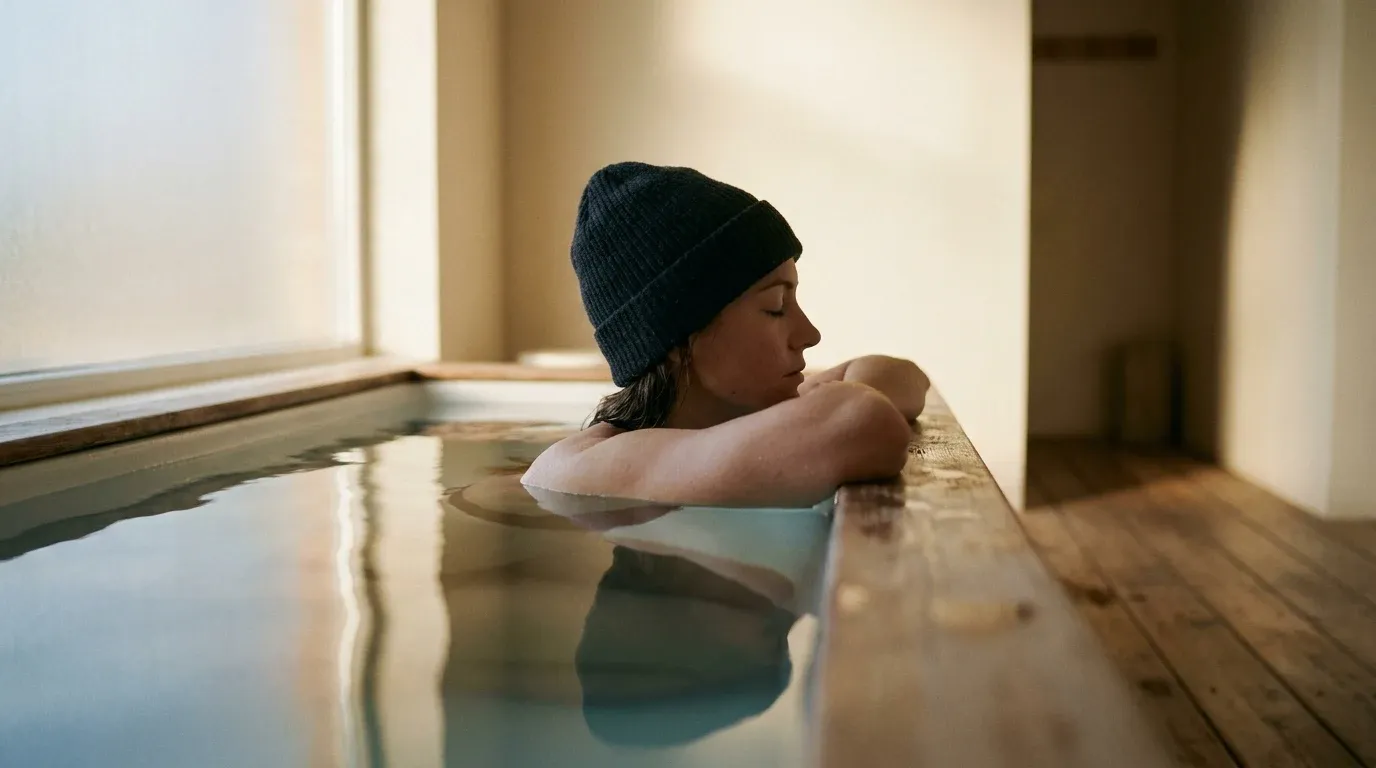
Cold-water immersion has become a fixture in gym culture. Ice baths, cold plunges, contrast therapy. Walk into almost any serious training facility and you'll find someone easing into a tub of frigid water within minutes of finishing their last set. The logic feels intuitive: you worked hard, your muscles are inflamed, cold reduces inflammation, so cold must help you recover faster.
That logic isn't wrong. It's just incomplete. And depending on your goals, applying it at the wrong time could quietly be working against you.
The Signal You're Trying to Silence Is the One You Need
When you finish a resistance training session, your muscles are damaged at a microscopic level. That damage triggers an acute inflammatory response, and that response is not a side effect of training. It's the point of training. The swelling, the heat, the soreness. those are signals that activate satellite cells and initiate muscle protein synthesis, the biological process by which your body rebuilds muscle tissue slightly larger and stronger than before.
Cold-water immersion blunts that process. Research published in the Journal of Physiology confirmed that athletes who regularly used post-exercise cold immersion showed significantly lower rates of muscle fiber growth compared to those who used active recovery. The cold suppresses key inflammatory mediators, including prostaglandins and cytokines, that act as upstream signals for muscle repair and growth. You're not accelerating recovery in those cases. You're interrupting it.
This is covered in detail in the companion piece Ice Baths Feel Good. They May Cost You Muscle., which walks through the specific molecular pathways involved. The short version: cold after lifting tells your body the emergency is over before the adaptation has had a chance to begin.
What the Research Actually Shows on Long-Term Gains
A 2019 study tracked two groups of trained men through a 12-week strength program. One group used cold-water immersion after each session. The other used active recovery (light cycling). At the end of the study, the cold immersion group showed significantly lower gains in muscle mass and strength compared to the active recovery group. Not a marginal difference. Meaningfully lower.
A separate analysis found that cold immersion after resistance training reduced the activation of mTOR signaling pathways, which are central to muscle protein synthesis. mTOR is essentially the on-switch for muscle building. Repeatedly suppressing it after sessions adds up over weeks and months into less total adaptation than you'd otherwise achieve.
If you're lifting two to four times a week with hypertrophy or strength as your primary goal, as many readers training under structured programs are, this matters. The weekly volume you're putting in only produces results if the post-training signaling cascade runs its course. Consistently cutting that short with cold exposure means leaving real gains on the table.
For a deeper look at how to structure that training volume effectively, The Weekly Lifting Sweet Spot Coaches Should Know breaks down frequency and load in a way that maximizes long-term adaptation.
When Cold Immersion Actually Makes Sense
None of this means cold-water immersion is useless. It means context is everything.
There are scenarios where managing soreness in the short term is more important than optimizing adaptation over weeks. Those scenarios are real, and athletes who dismiss cold therapy entirely on the basis of hypertrophy research are making the opposite mistake.
Here's when cold immersion earns its place:
- Back-to-back competition days. Team sport athletes, combat sports competitors, or anyone who needs to perform again within 24 hours benefit significantly from reduced soreness and improved perceived readiness. In that window, adaptation is secondary to function.
- High-frequency training blocks. During periods where you're training the same muscle group two or more times within 48 hours, for example a tournament prep block or an intensive training camp, cold can help you maintain quality across sessions even if it mildly reduces the adaptive signal per session.
- Skill or technique sessions where muscle fatigue impairs learning. If your next session is technically demanding and you need your neuromuscular system as fresh as possible, reducing residual fatigue takes priority.
- Non-hypertrophy training phases. If you're in a maintenance block, a deload, or primarily training for cardiovascular fitness or skill, the suppression of muscle-building signals is simply less relevant.
The key distinction is whether you're optimizing for today's performance or next month's physique. Those are different objectives, and they warrant different recovery tools.
The Recovery Hierarchy Worth Understanding First
Before reaching for cold therapy, it's worth making sure the basics are in place. Research consistently shows that sleep quality and nutritional timing outperform most recovery interventions in terms of actual muscle repair and adaptation support.
Protein intake in particular matters enormously. Getting sufficient leucine-rich protein within a few hours of training supports muscle protein synthesis regardless of whether inflammation is present. Cold immersion, even when appropriate, doesn't substitute for that. As covered in Sleep and Food Still Beat Every Recovery Gadget, the gap between what diet and sleep can do versus what any single recovery tool can do is wider than most people assume.
If you're not hitting your protein targets consistently, that gap deserves attention before cold plunge timing becomes a priority. For guidance on how those targets shift with age and life stage, Your Protein Needs Change With Life Stage. Here's How. provides useful benchmarks.
A Decision Framework for Cold Immersion After Strength Training
The question isn't whether cold immersion is good or bad. It's whether it's the right tool for the specific session you just completed and the goal you're working toward. Here's a straightforward framework for making that call.
Skip cold immersion after a strength session if:
- Your primary goal is muscle hypertrophy or maximum strength development.
- You have at least 48 hours before your next training session for the same muscle group.
- You're in a progressive overload phase where long-term adaptation is the priority.
- You have no performance requirement in the next 12 to 24 hours.
Use cold immersion after a strength session if:
- You need to perform again in less than 24 hours.
- You're in a high-frequency block where soreness management protects training quality.
- You're not in a hypertrophy-focused phase and adaptation per session is not the priority.
- The session was unusually high volume and you're managing acute soreness to protect movement quality for a skill or technique session the next day.
This framework works regardless of whether you're using a professional cold plunge setup, a bathtub with ice, or a cold shower. The temperature target most research uses is between 50 and 59 degrees Fahrenheit (10 to 15 degrees Celsius), with immersion durations of 10 to 15 minutes. Going longer or colder doesn't linearly increase benefit and may increase the suppressive effect on recovery signaling.
Timing Within a Training Week Also Matters
If you lift Monday, Wednesday, and Friday with rest days in between, avoiding cold immersion after those sessions gives the inflammatory cascade time to run its full course. If you then want to use cold on a rest day, perhaps for mental wellness or general relaxation, you're not interrupting any active post-training signal. That's a reasonable compromise for people who value the psychological benefits of cold exposure without wanting to trade away muscle adaptation.
Periodization thinking applies here just as it does to training loads. You can plan cold use strategically, keeping it for competition periods or specific high-density training blocks, while protecting the adaptive window during your base-building phases.
For athletes navigating longer recovery windows, particularly those over 40 where post-training inflammation resolves more slowly, Why Recovery Takes Longer After 40 (And What to Do) outlines how physiology shifts and which interventions remain worth prioritizing as you age.
The Bottom Line on Cold and Muscle Building
Cold-water immersion is a legitimate recovery tool. It reduces soreness, improves perceived readiness, and has real applications in high-performance contexts. But it's not a universal recovery solution, and treating it like one has a measurable cost if strength or muscle growth is your goal.
The inflammation you feel after a hard lifting session isn't damage to be suppressed. It's a biological conversation your body is having with itself, one that ends in new muscle if you let it run. Cold immersion pauses that conversation. Sometimes that's the right call. Often, it isn't.
Know which situation you're in before you fill the tub.