
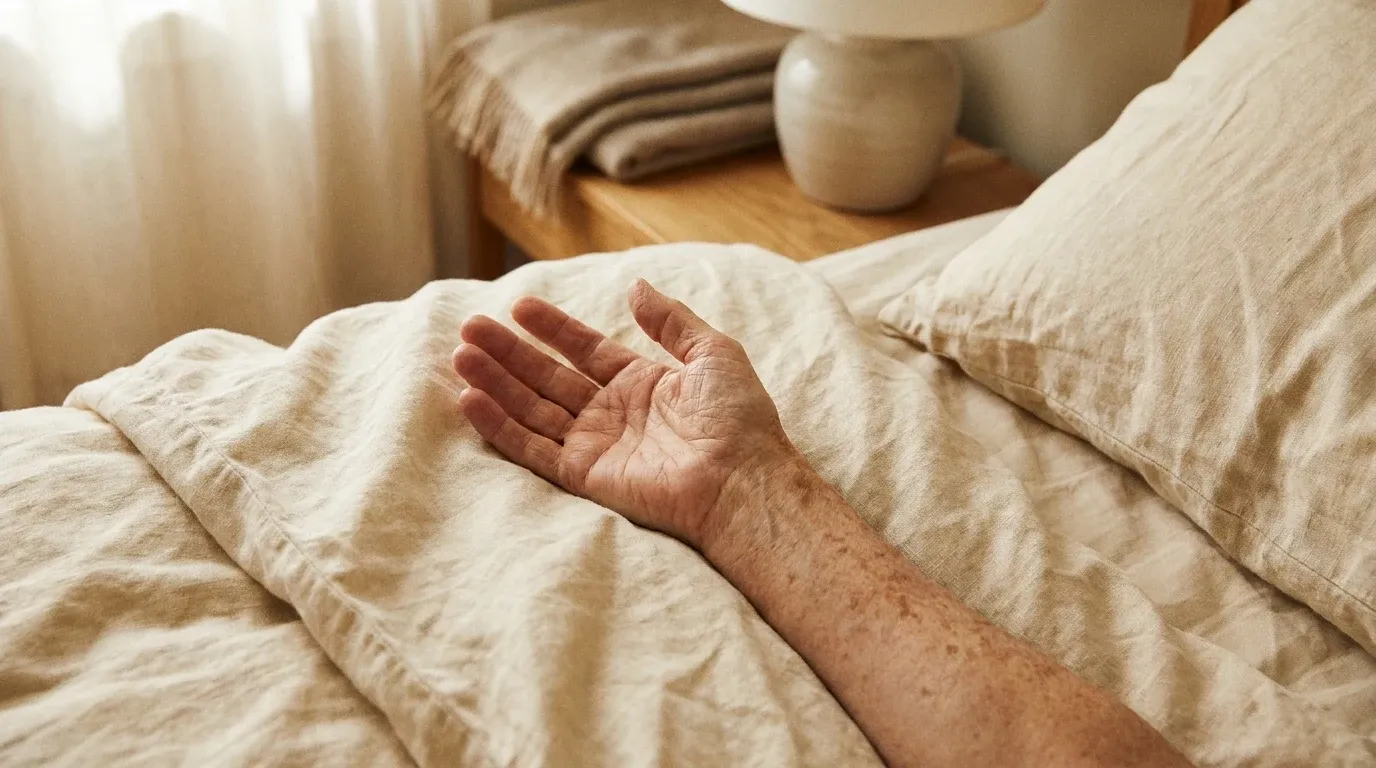
Every night, while you sleep, your brain runs a biological cleaning cycle. Cerebrospinal fluid pulses through narrow channels, flushing out metabolic waste products that accumulate during waking hours. This system, known as the glymphatic system, depends almost entirely on deep sleep to function. And new research from MIT suggests that as you get older, that cleaning cycle becomes significantly less effective.
The findings point to a troubling chain of events: reduced deep sleep leads to impaired waste clearance, which may accelerate the buildup of proteins linked to Alzheimer's and other neurodegenerative diseases. Understanding why this happens, and what you can realistically do about it, matters more than most people realize.
What MIT Researchers Found
The MIT study focused on slow brain waves, specifically the low-frequency oscillations that define deep, slow-wave sleep. These waves, which occur at around 0.5 to 2 Hz, appear to drive the rhythmic movement of cerebrospinal fluid through the brain's glymphatic channels. When researchers compared brain activity during deep sleep across different age groups, they found a clear and significant reduction in slow-wave amplitude and coherence in older adults.
In practical terms, this means older brains generate weaker, less coordinated slow waves during sleep. The pumping action that moves waste-clearing fluid through the brain is diminished. The brain's nightly clean-up becomes incomplete.
This builds on earlier work showing how the glymphatic system operates. To understand the basic mechanics of how sleep clears waste from the brain, the research on how sleep actually clears waste from your brain lays out the foundational science clearly. The MIT findings add an important layer: it's not just about getting sleep, it's about the quality and depth of that sleep, and both decline with age in measurable ways.
The Link to Neurodegenerative Disease
The glymphatic system is particularly responsible for clearing amyloid-beta and tau proteins from the brain. These are the same proteins that accumulate in Alzheimer's disease. When slow-wave sleep weakens, the clearance of these proteins slows down. Over years and decades, the buildup accelerates.
This creates what researchers describe as a vicious cycle. Poor sleep leads to more amyloid accumulation. Amyloid accumulation further disrupts sleep architecture. The decline compounds itself, which is part of why cognitive deterioration often accelerates once it begins.
The MIT research adds to a growing body of evidence suggesting that the sleep changes associated with aging aren't just an inconvenience. They may be a meaningful driver of neurological risk, not simply a byproduct of it. That distinction shifts how we should think about protecting sleep in midlife and beyond.
How Deep Sleep Changes With Age
Deep sleep, or slow-wave sleep, typically occupies roughly 20 percent of total sleep time in young adults. By the time you reach your 60s, that figure can drop to under 10 percent. The drop isn't just about total sleep duration. The structure of sleep itself changes.
Older adults tend to cycle through sleep stages more quickly, spending less time in the deeper phases of each cycle. Sleep becomes more fragmented. The brain's ability to generate the slow oscillations that characterize true restorative sleep weakens due to changes in neuronal connectivity and the density of sleep-promoting neurons in key brain regions.
Some of this is unavoidable. But the research is clear that lifestyle factors significantly influence how much slow-wave sleep you preserve, and how effectively your brain generates those critical slow waves when you do sleep.
What You Can Actually Do About It
The good news is that slow-wave sleep is not entirely beyond your control. Several evidence-based strategies can support slow-wave activity and, by extension, glymphatic function.
Keep Your Sleep Schedule Consistent
Circadian rhythm consistency is one of the strongest predictors of sleep quality. When you go to bed and wake up at the same time every day, including weekends, your body's internal clock aligns more precisely with your sleep architecture. This alignment supports the natural scheduling of slow-wave sleep in the early part of the night.
Irregular sleep timing disrupts this architecture even when total sleep hours are maintained. Studies suggest that social jet lag, the mismatch between your biological clock and your actual sleep schedule, is associated with reduced slow-wave activity regardless of age.
Lower Your Bedroom Temperature
Core body temperature naturally drops as you enter deep sleep. This thermoregulatory drop is part of what triggers slow-wave activity. A cooler bedroom environment supports that process. Research suggests an ambient temperature of around 65 to 68 degrees Fahrenheit (18 to 20 degrees Celsius) is optimal for most adults.
As you age, thermoregulation becomes less efficient. That makes the bedroom environment more important, not less. Cooling your room down before bed gives your biology less work to do and creates better conditions for the brain wave patterns you're trying to preserve.
Exercise Regularly, and Vary the Intensity
Physical activity is one of the most reliably documented methods for increasing slow-wave sleep. Aerobic exercise in particular has been shown to increase the amplitude of slow oscillations during subsequent sleep, with effects measurable even in older adults.
High-intensity interval training has shown specific benefits here. Research on HIIT once vs. three times a week shows that even limited frequency produces meaningful cardiovascular adaptations, and those adaptations correlate with improvements in sleep quality. You don't need to exercise every day to see benefits, but consistency over weeks matters more than any single session.
Strength training also contributes. For women navigating the hormonal shifts of midlife, understanding how to adjust strength training through menopause is particularly relevant, since menopause itself is associated with significant deterioration in sleep architecture and slow-wave activity.
Exercise also supports bone health, and emerging research suggests that high-impact movement plays a role that resistance training alone doesn't cover. Your bones need more than lifting to stay strong, and the same explosive, impact-based activities that benefit bone density also appear to support cardiovascular fitness and, through that pathway, deeper sleep.
Limit Alcohol and Sedatives
Alcohol is widely misunderstood as a sleep aid. While it does reduce sleep onset latency, it significantly suppresses slow-wave sleep in the second half of the night. The result is sleep that feels like rest but lacks the restorative depth that the brain needs for effective waste clearance.
Sedative sleep medications present a similar problem. Benzodiazepines and many over-the-counter sleep aids alter sleep architecture in ways that reduce slow-wave activity. For older adults already experiencing age-related declines in deep sleep, these substances compound an existing vulnerability rather than address it.
Manage Light Exposure
Light is the primary signal that sets your circadian clock. Morning light exposure, ideally within an hour of waking, reinforces a robust circadian rhythm that in turn supports proper sleep architecture. Evening exposure to blue-spectrum light from screens suppresses melatonin and delays sleep onset, which can shorten the deep sleep window early in the night.
This is not a minor concern. Chronic circadian disruption, even mild forms caused by inconsistent light exposure, is associated with reduced slow-wave amplitude. Using blue-light filters in the evening or simply reducing screen brightness after sunset takes about 30 seconds to implement and has meaningful cumulative effects over time.
Recovery as a Whole-System Priority
The MIT research reframes deep sleep not as a passive state but as an active physiological process with serious long-term consequences when it's impaired. For older adults, that reframing has real implications for how recovery is prioritized.
Sleep is often the first thing people compromise when schedules are busy. It's treated as flexible. But if the glymphatic system depends on deep sleep to prevent the accumulation of proteins that drive neurodegeneration, then cutting sleep short, or accepting poor sleep quality as inevitable, carries a cost that extends well beyond feeling tired the next morning.
Understanding the difference between active and passive recovery approaches can also help you structure your overall wellness routine in a way that supports, rather than undermines, sleep quality. The question of active vs. passive recovery isn't just about muscle repair. It's about how every component of your daily routine either contributes to or detracts from the depth of sleep your brain gets each night.
The science is increasingly clear: deep sleep is not a luxury, and its decline with age is not entirely beyond your influence. The strategies that protect it overlap significantly with the strategies that protect cardiovascular health, metabolic health, and musculoskeletal function. That's not a coincidence. It's a signal that your body's systems are more integrated than they appear, and that taking sleep seriously is one of the most evidence-backed decisions you can make for long-term brain health.