
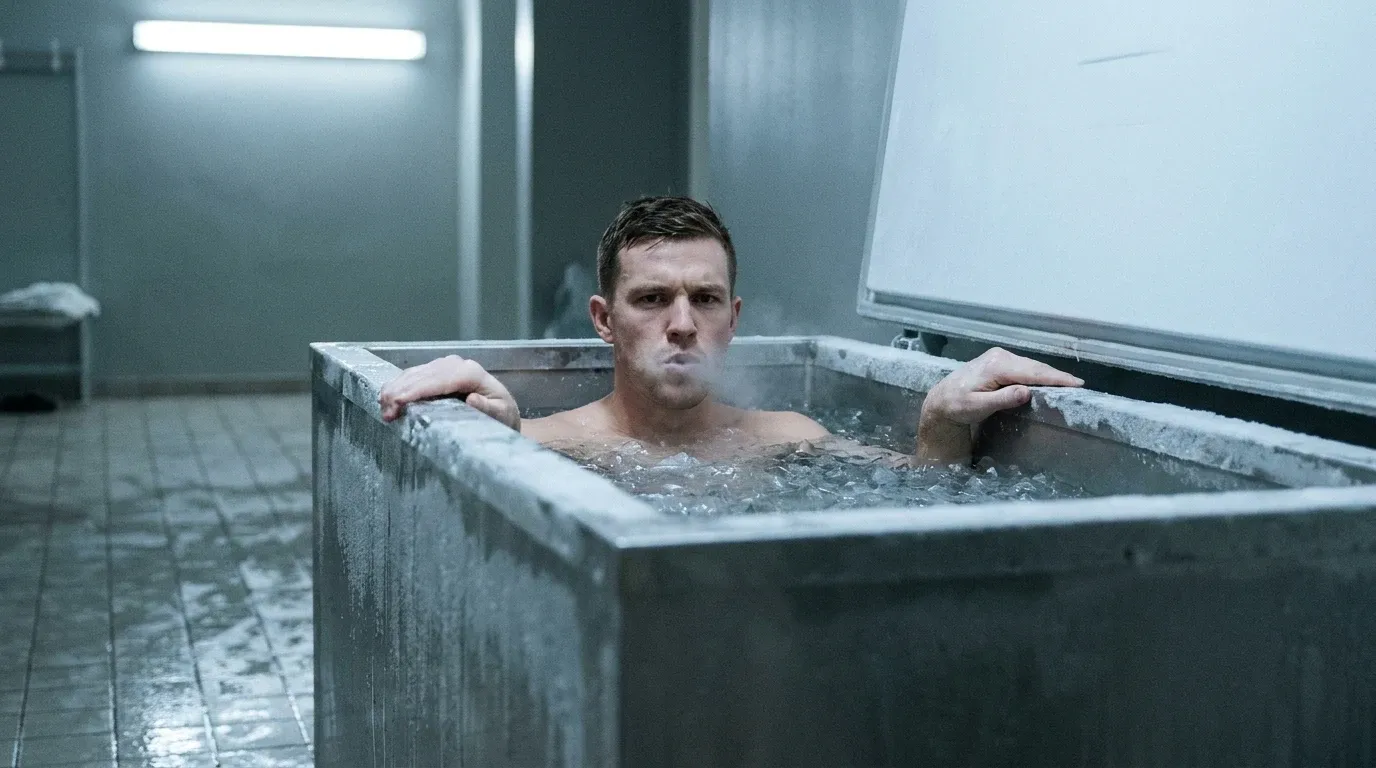
Cold-water immersion has gone from fringe recovery hack to mainstream ritual. Walk into any serious training facility and you'll find athletes climbing into ice baths after almost every session, convinced they're accelerating recovery. Some of them are right. Some of them are actively working against their own goals. The difference comes down to what you're training for, and when.
New research doesn't position ice baths as universally good or bad. It positions them as context-dependent tools. Used at the right time, for the right purpose, they deliver real performance benefits. Used habitually in the wrong context, they interfere with the cellular processes your body needs to get stronger.
What Cold-Water Immersion Actually Does
When you submerge in cold water, typically between 50°F and 59°F (10°C to 15°C) for 10 to 15 minutes, several things happen simultaneously. Blood vessels in the muscles constrict, reducing blood flow and limiting the inflammatory response. Core temperature drops. The nervous system shifts toward a parasympathetic state. Perceived soreness and fatigue decrease.
These effects are real and measurable. The question isn't whether they occur. The question is whether suppressing that inflammatory response is always something you want.
Inflammation after training isn't purely damage. It's also a signal. It tells your muscles to adapt, to rebuild thicker fibers, to generate more contractile protein. When you blunt that signal aggressively and repeatedly, you don't just feel less sore. You reduce the adaptation itself.
The Case for Ice Baths: Multi-Event and Tournament Recovery
Here's where cold-water immersion earns its reputation. If you're competing in a tournament, a multi-stage race, or any format where you need to perform again within 24 hours, ice baths offer a measurable advantage.
Research on team sport athletes competing in back-to-back matches shows that cold-water immersion significantly reduces perceived fatigue, restores sprint capacity, and maintains neuromuscular output between sessions separated by as little as 16 to 24 hours. The suppression of inflammation that works against you in a long-term hypertrophy program works for you when the priority is showing up functional tomorrow morning.
In these scenarios, the inflammatory cascade has nowhere useful to go. You're not resting for 48 to 72 hours to let adaptation occur. You need the acute tissue swelling managed, the nervous system calmed, and the perception of readiness restored. Cold water does exactly that.
Endurance athletes face a similar reality. A cyclist completing consecutive race days, a triathlete in a stage event, or a rugby player on a tournament weekend all share the same constraint: performance is the immediate priority, not adaptation. For these athletes, regular cold immersion is not just defensible. It's strategic.
The Case Against Ice Baths: Resistance Training and Muscle Growth
Now for the part that might change how you're currently using them.
If your primary training goal is building muscle or developing maximal strength, habitual post-session ice baths are likely slowing your progress. The research on this has become increasingly consistent. Cold-water immersion applied regularly after resistance training attenuates the anabolic signaling pathways, specifically mTOR and satellite cell activation, that drive muscle protein synthesis.
One frequently cited set of studies found that athletes who used cold-water immersion after every strength session over several weeks showed significantly smaller gains in muscle mass and strength compared to those who used active recovery like light cycling. The cold-treated group wasn't just recovering differently. They were adapting less.
This matters if you're trying to break through a strength plateau. Adding ice baths to your post-lifting routine might feel productive, but it may be one of the factors undermining your progress at the cellular level.
The mechanism isn't complicated. Resistance training creates localized muscle damage and inflammation. That inflammation triggers a hormonal and cellular cascade that ultimately produces stronger, larger muscle fibers. When you cool the tissue aggressively within the first hour or two after training, you interrupt that cascade before it completes. Do that consistently over weeks and months, and the cumulative effect on adaptation is significant.
Timing and Frequency: The Variables That Matter Most
Not all cold exposure is equal. The timing relative to your training session appears to be critical.
Cold-water immersion performed more than four to six hours after resistance training shows substantially less interference with anabolic signaling than immersion performed immediately post-session. If recovery is your goal and you're not competing in the next 24 hours, waiting several hours or shifting cold exposure to a non-training day reduces the blunting effect considerably.
Frequency matters as well. Occasional cold immersion, used strategically around high-stress training blocks or competition, is different from daily post-workout ice baths that become a default recovery ritual. The research suggesting impaired muscle gain focuses primarily on habitual, session-to-session use. Athletes who reserve cold immersion for specific high-load periods don't appear to face the same level of adaptive interference.
This aligns with broader recovery science, which consistently shows that more isn't better when it comes to recovery interventions. The goal is to support the training stimulus, not override it. As covered in our look at why cheap recovery often outperforms expensive tech, the simplest interventions applied intelligently tend to outperform complex protocols used indiscriminately.
Practical Guidelines Based on Your Goal
The clearest way to apply this research is to match your recovery tools to your actual training objective.
- If you're competing in back-to-back events or multi-day formats: Cold-water immersion is well-supported. Use it within one to two hours post-event, 10 to 15 minutes at 50°F to 59°F. Prioritize it over passive rest when time between performances is short.
- If you're in a strength or hypertrophy training block: Limit or skip ice baths in the hours immediately following your sessions. If you want cold exposure for general recovery or stress management, time it at least six hours post-training or on rest days.
- If you're an endurance athlete with no back-to-back performance pressure: The evidence is less clear-cut. Cold immersion may still blunt some endurance adaptations, though the effect appears smaller than with resistance training. Use it selectively around heavy training blocks rather than as a daily default.
- If your primary goal is general wellness rather than performance: Occasional cold immersion carries real benefits for mood, stress regulation, and perceived recovery. Without a competing anabolic goal, the trade-offs are minimal.
It's also worth noting that cold exposure in other forms, such as cold showers or localized ice packs on specific joints, doesn't carry the same systemic effects as full-body cold-water immersion. The research on adaptation blunting relates specifically to full-body or lower-body submersion for sustained durations.
What You're Competing With
Recovery is a system, and ice baths are one input. The mistake most athletes make is treating any single intervention as a primary lever rather than one component in a larger picture.
Sleep quality has a substantially larger impact on muscle repair and hormonal recovery than cold immersion does in either direction. Research tracking over 23,000 people's sleep patterns has shown consistent associations between sleep regularity and systemic recovery markers, with irregular sleep timing linked to elevated inflammatory profiles that no ice bath can reverse.
Nutrition timing, specifically protein availability in the hours around training, also exerts a larger effect on muscle protein synthesis than whether you cool tissue post-session. And understanding how often you actually need to train to maintain or build muscle, particularly during periods when you're managing recovery more carefully, is worth revisiting. The minimum effective dose for maintaining muscle is lower than most people assume, which creates flexibility in how you structure training loads around competition periods where cold immersion is strategically appropriate.
Recovery choices also interact. If you're already compromising adaptation through poor sleep, inconsistent nutrition, or high life stress, adding ice baths after every strength session compounds the interference. If your foundational recovery is solid, the occasional post-training cold dip carries less total risk. But the reverse is also true: if you're in a tournament format and genuinely need to perform tomorrow, cold immersion combined with strong sleep and protein intake creates a recovery stack that's genuinely effective.
The Bottom Line
Ice baths are not a universal recovery tool. They're a performance management tool with specific use cases. When you need to compete again soon and adaptation is secondary, they work. When you're in a training block focused on building muscle and strength, they get in the way.
The athletes who benefit most from cold-water immersion are those who use it deliberately, not habitually. They know what they're trying to accomplish, they know what recovery window they're in, and they apply the intervention accordingly.
If you've been defaulting to an ice bath after every session regardless of context, it's worth auditing that habit. The goal isn't to avoid cold exposure entirely. It's to use it when it serves your actual objective, and skip it when it doesn't. That's not a complicated framework. It's just an honest one.
Recovery tools, from cold immersion to wearables to supplements, are most valuable when they're matched to a specific physiological need. If you're assessing your full recovery stack, it's also worth examining how chronic stress interacts with physical recovery, since it operates through many of the same inflammatory pathways that cold exposure affects.