
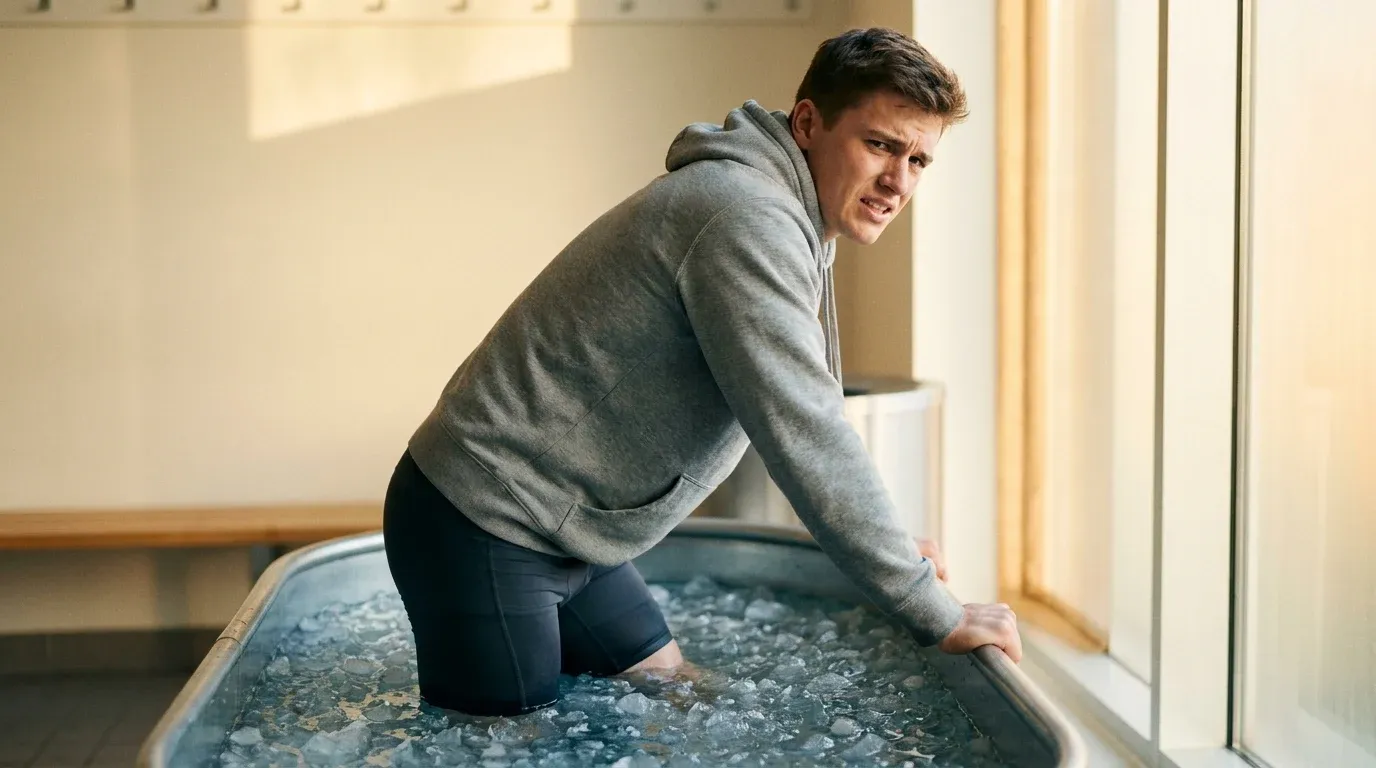
Cold-water immersion has become one of the most visible rituals in modern fitness culture. Athletes post ice bath videos. Gyms advertise plunge pools. Wellness brands sell portable cold tubs for upward of $500. But a wave of new scientific reviews is complicating the narrative around this recovery staple, and the findings are worth paying attention to if building strength or muscle is your primary goal.
The short version: the inflammation you're trying to suppress after a hard training session may be exactly what your muscles need to grow.
What the Latest Science Actually Says About Ice Baths
Post-exercise inflammation has long been treated as a problem to solve. Soreness, swelling, and fatigue in the hours after training are uncomfortable, and the instinct to reduce them is understandable. Cold-water immersion works, to a point. It numbs discomfort, reduces perceived soreness, and helps athletes feel ready for their next session faster.
The problem is that those inflammatory signals. the ones ice baths are specifically designed to blunt. are not just side effects of hard training. They are central drivers of muscle adaptation. Recent meta-analyses confirm that cold-water immersion significantly reduces the acute inflammatory response following resistance exercise, and in doing so, it appears to interfere with the cellular signaling cascades that stimulate muscle protein synthesis and long-term hypertrophy.
Specifically, research points to suppression of satellite cell activity and blunted mTOR pathway signaling, both of which are critical for muscle repair and growth. Studies comparing athletes who use cold-water immersion after strength training against those who use passive recovery consistently show smaller gains in muscle size and maximal strength over weeks and months of training. The effect isn't dramatic in any single session, but it compounds over time.
If you're training primarily for strength or hypertrophy, the evidence increasingly suggests that reaching for the ice bath after every lifting session may be quietly working against your goals.
Massage Guns, Compression Gear, and Recovery Supplements: Overhyped?
Ice baths aren't the only recovery tool getting a harder look. The same wave of reviews has scrutinized other popular interventions, and the picture is similarly sobering for consumers who've spent hundreds of dollars on recovery technology.
Massage guns are effective at reducing perceived muscle soreness and improving short-term range of motion. But current evidence does not support claims that they meaningfully accelerate muscle repair or improve performance outcomes over time. They feel good. That's a real benefit. But the $300 to $600 devices are not doing what many users believe they're doing at a physiological level.
Compression garments show modest benefits for perceived recovery and minor reductions in delayed onset muscle soreness. The effect sizes in controlled studies are small, and there's limited evidence that wearing compression sleeves or tights translates into measurable performance gains in subsequent training sessions.
Recovery-specific supplements, including products marketed around branch-chain amino acids (BCAAs) as standalone recovery aids, tart cherry extract, and various "recovery blends," show mixed results in the literature. Some components have legitimate support in specific contexts, but the overall category is overstated relative to what the evidence can actually back up, particularly when baseline nutrition is already adequate.
None of this means these tools are useless. Reducing soreness has real value, especially for athletes managing high training volumes or competing in consecutive events. But there's a meaningful difference between "helps you feel better" and "drives muscle adaptation," and the marketing around recovery products frequently conflates the two.
What Actually Works for Muscle Recovery
The most evidence-supported recovery strategies are also the least glamorous. They don't involve cold plunge pools or percussive therapy devices. They're also free, or close to it.
Sleep is the single most powerful recovery tool available to any athlete. During deep sleep stages, the body releases growth hormone, clears metabolic waste from muscle tissue, consolidates motor learning from training, and drives the repair processes that cold immersion was interrupting. Deep sleep builds muscle, burns fat, and protects brain health, and no recovery product on the market comes close to replicating those effects. Seven to nine hours for most adults. Consistent sleep and wake times. A cool, dark room. That's the protocol.
Protein intake is the other non-negotiable. Muscle protein synthesis requires adequate substrate. Current evidence supports a daily intake of 1.6 to 2.2 grams of protein per kilogram of bodyweight for individuals focused on hypertrophy, distributed across meals throughout the day. No recovery drink replaces that foundation.
Scheduled rest days remain underutilized, particularly among motivated athletes who conflate more training with faster progress. Muscle growth happens during recovery, not during the training session itself. Programming deliberate rest is not laziness. It's physiology.
For anyone working with a coach or considering professional guidance on structuring recovery alongside training, what a coach should change first when training athletes over 35 addresses exactly how recovery needs to be weighted more heavily as the body's repair timeline extends with age.
Who Should Still Use Cold-Water Immersion
The findings around cold immersion and blunted muscle adaptation are most relevant for strength and hypertrophy athletes. If your primary training goal is to get bigger or stronger, the evidence for limiting ice baths after resistance sessions is now reasonably strong.
The calculus is different for endurance athletes. Long-distance runners, cyclists, triathletes, and hybrid athletes competing across multiple events in close succession have different recovery priorities. For these athletes, managing soreness and reducing systemic fatigue between sessions matters more than maximizing the acute anabolic signal from any single workout. Cold-water immersion can genuinely support that goal without the same trade-off in adaptation.
The distinction also applies to competitive contexts. An athlete competing in a tournament or multi-day event who needs to perform again in 24 hours is not in the same situation as someone doing a standard weekly strength program. Soreness management becomes the priority, and cold immersion earns its place in that context.
Hybrid athletes, including the growing number of women pursuing demanding multi-modal competition formats, are navigating this trade-off more frequently. Women in their 30s and 40s training for HYROX are a good example of a population for whom recovery strategy needs to be individualized rather than applied by default.
The Bigger Problem With Recovery Culture
The broader issue isn't ice baths specifically. It's the way the wellness industry has successfully reframed basic biological processes as problems requiring expensive technological solutions.
Recovery is not a product category. It's a set of physiological processes that occur when you give your body adequate time, nutrition, and sleep. The $400 compression boots, the cold plunge memberships, the recovery-specific wearable data dashboards. these tools exist at the margin of what actually drives adaptation. They're not worthless, but their benefits are consistently smaller than the fundamentals they're being sold alongside, and sometimes in place of.
There's also a compliance cost worth naming. Time spent in an ice bath, researching recovery supplements, or interpreting wearable recovery scores is time not spent sleeping, cooking adequate protein-rich meals, or simply resting. Passive rest may actually be one of the best recovery strategies available, precisely because it requires nothing and costs nothing, yet remains the most systematically undervalued option in a market that profits from complexity.
The fitness industry has a long history of selling solutions to problems it helped create. Recovery anxiety is the newest version of that pattern. If you're lying awake worrying about your HRV score, that's not recovery optimization. That's the opposite.
What to Do With This Information
You don't need to throw out your ice bath or sell your massage gun. But it's worth being honest about what these tools are actually doing for you, and what they're not.
- If strength and hypertrophy are your primary goals, limit cold-water immersion to rest days or off-season periods, or use it strategically for soreness management rather than as a default post-lifting ritual.
- Prioritize sleep above every other recovery intervention. Seven to nine hours of quality sleep consistently outperforms any device or supplement on the market.
- Hit your daily protein targets before spending money on recovery products. The substrate for muscle repair has to come from somewhere.
- Build scheduled rest days into your program. Treat them as training, not as failure.
- Use cold immersion, compression, and massage tools for what they're actually good at: managing soreness and improving how you feel, especially in high-volume training blocks or around competitions.
The science on recovery is not telling you to do less. It's telling you to be smarter about where you put your effort and your money. The fundamentals are free. The expensive options are optional extras at best, and counterproductive at worst, depending on your goals.
For readers thinking about how these principles apply across different life stages and training contexts, the relationship between deep sleep and hormonal recovery is a useful place to start understanding why the basics keep outperforming the gadgets.