
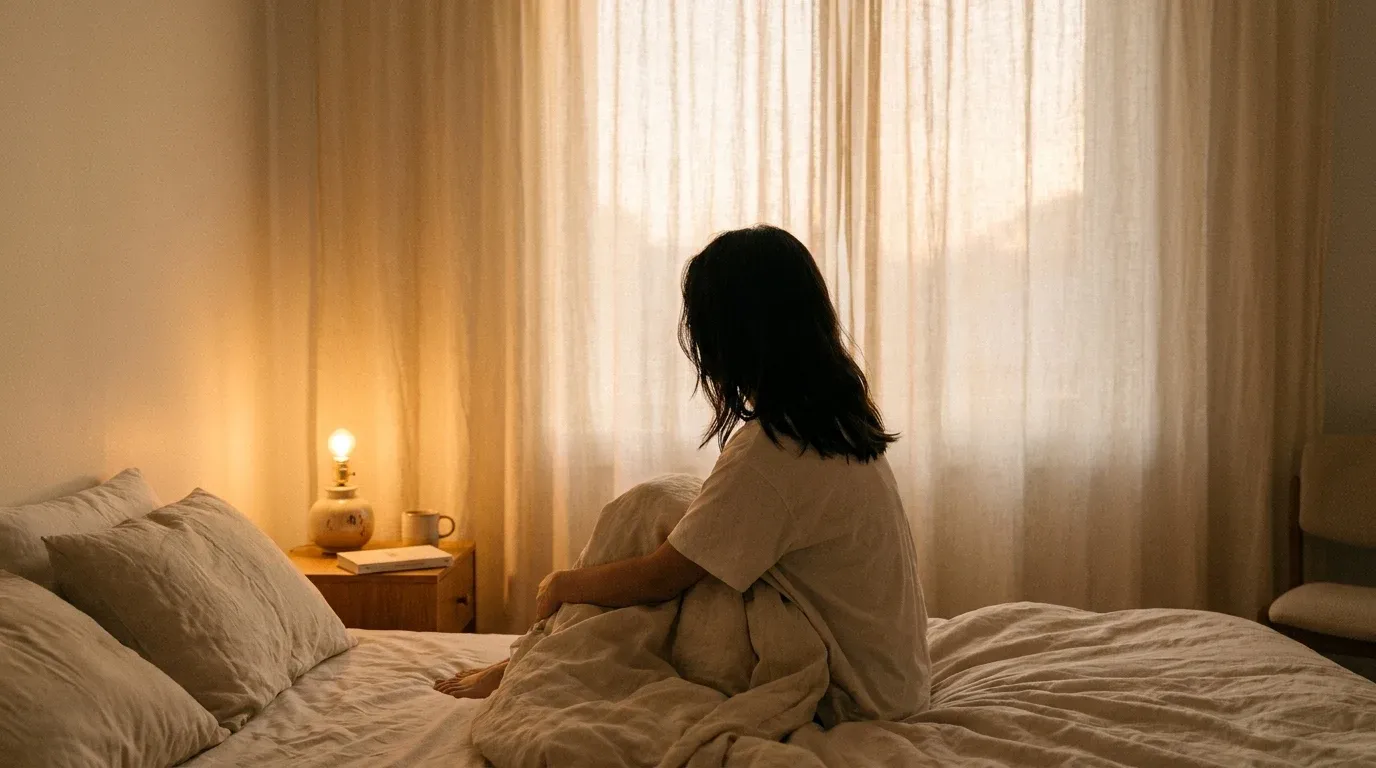
Every October, millions of people notice the same thing: they're tired earlier, groggier in the morning, and vaguely off in a way they can't quite name. Most chalk it up to stress, a busy season, or not exercising enough. The actual cause is more specific, and the fix is more actionable than you'd expect.
Fall doesn't just feel different. It changes the biological signals your body uses to regulate sleep. Once you understand the mechanism, the seasonal slump stops feeling mysterious and starts feeling manageable.
What Fall Actually Does to Your Body Clock
Your circadian rhythm runs on light. Specifically, it runs on the timing, intensity, and spectrum of light hitting your retina throughout the day. Your brain uses that information to schedule hormone releases, including the morning cortisol spike that wakes you up properly and the melatonin surge that pulls you toward sleep at night.
In fall, that light input shrinks. Dawn arrives later. Dusk arrives earlier. The total daily light exposure you're getting drops significantly, often by two to three hours compared to midsummer. That reduction has a direct physiological consequence: your morning cortisol peak becomes blunted and delayed, and your melatonin onset shifts earlier in the evening.
The result is a pattern that feels like fatigue but is actually a mild phase shift. You feel sleepy at 9 p.m. instead of 11 p.m. You wake up at your usual time but feel as though you haven't slept. Your body has essentially started adjusting toward a longer-night schedule, while your calendar hasn't. That mismatch is what's exhausting you.
The Clock Change Makes It Worse
Late October delivers a second hit on top of the gradual seasonal shift: daylight saving time ends in most of the US, UK, Canada, and Australia. Clocks roll back one hour, and the light-dark cycle abruptly shifts to match. Research consistently shows that the average adult takes five to seven days to fully re-entrain their circadian rhythm after a one-hour clock change. That's nearly a full working week of impaired sleep quality, reaction time, and mood.
The "fall back" version is generally considered less disruptive than spring's "spring forward," but it's not harmless. The early darkness that follows the clock change compresses your evening light exposure even further, often triggering that 8 or 9 p.m. sleepiness while also causing you to wake too early in the morning, confused by the new dawn timing.
It's also worth noting that this isn't a minor inconvenience. Studies tracking health data around clock transitions show measurable upticks in sleep disturbance, mood disruption, and metabolic irregularity in the days immediately following the shift. If you've ever felt inexplicably terrible the week after clocks change, the data backs you up.
If you're curious about how sleep architecture itself affects hormonal health beyond just circadian timing, the brain circuit that links deep sleep to hormones is a useful primer on what's happening at a structural level during your sleep cycles.
The Single Highest-Impact Fix: Morning Light
Here's what the science is clear on. The most powerful lever you have over your circadian clock is light exposure in the first 30 minutes after waking. Not exercise. Not melatonin supplements. Light.
When bright light hits your retina shortly after waking, it triggers a cascade that sets your cortisol peak, sharpens your alertness, and anchors the timing of your melatonin release that night. Done consistently, it's the equivalent of resetting a clock by syncing it to a reference signal every morning.
In fall, this is harder to get naturally. If you wake at 7 a.m. in late October, it may still be dim outside, especially if you're in a northern city. That's exactly why you need to be deliberate about it. On clear days, step outside for 10 to 15 minutes, even if it's cold. Overcast outdoor light still delivers far more lux than indoor lighting. On darker days, a dedicated light therapy lamp rated at 10,000 lux placed about 30 centimeters from your face for 20 to 30 minutes is a practical substitute.
The key word is consistent. Doing this sporadically doesn't work. The circadian system responds to patterns, not one-off exposures. Pick a wake time, commit to it including weekends, and add morning light immediately. That combination is the foundation everything else builds on.
Your Bedroom Temperature Is Quietly Sabotaging You
There's a less-discussed fall factor that compounds the circadian disruption: your central heating. As outdoor temperatures drop in October, most people switch their heating on. That's entirely reasonable. What they don't adjust for is the impact on sleep onset.
Your body needs to drop its core temperature by roughly one to two degrees Celsius to initiate sleep. That thermoregulatory dip is not optional. It's a trigger. When your bedroom is too warm, your body struggles to execute that drop, and sleep onset is delayed or fragmented.
The research-supported optimal sleep temperature range is 17 to 19 degrees Celsius (roughly 63 to 66 degrees Fahrenheit). Most centrally heated bedrooms in fall and winter run warmer than this, often sitting between 21 and 23 degrees Celsius without the occupant noticing. You may be falling asleep on the sofa at 9 p.m., where it's cooler, then lying awake in bed at 10:30 p.m. wondering what's wrong.
The fix is straightforward: turn your bedroom thermostat down, or keep a window slightly open if outdoor air is in the right range. Use layered bedding so you can regulate without changing the room temperature. If you're interested in how recovery-oriented temperature tools interact with physiology more broadly, ice baths and their effect on muscle recovery covers some of the same thermal biology from a different angle.
The Three-Step Fall Sleep Reset
The protocol below isn't complicated. Its value is in the sequence. Each step builds on the one before it, and doing all three together produces results faster than any single intervention alone.
Step one: Fix your wake time. Choose a single wake time and hold it every day, including weekends, for at least two weeks. This is the anchor point. Your circadian rhythm can only consolidate when it has a consistent reference. Sleeping in on weekends, even by 60 to 90 minutes, is enough to undo the re-entrainment you've built during the week. Yes, this is uncomfortable at first. It gets easier within four to five days.
Step two: Add morning light within 30 minutes of waking. Go outside if conditions allow. Sit by a bright window. Use a 10,000-lux lamp if needed. The goal is bright light exposure to your eyes, not your skin. Sunglasses defeat the purpose. Do this for 15 to 30 minutes while you have coffee, eat breakfast, or read. You're not adding a new activity to your morning. You're adjusting where you do the ones you already do.
Step three: Cool your bedroom to 17 to 19 degrees Celsius. Set this before you go to bed, not after you're already lying awake. If your heating system doesn't allow precise room-level control, consider a programmable plug-in radiator for the bedroom, or open a window to let cooler air circulate for 20 minutes before sleep. Layer your bedding so you stay warm without the room needing to be warm.
Run all three steps together for seven consecutive days. Most people notice meaningful improvement in sleep onset time and morning alertness within that window. The circadian system is responsive when you give it consistent signals.
What About Supplements and Other Interventions?
Melatonin is frequently the first thing people reach for when sleep gets disrupted. It can be useful in a specific context: taken at a low dose (0.5 to 1 mg) about two hours before your target sleep time, it can nudge melatonin onset earlier during re-entrainment. It's not a sleep drug and shouldn't be used that way. High doses produce grogginess without meaningfully improving sleep quality.
Magnesium glycinate taken in the evening is supported by a reasonable body of evidence for improving sleep quality and reducing sleep latency. It's worth trying if you're not already using it, and it's inexpensive. Beyond those two, the supplement landscape gets noisy fast. Passive rest and recovery also plays a meaningful role in overall sleep quality that often gets overlooked in favor of more active interventions.
It's also worth auditing your evening light environment. Screens and overhead lighting in the hour before bed suppress melatonin and counteract whatever morning light work you've done. Dimming your environment after 9 p.m. is free and effective. Blue-light-blocking glasses have more mixed evidence, but reducing overall brightness matters regardless of spectrum.
Why This Is Worth Taking Seriously
Poor sleep doesn't just make you feel bad. It impairs glucose regulation, suppresses immune function, reduces cognitive performance, and disrupts appetite hormones in ways that directly affect body composition. If you've noticed that your diet discipline and training quality both drop in fall and winter, disrupted sleep is likely part of the explanation. For more on the relationship between recovery, hormones, and performance, how deep sleep triggers growth hormone covers the downstream effects in detail.
The good news is that your circadian rhythm is not broken. It's responding logically to the environmental signals it's receiving. Change the signals, change the output. The three steps above do exactly that, and you can start tonight.