
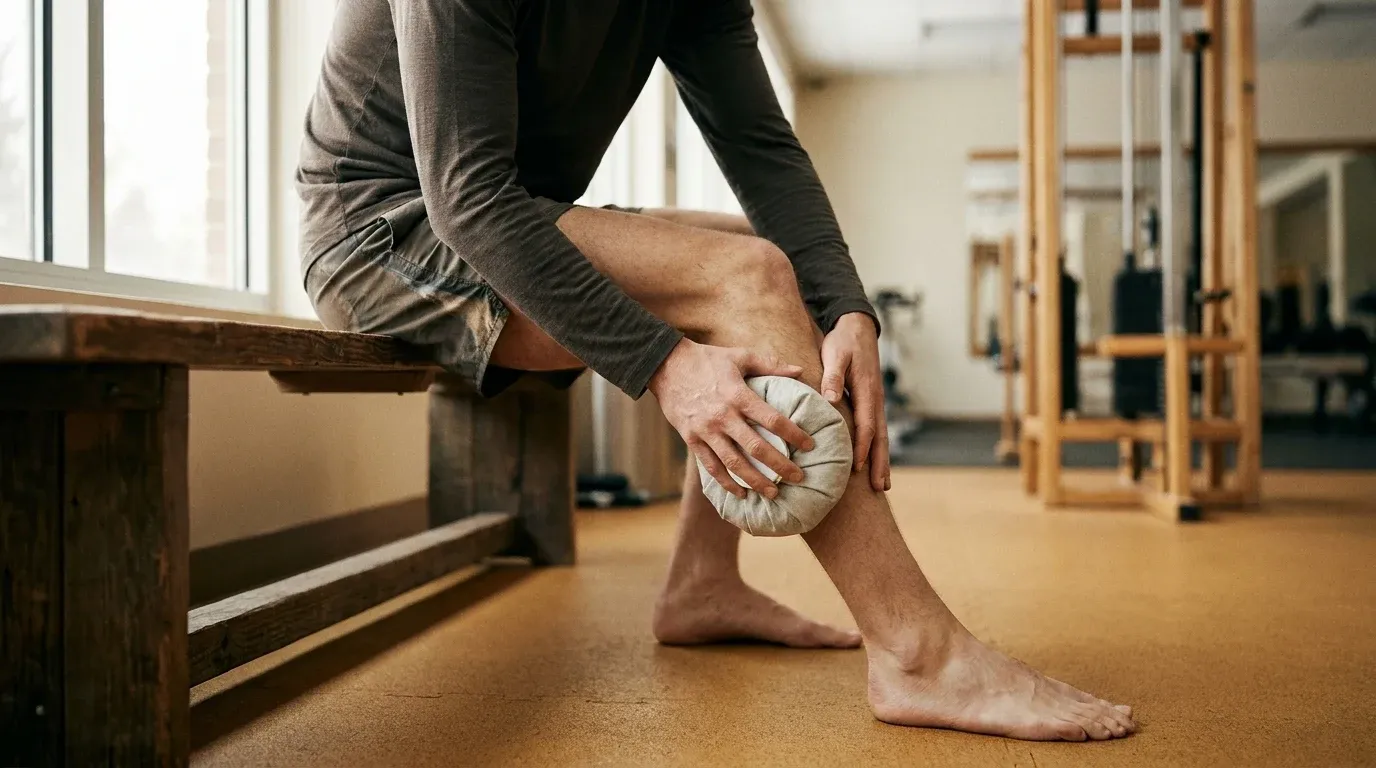
You finish a hard run, your calves are screaming, and you're staring at a bag of ice, a massage gun, and the couch. The choice feels arbitrary. It doesn't have to be. A study published in Scientific Reports put all three options head-to-head over 72 hours, and the results give you an actual hierarchy to work with.
What the Study Actually Tested
Researchers recruited recreational runners and subjected them to eccentric calf loading, the kind of muscle stress that reliably produces soreness, stiffness, and performance loss. This mirrors what happens after a downhill run or a hard interval session on the track.
Participants were assigned to one of four recovery conditions: repeated ice massage, percussive massage (a massage gun), a combined protocol using both, or passive rest. Measurements were taken at multiple points across 72 hours, tracking muscle-tendon stiffness, delayed onset muscle soreness, reactive strength index (a measure of explosive leg power), and perceived recovery.
That 72-hour window matters. Most recovery research stops at 24 hours, which is too short to capture how the body actually rebuilds. This design gives a more realistic picture of what helps you feel and perform better across a full recovery cycle.
Ice Massage: The Clear Winner for Perceived Recovery
Of all four conditions, ice massage produced the largest improvement in perceived recovery. Participants who received repeated ice massage reported feeling significantly better than those who rested passively, and their advantage over the other active methods was meaningful.
The mechanism isn't mysterious. Cold applied directly to tissue reduces local blood flow acutely, blunts inflammatory signaling, and lowers nerve conduction velocity, which translates to less pain. When you pair that with the mechanical pressure of massage, you're addressing both the inflammatory and the neural components of soreness simultaneously.
Ice massage is also one of the lowest-cost recovery tools available. You need ice and a towel. That's it. No subscription, no device that needs charging, no professional required. For recreational athletes managing their own recovery, that accessibility matters.
The Massage Gun's Real Strength: Reactive Power
Percussive massage didn't top the charts for perceived recovery, but it wasn't far behind ice massage. Where it distinguished itself was in combination with ice. The combined protocol produced the greatest improvement in reactive strength index, the metric that reflects how efficiently your muscles absorb and release energy during explosive movements like jumping or sprinting.
Reactive strength index is relevant beyond elite sport. If you train for any activity that involves change of direction, stairs, or high-impact movement, your ability to generate force quickly is part of your functional capacity. Losing it after a hard session, and not recovering it quickly, affects your next workout and your injury risk.
The percussive component likely works by increasing blood flow through rapid tissue oscillation, temporarily reducing muscle stiffness and improving motor unit recruitment. When layered on top of the anti-inflammatory effect of ice, you get a more complete recovery stimulus than either tool delivers alone.
All Three Beat Rest. By a Significant Margin.
Here's the finding that should actually change your behavior: across every outcome measured, including muscle-tendon stiffness, soreness, and perceived recovery, all three active recovery methods outperformed passive rest. The gap wasn't trivial.
This aligns with a broader body of evidence showing that doing something, almost anything deliberate, accelerates recovery more than lying still. The physiological argument is straightforward. Active recovery stimulates circulation, promotes metabolic waste clearance, and maintains neuromuscular signaling without adding new stress to damaged tissue.
If you've ever wondered whether your post-run recovery routine is actually worth the effort, this study gives you a direct answer. It is. The active vs. passive recovery debate now has cleaner data behind it, and the data favors action.
How to Use This Evidence Practically
The study's design gives you a usable framework. You don't need to guess or rotate randomly between methods. Here's how to apply what the research shows:
- If perceived recovery is your priority (you need to feel good for tomorrow's session), lead with ice massage. Apply ice wrapped in a damp cloth directly to the affected muscle group for 10 to 15 minutes, using gentle circular or linear strokes. Repeat once or twice across the first 24 hours.
- If performance is your priority (you need explosive output back quickly), use the combined protocol. Run ice massage first, then follow with 10 minutes of percussive massage on the same muscle groups. The sequence appears to matter: cold first to reduce acute inflammation, percussive second to restore tissue mobility.
- If you only have a massage gun, use it. It's still substantially better than nothing, and its advantage over rest for stiffness and soreness is real.
- If you have nothing, light movement, walking, or easy cycling activates circulation without adding load. That's always better than the couch.
What the Study Doesn't Tell You
The participants were recreational runners, not elite athletes. The loading protocol was eccentric calf work, not a full marathon or a heavy squat session. Recovery needs scale with training volume, fitness level, and individual biology, so the specific numbers from this study won't translate perfectly to every situation.
The study also doesn't address how recovery tools interact with nutrition. What you eat and drink in the hours after a hard session shapes how effectively any physical recovery method works. If you're under-fueling, no massage protocol will fully compensate. Getting your carbohydrate and protein intake right matters. The relationship between energy availability and recovery is well documented, and relative energy deficiency in sport remains one of the most underdiagnosed obstacles to recovery in recreational athletes.
Sleep is the other variable this study couldn't control for. The glymphatic system processes metabolic waste during deep sleep, and tissue repair is hormonally driven by sleep quality. If you're applying ice massage but sleeping five hours a night, you're leaving most of your recovery potential on the table. How sleep clears waste from your brain is a process that also reflects what's happening systemically in your muscles and connective tissue.
Beyond Calves: Does This Apply to Other Muscles?
The study targeted the calf complex specifically, partly because eccentric calf loading is a reliable and controllable model for inducing muscle damage. The gastrocnemius and soleus respond predictably, which makes them a useful research target.
The underlying mechanisms, reduced inflammation, restored stiffness, improved circulation, are not calf-specific. There's reasonable grounds to expect similar effects in the quadriceps, hamstrings, or hip flexors after comparable loading. But extrapolating from one muscle group to the whole body requires caution. Research on eccentric quad loading, for example, shows broadly similar responses to cold and compression, though the magnitude differs.
If you're a runner dealing with cumulative fatigue across multiple sessions, your recovery needs also compound over time. Tools that help you recover from individual sessions matter more when training frequency is high. This connects to how often and how hard you train. Training frequency decisions shape how much recovery stress you're managing in total, and that context determines whether daily ice massage is a nice habit or a genuine necessity.
The Bottom Line on Recovery Tools
This study doesn't tell you to buy an expensive device or follow a complicated protocol. It tells you that deliberate recovery beats passive rest across every metric that matters to a recreational runner. It tells you that ice massage, cheap and low-tech, outperforms fancier options for how you feel. And it tells you that combining tools is worth the extra ten minutes if you need your legs back fast.
Recovery isn't passive. Your body is doing significant work after every hard session, rebuilding contractile proteins, clearing metabolic byproducts, restoring neuromuscular readiness. The question isn't whether to support that process. It's which tool you're going to pick up first.
Based on this evidence, the answer is probably ice. But the second-best answer is anything other than nothing.