
Breathing exercises and mindfulness get most of the attention in stress management conversations. They deserve it. But there's a parallel body of research on music therapy that's quietly grown into something substantial, and most wellness readers have never seen it translated into practical listening strategies.
That changes here. Whether you're managing daily work stress or looking to build a more complete recovery toolkit, the science of music therapy offers specific, actionable guidance. Not vague advice to "put on something calming." Actual mechanisms, actual evidence, and actual techniques you can apply today.
The Physiology: What Music Does to Your Stress Response
Stress isn't just a feeling. It's a measurable cascade of hormonal and cardiovascular events. Cortisol rises, heart rate climbs, blood pressure increases. These are the metrics that matter when researchers study stress interventions, and music therapy has demonstrated meaningful effects on all three.
A meta-analysis published in PLOS ONE examining over 400 studies found that music listening produced statistically significant reductions in cortisol levels across a wide range of contexts, from pre-surgical anxiety to occupational stress. Heart rate and systolic blood pressure dropped consistently in controlled trials, with effects comparable in some cases to standard relaxation techniques.
The mechanism isn't fully understood, but the leading hypothesis centers on the autonomic nervous system. Music appears to shift the body from sympathetic dominance (the fight-or-flight state) toward parasympathetic activation (rest and digest). This happens partly through auditory cortex signaling, partly through emotional processing in the limbic system, and partly through entrainment, the tendency of your heart rate and breathing to synchronize with external rhythmic cues.
Entrainment is the key concept here. Your body doesn't just react to music emotionally. It physically aligns with it. That's why the type of music you choose matters far more than most people realize.
Tempo, Key, and Familiarity: Why Your Playlist Choice Is a Clinical Decision
Not all music reduces stress. Some of it amplifies it. Research is consistent on this point, and the variables that determine which direction you go are surprisingly specific.
Tempo: Music between 60 and 80 beats per minute (BPM) aligns most closely with a resting heart rate and appears most effective at inducing parasympathetic activity. Classical compositions, ambient electronic music, and slow jazz tend to fall in this range. High-tempo music above 120 BPM, even if you personally enjoy it, has been shown to increase heart rate rather than reduce it.
Key and mode: Major keys (which sound bright and resolved) and minor keys (which sound darker or more melancholic) produce different emotional and physiological responses. For stress reduction specifically, research suggests that music in major keys at slow tempos produces the most consistent cortisol-lowering effects. Minor key music can be deeply moving but may also sustain or deepen a negative emotional state if you're already under pressure.
Listener familiarity: This one surprises people. Studies consistently show that familiar music, tracks you know well, outperforms unfamiliar music for stress reduction, even when the unfamiliar music is objectively "calmer" by acoustic metrics. Familiarity reduces cognitive load. Your brain isn't working to predict or process what comes next, which allows deeper relaxation. One study found cortisol reductions were nearly 50% greater with personally familiar music compared to researcher-selected relaxation tracks.
The practical implication: build a dedicated stress-relief playlist from music you already love, filtered for slower tempos and brighter keys where possible. Don't assume a curated "relaxation" playlist from a streaming service will work better than something you know well.
If you're already managing stress through multiple channels, it's worth reading Stress Management: What Actually Works to see how music therapy fits alongside evidence-based methods like exercise and sleep optimization.
Passive Listening vs. Active Music-Making: Two Separate Tools
Here's where music therapy gets genuinely interesting, and where most popular coverage misses the point entirely. Passive listening (putting on music while you work, rest, or drive) and active music-making (singing, playing an instrument, drumming) trigger different neurological and physiological mechanisms. They're not interchangeable. They're complementary.
Passive Listening: The Accessible Entry Point
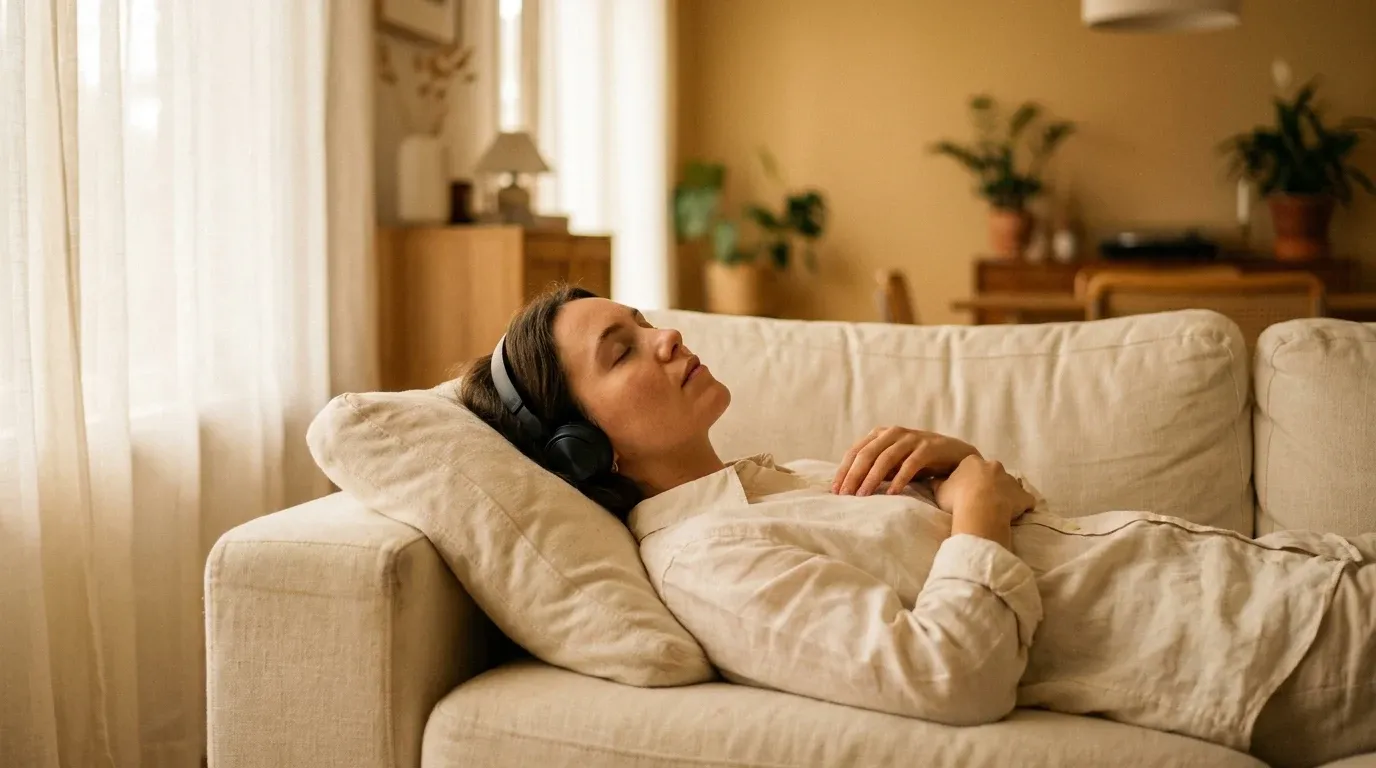
Passive listening is the lower-barrier option. You don't need any musical training. You need headphones and fifteen minutes. Research on passive music listening consistently shows reductions in perceived stress, cortisol levels, and heart rate, particularly when listening is intentional rather than incidental.
Intentional listening means treating it more like a practice than background noise. Sit or lie down. Remove other stimuli. Focus on the music rather than using it as wallpaper. Studies comparing intentional vs. background listening show meaningfully different physiological outcomes, with intentional listening producing stronger parasympathetic effects.
Duration also matters. Most studies showing significant cortisol reductions used listening sessions of 20 to 30 minutes. Shorter sessions (under 10 minutes) showed weaker or inconsistent effects. If you're using music deliberately for stress management, treat it like a proper recovery session, not something you squeeze in between tasks.
Active Music-Making: The Deeper Mechanism
Active music-making, whether singing, playing piano, drumming, or strumming a guitar, engages stress relief through a different route. Where passive listening primarily works through the autonomic nervous system and emotional processing, active music-making has demonstrated effects on the immune system, specifically through elevated secretory immunoglobulin A (sIgA) and reduced pro-inflammatory cytokines.
Group singing in particular has shown striking results. A study published in Frontiers in Human Neuroscience found that synchronized choral singing produced heart rate coherence across participants, a phenomenon where individual heart rate variability patterns aligned. Heart rate variability (HRV) is one of the most reliable physiological markers of stress resilience, and increasing it is a primary goal of most recovery-focused interventions.
You don't need to be good at music for this to work. The research doesn't show that musical skill determines outcomes. Consistent engagement does. Even 15 minutes of drumming or singing along to music you know has been shown to shift cortisol levels downward compared to passive sitting. The key is active physical and vocal engagement with sound, not performance quality.
If you're already thinking about recovery and performance in a more integrated way, it's worth knowing that sleep quality plays a comparable role in stress regulation. The research covered in Deep Sleep Waves May Guard Against Alzheimer's highlights just how much happens at the neurological level during quality sleep, much of it relevant to stress processing as well.
Practical Protocols to Start This Week
Science without application is just interesting reading. Here's how to actually use this.
- Build your stress-relief playlist. Aim for 25 to 30 minutes of music you know well. Filter for slower tempos where you can. Don't overthink genre. Familiar beats familiarity in terms of cortisol response.
- Schedule intentional listening sessions. Treat them like training sessions. Mornings after waking or evenings before sleep are when cortisol is most responsive to environmental input. Sit down, close your eyes, and actually listen.
- Add one active music practice. This doesn't require an instrument. Singing along in the car counts. Download a basic percussion app and drum along to a rhythm for 15 minutes. Join a community choir. The bar is engagement, not skill.
- Avoid high-tempo music before bed. This is the most common mistake. Music above 120 BPM increases sympathetic nervous system activity. If you're playing energizing music while winding down, you're working against your own recovery.
- Pair music with other recovery inputs. Magnesium supplementation, for example, has documented effects on cortisol regulation and sleep quality. Magnesium Forms: Which Type Actually Works for You? breaks down which specific forms of supplementation the research actually supports.
The Honest Limitations
Music therapy research has real methodological challenges. Study sizes are often small. Blinding participants is essentially impossible since you can't give someone a music placebo. Individual variation in musical preference is enormous, which makes standardization difficult across studies.
What the evidence does support is directional consistency. Across dozens of controlled trials, slow-tempo familiar music in intentional listening contexts reduces cortisol and heart rate more reliably than silence or comparison conditions. The effect sizes are modest to moderate, not dramatic. Music therapy isn't a replacement for addressing the structural causes of chronic stress, whether that's sleep deprivation, poor recovery from exercise, or unmanaged anxiety.
Sleep, in particular, remains one of the most powerful levers you have. If you're not sleeping enough, or sleeping too much, the hormonal consequences are significant. The evidence around this is clear in Too Much or Too Little Sleep Ages You Faster, and no amount of playlist optimization will compensate for chronically disrupted sleep.
But within a broader stress management approach, music therapy earns its place. It's accessible, it's free, and the research behind it is more rigorous than most people assume. The main thing standing between you and using it effectively isn't access to the right playlist. It's treating it with the same intentionality you'd give any other recovery practice.
That's the shift. Music as a deliberate physiological tool, not background noise.