

Nasal Breathing and Athletic Performance: What the Research Actually Shows
Nasal breathing has become one of the more persistent ideas in wellness culture. Books like Breath by James Nestor gave it mainstream momentum. CrossFit athletes and endurance runners started taping their mouths shut during training. Coaches built protocols around it. But the actual research tells a more specific story than the hype suggests, and understanding the nuances could genuinely change how you train.
Here's what the current evidence says, where it's strong, where it's limited, and how to apply it without overcorrecting.
Why the Nose Is Not Just a Filter
The most clinically significant function of nasal breathing isn't filtration or humidification. It's nitric oxide production. The nasal sinuses produce nitric oxide (NO), a molecule that acts as a natural vasodilator. When you inhale through your nose, you carry NO into your lungs, where it helps redistribute blood flow more efficiently across the pulmonary vasculature.
The practical result is improved ventilation-perfusion matching. More of the air you breathe reaches alveoli that are actually receiving blood flow, which means more oxygen gets transferred to working muscles per breath. Oral breathing bypasses this mechanism almost entirely.
Research published in Frontiers in Physiology confirms that nasal NO production is not trivial. Nasal NO concentrations are roughly 15 to 20 times higher than oral concentrations. During exercise, this difference translates into measurable effects on oxygen delivery, particularly at sub-maximal intensities where breathing mechanics have time to operate efficiently.
What the 2025 Research Actually Found
A 2025 study in Frontiers in Physiology examined nasal versus oral breathing in well-trained endurance athletes across a range of exercise intensities. The findings are worth reading carefully because they're more nuanced than the wellness community tends to acknowledge.
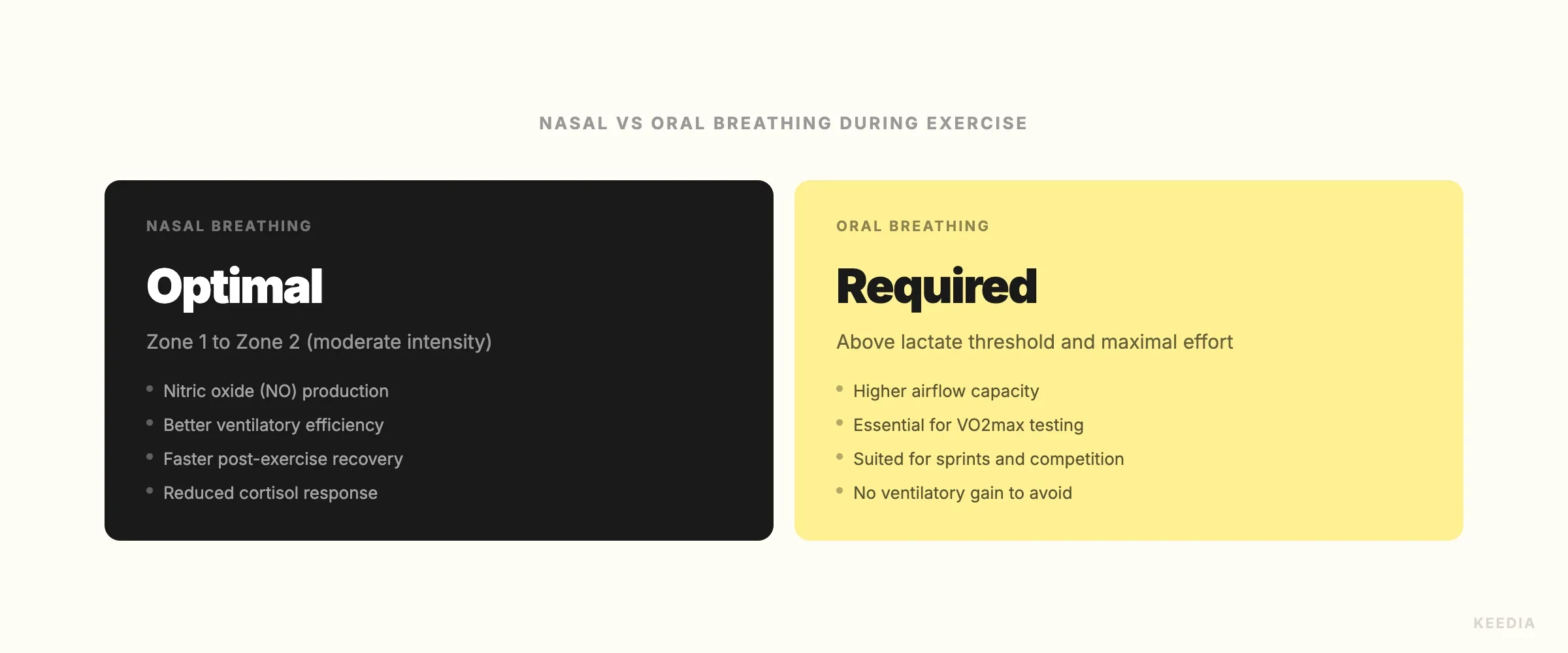
At moderate intensities, nasal breathing improved ventilatory efficiency. Athletes produced the same or better oxygen delivery with lower minute ventilation. That's a meaningful efficiency gain. It means your respiratory muscles are doing less work to move the same amount of oxygen. Over a long training session or race, that adds up.
At maximal effort, however, nasal breathing could not keep pace. When intensity exceeded the lactate threshold and approached VO2max, airflow demand outstripped what nasal passages could deliver. Oral breathing matched higher metabolic demands more effectively at that ceiling. Notably, the researchers confirmed that VO2max testing itself requires oral breathing to produce valid measurements. If you're using a metabolic cart or structured VO2max protocol, nasal-only breathing will artificially suppress your numbers.
If you're working to raise your aerobic ceiling, research-backed VO2max protocols remain grounded in oronasal breathing for high-intensity intervals. That's not a contradiction of nasal breathing. It's a clarification of where each approach belongs.
Recovery Is Where Nasal Breathing Earns Its Reputation
The strongest and most consistent finding across recent research is not performance during exercise. It's what happens after. Post-exercise nasal breathing shows measurable advantages in three specific recovery markers.
- Cortisol response: Nasal breathing recovery protocols are associated with a lower cortisol spike following intense exercise, suggesting a reduced stress signal and faster return toward hormonal baseline.
- Heart rate recovery: Subjects using nasal breathing during recovery intervals showed faster return to resting heart rate than those using oral breathing post-exercise. The parasympathetic nervous system activates more readily when you breathe through your nose.
- Inflammatory markers: Preliminary data points to reduced systemic inflammatory signaling following nasal recovery breathing compared to oral breathing. The mechanism is likely tied to both the nitric oxide pathway and the parasympathetic activation effect.
This makes nasal breathing particularly relevant during rest intervals in interval training, the cool-down phase, and the first 20 to 30 minutes after a session ends. If you've been mouth-breathing through your recovery period, you may be leaving a meaningful adaptation signal on the table.
Recovery quality connects directly to sleep. If you're also looking at other ways to support physiological recovery between sessions, the evidence on sauna and cardiovascular health and the data on magnesium for athlete sleep quality both point toward similar parasympathetic mechanisms.

Nasal Breathing Is a Trainable Skill
One of the more important findings in recent research is that nasal breathing isn't simply an on/off switch. For most adults, particularly those who've spent years as habitual mouth-breathers, nasal-only breathing at exercise intensities feels uncomfortable at first. That's expected, and it doesn't mean it isn't working.
Feasibility studies show that with 6 to 8 weeks of deliberate nasal-only training at low-to-moderate intensities, athletes adapt significantly. Breathing mechanics improve, carbon dioxide tolerance increases (which is actually a key driver of breath urgency), and the threshold at which nasal breathing becomes uncomfortable shifts upward.
That CO2 tolerance point is worth emphasizing. The urge to open your mouth during exercise is largely driven by CO2 accumulation, not oxygen deficit. Your body interprets rising CO2 as a signal to breathe harder. Over time, nasal training recalibrates that sensitivity, allowing you to stay comfortable at higher effort levels without switching to oral breathing prematurely.
This adaptation process has parallels with other training variables. Just as you wouldn't expect deload protocols to produce results in a single week, nasal breathing adaptation requires consistent, patient exposure. For context on how structured adaptation periods work across training, deload research illustrates how the body needs progressive stress and recovery cycles to reorganize.
Structured Nasal Breathing Produces Measurable Gains
A 6-week structured nasal breathing protocol in young basketball players provides some of the clearest evidence that breath training can improve performance independent of other training variables. Participants followed a deliberate nasal-only breathing program during conditioning sessions and showed statistically significant improvements in pulmonary function and cardiorespiratory fitness at the end of the intervention.
This isn't just an anecdote from elite athletes. It suggests that structured breath training is a legitimate performance variable that coaches and athletes can isolate, program, and measure. The effect size was meaningful enough to warrant inclusion as a training tool, not just a wellness add-on.
The implication for team sport athletes is particularly interesting because basketball training involves repeated high-intensity bursts followed by rest periods. Nasal breathing during those rest periods may accelerate the recovery needed to perform the next effort at full output.
How to Apply This Practically
The research translates into a fairly clear framework for when to use nasal breathing and when to stop worrying about it.
- Warm-up: Breathe exclusively through your nose. This primes nitric oxide production, activates the parasympathetic system before transitioning to sympathetic effort, and builds tolerance for nasal breathing as intensity rises.
- Zone 1 and Zone 2 training: Nasal breathing is both feasible and beneficial here. If you can't maintain nasal breathing in Zone 2, you're likely above Zone 2. Use it as a real-time intensity check. If you need help identifying your actual Zone 2 without lab equipment, finding your Zone 2 accurately is a useful starting point.
- Above lactate threshold: Switch to oronasal or oral breathing without guilt. Trying to force nasal breathing at high intensity will compromise output without adding benefit. The physiology doesn't support it at that level.
- Recovery intervals and cool-down: Return to nasal breathing as quickly as possible. This is where the cortisol, heart rate recovery, and inflammatory benefits are most accessible. Train yourself to make the switch within the first 30 to 60 seconds of a rest interval.
- Night and rest: If you're a habitual mouth-breather during sleep, that's a separate issue worth addressing. Nighttime nasal breathing supports the same recovery mechanisms discussed here, and some athletes use low-adhesive tape during sleep to reinforce the habit during the adaptation period.
The Bottom Line
Nasal breathing is not a performance hack that replaces hard training. The research doesn't support that framing. What it does support is that nasal breathing improves nitric oxide-mediated oxygen delivery at moderate intensities, meaningfully accelerates post-exercise recovery, and becomes more effective the more deliberately you train it over 6 to 8 weeks.
The athletes seeing real benefit from nasal breathing aren't necessarily breathing through their noses at maximum effort. They're using it strategically during warm-up, base training, and recovery. That's where the physiology actually works in your favor.
Start with your Zone 1 and Zone 2 sessions. Be patient with the adaptation period. And don't confuse discomfort in the first two weeks with evidence that it isn't working. The research suggests you're just not adapted yet.