
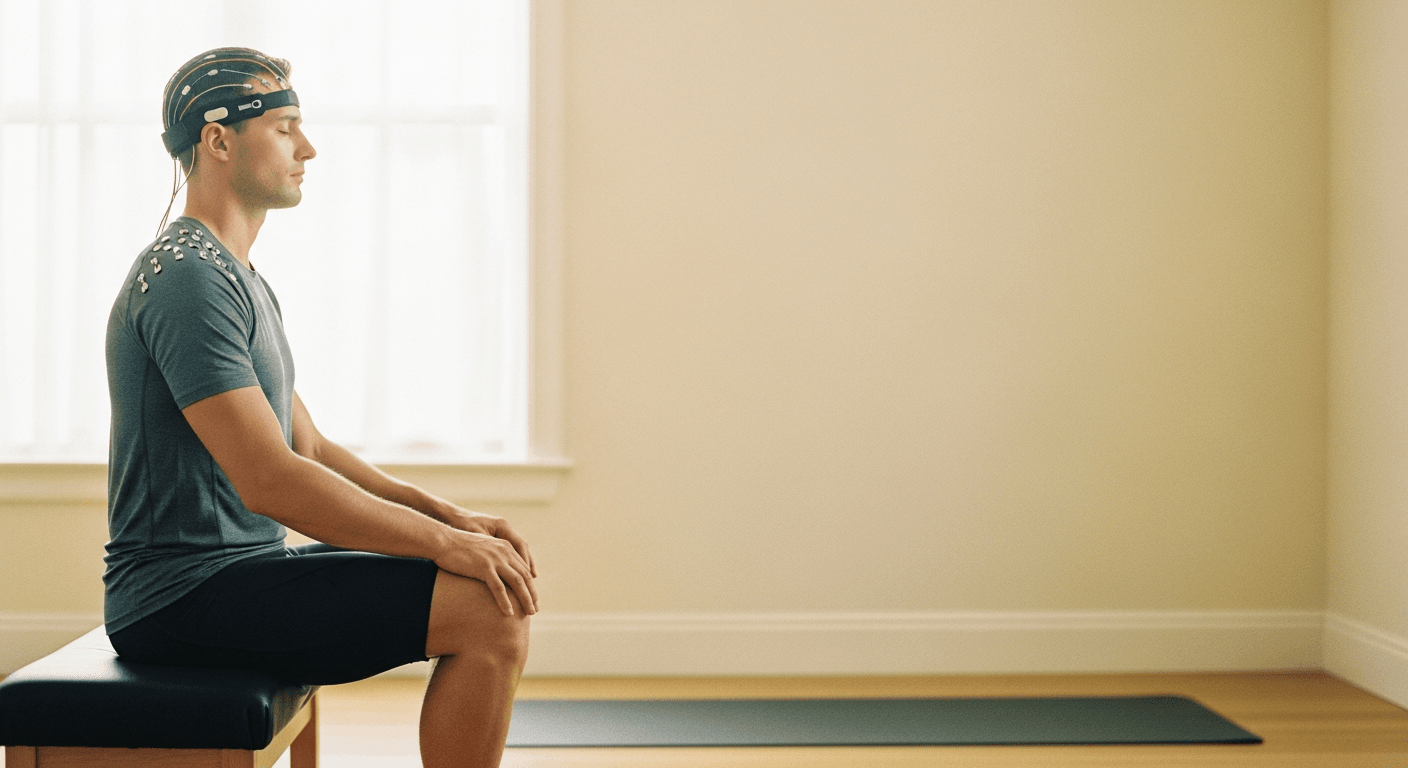
Most athletes think about recovery in terms of muscles. You pushed hard, your legs are sore, so you rest. That logic is intuitive, but it's incomplete. The part of your body that coordinates everything. your brain and nervous system. recovers on its own timeline, and it doesn't always match what your muscles are telling you.
A new wave of neurotechnology platforms is making it possible to measure that timeline directly. Tools that assess nervous system readiness in real time are no longer reserved for professional sports labs. They're becoming accessible to everyday athletes, older adults, and anyone serious about training smarter rather than just harder.
Recovery Is a Neurological Event, Not Just a Physical One
When you train, you're not just stressing muscle fibers. You're placing a load on the entire neuromuscular system: the network of signals between your brain, spinal cord, and muscles that makes movement possible. That system requires its own form of recovery, and it doesn't operate on the same clock as muscle tissue repair.
Research in exercise physiology consistently shows that neuromuscular fatigue can persist well after perceived soreness has faded. In practical terms, this means you can feel fine and still be operating at a significant neurological deficit. Your coordination suffers. Your reaction time slows. Your movement quality degrades. And if you train through that window repeatedly, your injury risk climbs.
This is why understanding the nervous system as the missing key to your recovery has become a priority for coaches working with both elite and recreational athletes. The question isn't just whether your muscles are ready. It's whether your nervous system is.
The Gap Between How You Feel and How Recovered You Are
Perceived exertion is a useful tool, but it's a noisy signal. Studies comparing subjective readiness scores to objective physiological markers consistently find poor alignment. Athletes regularly rate themselves as ready when their neuromuscular output is measurably impaired, and occasionally the reverse.
That gap has consequences. Overtraining syndrome, one of the more stubborn and underdiagnosed conditions in recreational sport, is largely a nervous system problem. It develops when accumulated neurological stress isn't given adequate time to resolve. By the time symptoms become obvious, weeks or months of training quality have already been compromised.
Heart rate variability (HRV) has become the most widely adopted proxy for nervous system recovery, and for good reason. HRV reflects the balance of activity between the sympathetic and parasympathetic branches of the autonomic nervous system, giving a daily snapshot of how recovered your body actually is. But HRV is a single number derived from a single physiological signal. Newer platforms are building on that foundation with richer data.
What Platforms Like Umo Actually Measure
Umo is one of the more clinically grounded entries in the neurotechnology space. Its platform assesses nervous system readiness and movement quality using balance-based tests that take just a few minutes to complete. The underlying science draws on posturography, the study of how the body maintains balance, which has long been used in clinical neurology to detect subtle deficits that traditional assessments miss.
The core insight is that balance is an extraordinarily sensitive window into nervous system function. Holding your body upright requires continuous, real-time integration of sensory information from your eyes, inner ear, and proprioceptive receptors throughout your muscles and joints. When the nervous system is fatigued, that integration becomes less precise. Sway increases. Reaction patterns change. Umo's sensors detect those changes and translate them into actionable training recommendations.
For the everyday athlete, this plays out in concrete terms. Instead of guessing whether today calls for a hard session or an easy one, you get a readiness score grounded in measurable neurological data. The platform adjusts training load recommendations based on that score, creating a feedback loop that tracks your recovery across days and weeks.
This kind of individualized load management sits at the intersection of neuroscience and practical coaching. It's also a meaningful step beyond what wearable devices like fitness trackers currently offer, most of which rely primarily on heart rate and sleep duration rather than direct assessments of neuromuscular function. You can read more about how AI and robotics are reshaping athlete rehabilitation to see how this broader technological shift is unfolding across sports medicine.
Neuroplasticity Means This Matters at Every Age
One of the most significant findings from neuroscience over the past two decades is that the brain retains the capacity for structural and functional change throughout life. Neuroplasticity doesn't stop at 25 or 40 or 60. It continues, though its nature shifts with age.
For athletes and active adults, this has a specific implication: balance and coordination are trainable skills at any point in life. The nervous system can form new movement patterns, refine existing ones, and recover from injury or disuse. That process is supported by targeted training, adequate sleep, proper nutrition, and controlled stress loads.
It also means that neurotechnology tools are relevant far beyond elite sport. For adults over 50, maintaining neurological function becomes increasingly tied to long-term physical independence. Falls are the leading cause of injury-related death in adults over 65, and the majority involve a failure of the balance and coordination systems that platforms like Umo are designed to assess and train.
Older adults who engage in balance-specific training show measurable improvements in postural stability and reaction time, even when starting from a low baseline. The nervous system responds to the right stimulus at any age. The challenge is knowing what the right stimulus is on any given day. which is exactly what real-time readiness measurement addresses.
For women navigating perimenopause and beyond, the stakes are particularly clear. Hormonal shifts directly affect neuromuscular coordination, bone density, and the recovery timeline from training stress. Evidence-based exercise protocols for menopause and perimenopause increasingly incorporate nervous system monitoring for precisely this reason.
The Role of Sleep and Nutrition in Neurological Recovery
Neurotechnology platforms don't operate in isolation. The data they generate is most useful when paired with the other inputs that actually drive neurological recovery. Two of the most important are sleep and nutrition.
Sleep is when the nervous system consolidates motor learning, clears metabolic waste, and regulates the hormonal signals that govern repair. Research shows that even moderate sleep restriction significantly impairs neuromuscular performance, sometimes more than physical fatigue alone. If your readiness scores are consistently low, sleep quality is one of the first variables worth examining. Subjective age perception also plays an underappreciated role: feeling older than your chronological age is measurably linked to worse sleep outcomes, which in turn affects recovery capacity.
Nutrition supports the neurological side of recovery in ways that are often overlooked. The nervous system has high metabolic demands, and deficiencies in specific micronutrients. particularly magnesium, B vitamins, and omega-3 fatty acids. impair neurotransmitter function and stress response regulation. Hydration also matters more than most athletes realize. Even mild dehydration affects cognitive performance and neuromuscular coordination before it registers as thirst.
For athletes thinking carefully about what they eat around training, it's worth considering how nutritional choices interact with neurological readiness, not just muscle fuel. The evidence on pre-workout hydration and its actual performance effects is more nuanced than the sports nutrition industry typically acknowledges.
What This Looks Like in Practice
The practical case for neurotechnology in everyday training isn't that you need to become an expert in posturography or autonomic physiology. It's simpler than that. These tools exist to close the gap between intuition and information.
A typical use case looks like this: you complete a two-to-three minute balance assessment first thing in the morning. The platform processes your postural data, compares it to your individual baseline, and returns a readiness score with a recommended training load. Over weeks, it identifies patterns. your nervous system might recover more slowly from lower-body strength sessions than from aerobic work, or your readiness might consistently dip mid-week regardless of how you feel.
That kind of longitudinal pattern recognition is difficult to develop through self-monitoring alone. Most athletes, even experienced ones, have blind spots about their own recovery. Technology that removes those blind spots doesn't replace good coaching or good instincts. It gives both a sharper foundation to work from.
Recovery tools that measure neurological readiness are part of a broader shift toward treating the body as an integrated system rather than a collection of parts. The muscles don't train in isolation from the nervous system that drives them. Recovery shouldn't be managed that way either.
- Balance testing provides a sensitive, real-time window into nervous system function that goes beyond what HRV or sleep trackers alone can capture.
- Neuroplasticity means that balance and coordination can be improved at any age with the right training stimulus.
- Readiness scores help athletes avoid the chronic under-recovery that accumulates when training load decisions are based on perception alone.
- Sleep and nutrition remain the primary drivers of neurological recovery, and technology works best when those fundamentals are in place.
The nervous system has always been the hidden variable in athletic performance. The difference now is that we have tools sensitive enough to measure it, and accessible enough that you don't need to be a professional athlete to use them.