
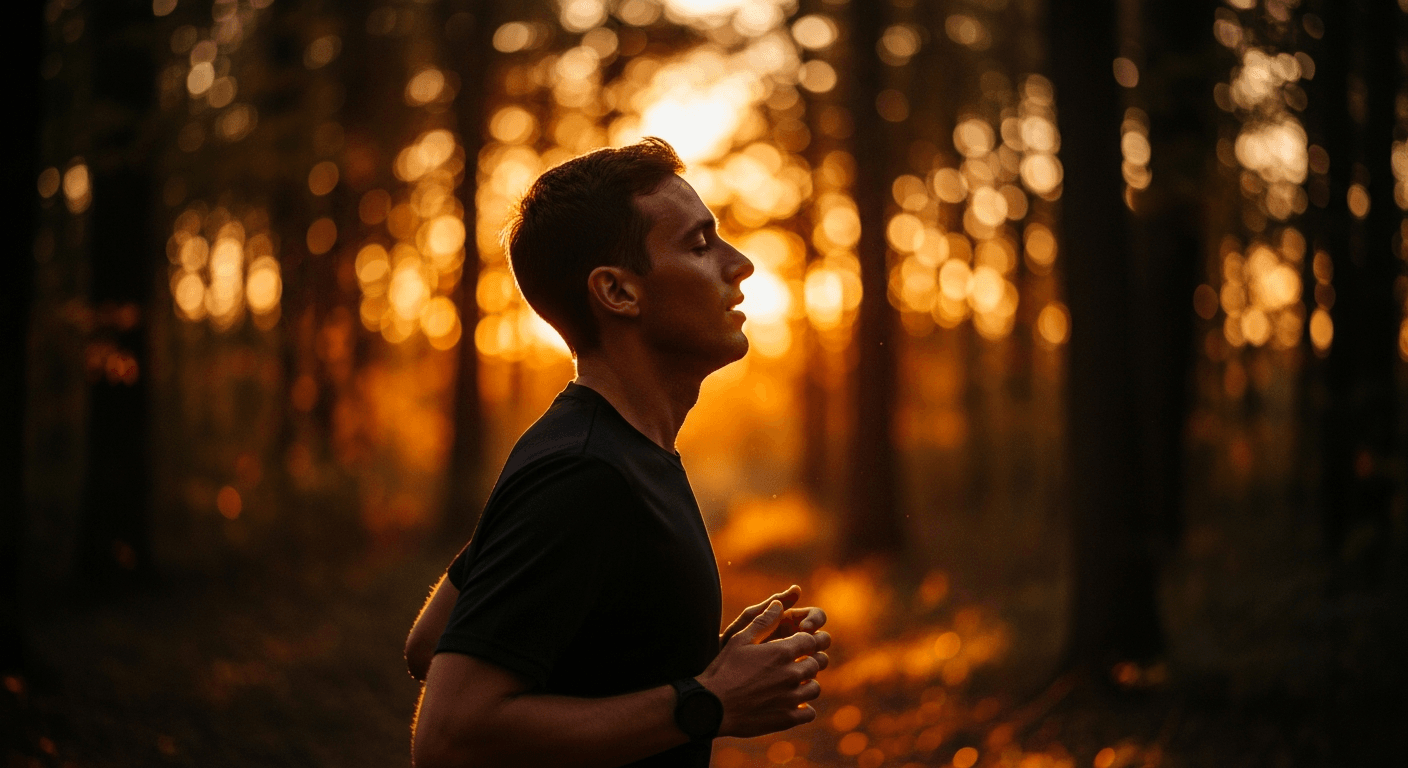
You run the same distance, at the same intensity, and burn the same calories. But if you do it in a park, forest, or along a river instead of on a treadmill, what happens to your brain and your stress levels isn't the same. Research on "green exercise", physical activity in natural environments, consistently shows measurably greater mental health benefits than the same activity indoors. Here's why.
Key Takeaways
- Just 5 minutes of exercise in a natural environment produces measurable effects on mood and self-esteem
- Exercise plus nature amplifies stress and depression benefits beyond exercise alone
- A 10-year UK study found living near green space significantly reduces anxiety and depression risk
- Nature restores attention and reduces mental fatigue through a mechanism researchers call Attention Restoration Theory (ART)
- Even an urban park produces real effects when sessions run at least 20-30 minutes
What Green Exercise Actually Means
Green exercise is physical activity performed in a natural environment. Running in a park, swimming in a lake, cycling on a forest trail, walking on a beach. What separates green exercise from gym exercise isn't the intensity or duration: it's the environment your body and brain operate in during the effort.
This research field developed seriously in the 2000s when environmental psychologists and sports scientists started precisely measuring the differences between indoor and outdoor exercise outcomes. The findings are consistent across studies: natural environments amplify the mental health benefits of exercise, often significantly.
Mechanism 1: Exercise Drops Cortisol. Nature Amplifies That Effect.
Physical exercise reduces cortisol (the stress hormone) through several pathways: it depletes muscle glycogen stores, which triggers a recovery hormonal response; it releases endorphins and endocannabinoids that modulate stress responses; and it "consumes" physiological activation of the fight-or-flight system in a constructive way.
What green exercise adds: natural environments directly reduce activation of the prefrontal cortex (the brain region associated with rumination and anxious planning) and increase activity in the anterior cingulate cortex, which is linked to emotional regulation. That's not poetry, that's neurology.
Studies measuring salivary cortisol in physically active adults consistently show lower post-session stress levels after exercise in green environments versus the same session indoors. If you're already dealing with elevated baseline stress, chronic psychological stress can quietly undermine these recovery benefits before they even take hold.
Mechanism 2: Attention Restoration Theory
Attention Restoration Theory (ART), developed by researchers Rachel and Stephen Kaplan, explains part of the cognitive benefits of nature contact. The core idea: directed attention, the kind you use for work, screens, and decision-making, gets fatigued. It needs to recover.
Nature provides what the Kaplans call "soft fascination": stimuli that capture attention without effort (leaves moving, water flowing, birds) and allow directed attention to regenerate. This is the exact opposite of what a gym demands (loud music, screens everywhere, an environment engineered to stimulate).
In practice: a 30-minute run in a park can reduce the mental fatigue accumulated during an intense cognitive workday in a way a treadmill session doesn't replicate, even at identical intensity.
Mechanism 3: The Visual System in Natural Mode
The human brain evolved in natural environments for 99.9% of the species' history. Natural landscapes activate safety and relaxation responses encoded deep in the nervous system. An open horizon, whether prairie, ocean, or mountain, measurably reduces amygdala alert levels (the brain's fear center) as shown in fMRI studies.
Built urban environments, even pleasant ones, demand constant low-level vigilance: traffic, sudden sounds, unpredictable movements. This micro-vigilance keeps cortisol slightly elevated even when you feel "relaxed." Nature cuts this background noise.
What Research Says About Minimum Effective Doses
One of the most practically important questions: how much time do you need to spend in nature to get measurable effects? Studies converge on some interesting numbers.
5 minutes: mood and self-esteem effects are measurable after just 5 minutes of exercise in a green space. Not enough for long-term benefits, but it shows how fast the mechanism kicks in.
20-30 minutes: this is where the evidence on cortisol reduction and anxiety symptom improvement becomes solid. Three sessions of 20-30 minutes per week in green spaces produces cumulative effects on mental health that become measurable within a few weeks.
Long term: a British 10-year study following thousands of participants found that people living within 300m of a green space showed significantly lower anxiety and depression levels than those without nearby green space access. Access to blue spaces (lakes, rivers, beaches) produced similar effects.
Does an Urban Park Count?
Yes. Green exercise research doesn't discriminate between old-growth forest and a city park. The key elements are the presence of vegetation, natural ground surface, and the relative absence of artificial stressors (traffic, construction, dense crowds). A neighborhood park with trees, grass, and ideally some water produces measurable stress-reduction effects.
Effects scale with "greenness": a forested park produces more benefit than a square with three trees, and a forest produces more than a forested park. But access to any green space beats exclusive indoor exercise for mental health outcomes.
Group Green Exercise: A Multiplier Effect
Research on group green exercise adds another layer. Exercising in groups in nature combines three effects: the benefits of exercise, the benefits of nature contact, and the benefits of social connection. Studies on group walking programs in natural settings show particularly strong effects on depression reduction and self-esteem improvement, especially in vulnerable populations (social isolation, chronic illness).
Nature prescriptions are emerging as a formalized therapeutic tool in several Nordic countries, where physicians literally prescribe hours of forest walking as a complement to treatment for mild-to-moderate anxiety.
Practical Takeaways
- If you run on a treadmill, swap one session per week for an outdoor run in a park or green space. Same duration, same intensity: observe the difference in your mental state post-session.
- You don't need a forest. A neighborhood park with trees and ideally some water produces measurable effects. The key is vegetation and the absence of artificial urban stressors.
- 20-30 minutes is the minimum for solid cortisol and anxiety effects. Under 10 minutes, mood effects exist but are limited.
- Combine outdoor exercise with morning light exposure (see the sleepmaxxing guide): a 20-minute outdoor run before 10 AM stacks cardiovascular, anti-stress, and circadian regulation benefits simultaneously.
- If you have access to water (lake, river, ocean, even a fountain in a park), prioritize it: blue spaces produce stress-reduction effects comparable to green spaces.
Sources: Wikipedia Green Exercise , Wikipedia Nature Exposure and Mental Health , Wikipedia Group Green Exercise , Wikipedia Nature Prescription , Wikipedia Urban Green Space