
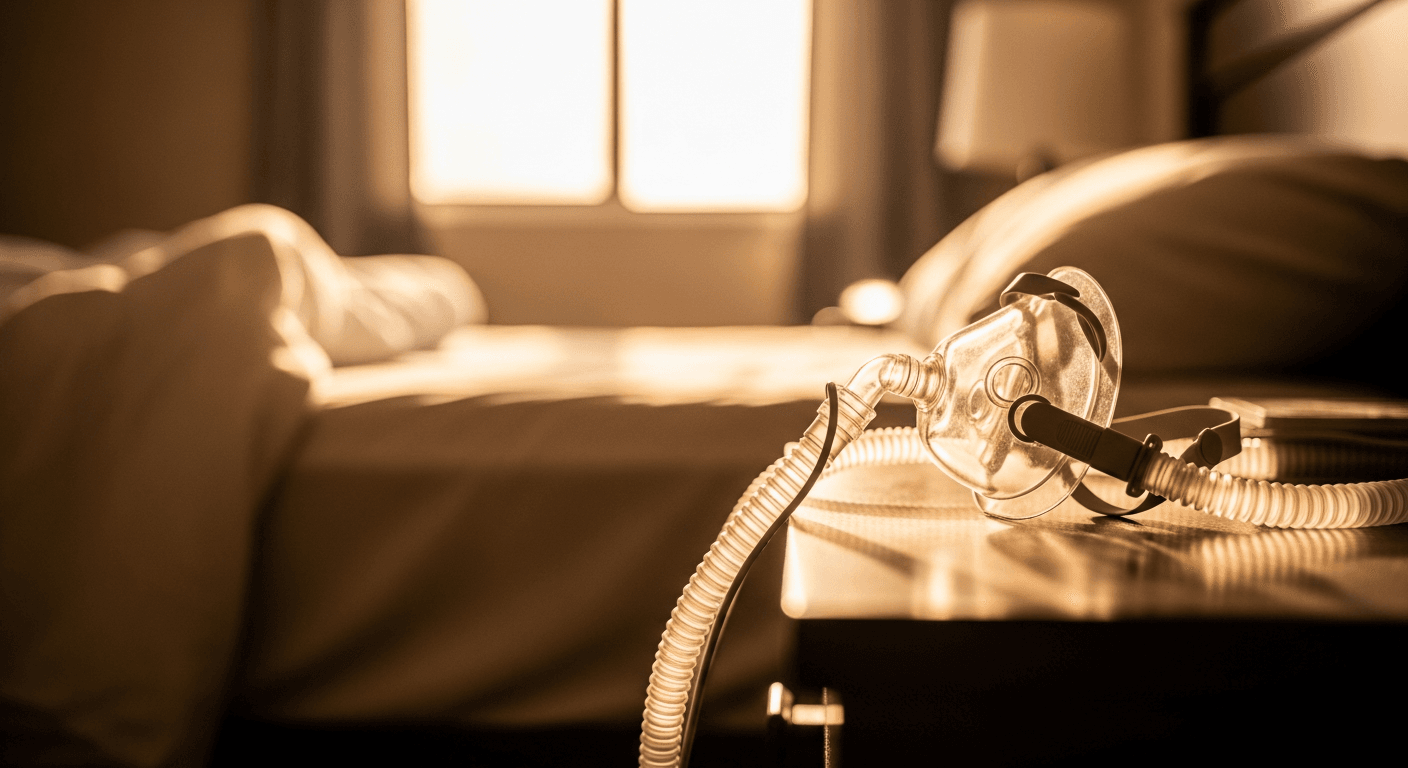
Sleep apnea affects an estimated one billion people globally. Most of them don't know they have it. And even among those who do, a significant portion can't tolerate or don't have access to the gold-standard treatment: the CPAP machine. A new line of research may be about to change what treatment looks like entirely.
Scientists have identified a previously overlooked biological target in the nervous system that plays a central role in the airway collapse underlying obstructive sleep apnea. The finding doesn't just offer a new explanation for why the condition occurs. It opens a realistic path toward pharmacological treatments and non-invasive interventions that don't require strapping a pressurized mask to your face every night.
What Sleep Apnea Actually Does to Your Body
Obstructive sleep apnea (OSA) occurs when the muscles and soft tissues at the back of the throat relax too much during sleep, partially or fully blocking the airway. The brain detects falling oxygen levels and triggers a brief arousal to restore breathing. This can happen dozens, even hundreds, of times per night.
You may not remember these micro-awakenings. But your body registers every single one.
The immediate consequence is fragmented sleep architecture. Deep sleep, particularly slow-wave sleep (stages three and four) and REM sleep, is repeatedly cut short before it can complete its biological function. That matters more than most people realize. Slow-wave sleep is when your body releases the majority of its nightly growth hormone, drives tissue repair, and consolidates motor memory. REM sleep is critical for emotional regulation and complex cognitive processing.
When those stages are fragmented night after night, the downstream effects are substantial. Research links untreated sleep apnea to increased cortisol levels, elevated blood pressure, impaired glucose metabolism, higher cardiovascular risk, and measurable cognitive decline over time. If you're training regularly, the performance cost is equally real. Your muscles don't recover as effectively, your reaction time suffers, and your perceived effort during workouts increases.
These effects connect directly to the broader picture of how nervous system recovery shapes athletic performance and overall health. Sleep isn't passive. It's the most active recovery process your body runs.
Why CPAP Leaves So Many People Behind
Continuous positive airway pressure therapy, CPAP, remains the most clinically validated treatment for moderate to severe OSA. It works by delivering a constant stream of pressurized air through a mask to keep the airway physically open during sleep. When used consistently, it's highly effective.
The problem is adherence. Studies consistently show that between 30 and 50 percent of people prescribed CPAP either stop using it within the first year or never use it for the recommended minimum of four hours per night. Common complaints include discomfort, claustrophobia, skin irritation, and the difficulty of traveling with bulky equipment.
Alternatives exist but come with their own limitations. Mandibular advancement devices work well for mild to moderate cases but can cause jaw pain and dental changes over time. Positional therapy helps only a subset of patients. Surgical options carry standard procedural risks and variable long-term outcomes. For many patients, the choice has essentially been CPAP or inadequate treatment. That gap is exactly what this new research addresses.
The New Biological Target: What Researchers Found
The study centers on the neural circuitry that controls upper airway muscle tone during sleep. Under normal conditions, motor neurons that govern the genioglossal muscle (the primary tongue muscle) reduce their activity during sleep. In people with OSA, this reduction is exaggerated, and the airway loses the structural support it needs to stay open.
What researchers identified is a specific molecular pathway involving receptors on these motor neurons that appears to regulate the degree of that relaxation. By targeting this pathway, it may be possible to selectively maintain muscle tone in the upper airway during sleep without disrupting overall sleep architecture or causing the kind of systemic sedation that makes many current pharmacological approaches impractical.
This is a meaningful distinction. Previous drug candidates for sleep apnea often failed because they either didn't adequately prevent airway collapse or produced side effects. sedation, disrupted sleep stages, cognitive fog. that made them counterproductive. A target that's more precise to the upper airway muscles specifically changes the calculus.
The research is still in early stages. Animal model data and early human mechanistic studies show the pathway is active and responds to targeted intervention, but clinical trials confirming safety and efficacy in broader human populations haven't been completed yet. That's a necessary caveat. This is a direction, not a finished treatment.
Why the Underdiagnosis Problem Makes This Matter More
One of the most persistent challenges with sleep apnea is that the majority of people who have it are never diagnosed. Estimates suggest that up to 85 percent of OSA cases globally go undetected. The condition doesn't always present with the classic picture of loud snoring and obvious daytime sleepiness. In many cases, especially in women, symptoms are subtler: fatigue that doesn't resolve with rest, mood disruption, difficulty concentrating, morning headaches.
This connects to a broader pattern in how sleep disorders get assessed and treated. Research into the psychological dimensions of sleep disruption consistently shows that people tend to underestimate how significantly poor sleep is affecting their cognitive and emotional function, partly because chronic impairment becomes a new baseline they stop noticing.
A pharmacological or non-invasive alternative wouldn't just help people who've tried CPAP and given up. It would make treatment accessible to the large share of people who never seek diagnosis in the first place, because the existing options feel too disruptive or too medicalized to pursue.
The Recovery and Performance Stakes
For anyone training with intention, whether you're an amateur athlete or simply someone who exercises consistently for health, sleep quality isn't a lifestyle variable. It's a biological requirement. The research on sleep deprivation and athletic performance is unambiguous: even moderate sleep restriction reduces muscle protein synthesis, elevates inflammatory markers, impairs glycogen replenishment, and blunts the hormonal response to training.
Untreated sleep apnea produces many of the same effects as chronic partial sleep deprivation, because that's functionally what it is. You may be spending eight hours in bed and still not completing the sleep cycles your body needs to recover.
This also intersects with how you think about other recovery inputs. The tools you use, from nutrition timing to temperature therapies, build on a foundation that sleep has to establish first. Understanding options like when to use heat versus cold for recovery matters far less if your sleep architecture is consistently fragmented by apnea events.
The same logic applies to women navigating hormonal transitions. Sleep apnea prevalence increases significantly after menopause, due in part to the loss of progesterone's protective effect on airway muscle tone. Understanding evidence-based approaches to managing health and performance during perimenopause and beyond has to include awareness of elevated OSA risk during that transition.
What You Should Do With This Information Now
The new treatment target is a promising development, but it doesn't change what's available to you today. What it does do is signal that the treatment landscape for sleep apnea is likely to look different in the next five to ten years. That matters if you're currently managing symptoms with imperfect solutions or if you've been putting off evaluation because current options don't appeal to you.
Here's what's actionable right now:
- Get assessed if you haven't been. Home sleep testing has become widely available and relatively affordable in the US and UK, often covered by insurance with a referral. If you regularly wake unrefreshed, experience daytime fatigue, or have been told you snore or stop breathing during sleep, that's enough clinical justification to pursue a test.
- Don't dismiss mild or moderate diagnoses. Even mild OSA can significantly fragment deep sleep stages. The severity classification reflects breathing disturbance frequency, not necessarily the degree of sleep disruption or health impact.
- If CPAP hasn't worked for you, revisit the conversation. Mask fit, pressure settings, and machine technology have improved substantially. A sleep medicine specialist can often troubleshoot adherence barriers more effectively than a general practitioner.
- Track relevant markers. Resting heart rate, HRV, and perceived recovery scores can all serve as indirect signals that your sleep quality is worse than it appears. Consistent patterns of poor recovery without obvious training or lifestyle explanation are worth investigating.
The biological complexity of sleep apnea has always made it harder to treat than a simple mechanical problem. The identification of a precise neural target represents real scientific progress, because it reframes the condition as something that may eventually respond to targeted, well-tolerated pharmacological intervention rather than requiring lifelong dependence on a device.
That's not a reason to wait. It's a reason to pay attention.