
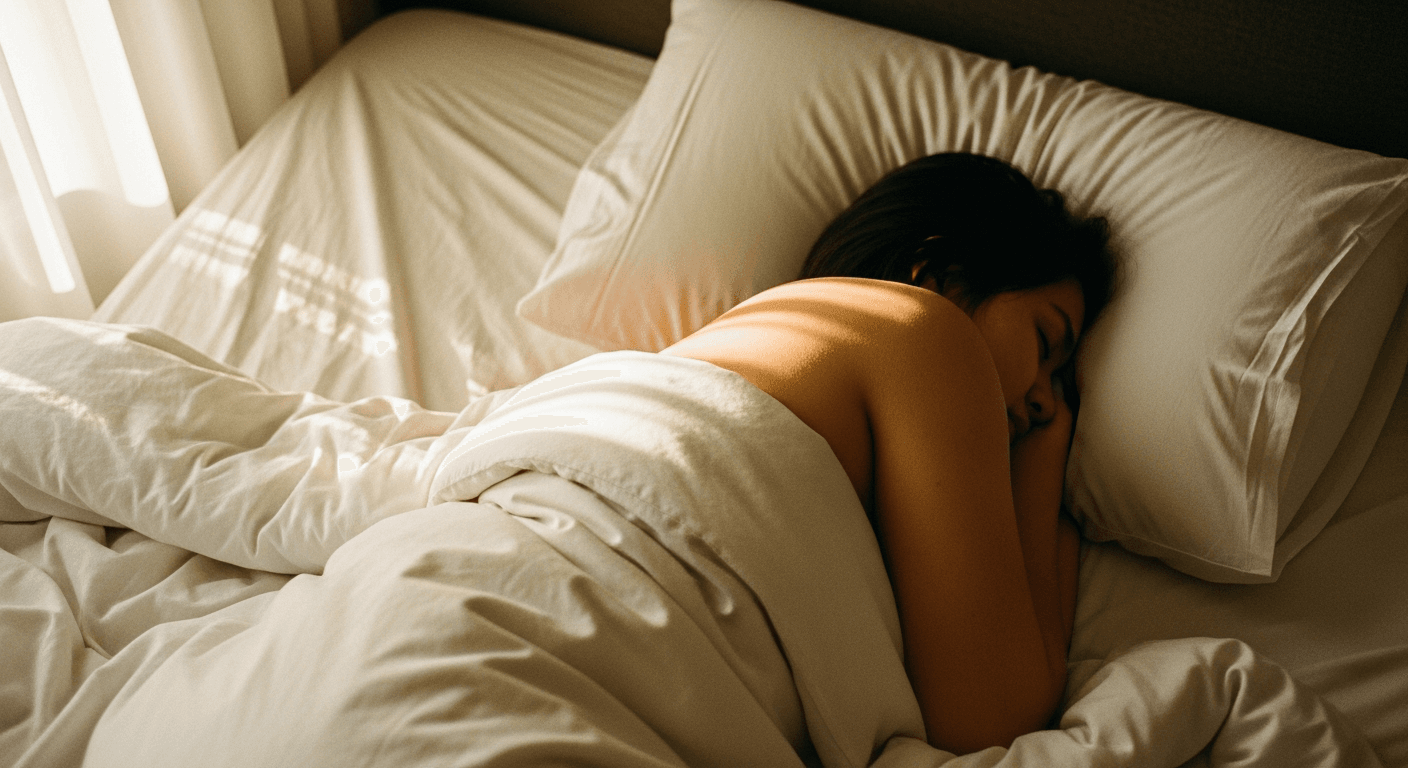
Most sleep advice sounds like a soft suggestion: get enough rest, wind down before bed, try not to stay up too late. It's well-meaning but frustratingly vague. What recent research is starting to show, however, is that sleep duration isn't just about how rested you feel the next morning. It's measurably linked to how fast your body ages at a cellular level.
That's not a metaphor. Biological aging, tracked through markers like DNA methylation clocks and telomere length, can now be measured with reasonable precision. And a growing body of evidence suggests that the number of hours you sleep each night has a direct, quantifiable effect on those markers.
What the Research Actually Found
A 2026 study examining biological aging across a large adult cohort found that participants who consistently slept within a specific duration window showed measurably slower rates of biological aging compared to those who slept outside that range. The effect was independent of exercise habits, diet quality, and body weight. Sleep duration alone moved the needle.
The optimal window identified was seven to eight hours per night. Adults who consistently hit this range showed biological age markers that lagged behind their chronological age. Those sleeping fewer than six hours or more than nine hours showed the opposite pattern: their biological clocks were running ahead of their actual age.
What makes this finding significant is the precision. Previous research connected poor sleep to cardiovascular risk, cognitive decline, and metabolic dysfunction in general terms. This newer work ties a specific duration range to a specific biological outcome. You're not just told to sleep more. You're given a target.
Why Both Extremes Age You Faster
The intuitive assumption is that more sleep is always better. The data doesn't support that. Sleeping nine or more hours consistently is associated with accelerated biological aging at a rate comparable to sleeping only five hours. The mechanism isn't fully understood, but researchers point to inflammation, disrupted circadian signaling, and underlying health conditions that both cause long sleep and contribute to cellular aging.
Short sleep is better understood. When you don't sleep enough, your body's cellular repair processes are cut short. During deep sleep, the brain clears metabolic waste through the glymphatic system. Tissues repair. Hormones that regulate growth and stress are rebalanced. Cut the window short and those processes are interrupted before completion.
Chronic sleep restriction, defined in most studies as under six hours for consecutive nights, elevates cortisol, suppresses immune function, and accelerates telomere shortening. Telomeres are the protective caps on chromosomes. When they shorten faster than expected, it's one of the clearest biological signals of accelerated aging.
This matters for anyone serious about longevity. If you're tracking your fitness markers, looking at grip strength as a predictor of healthspan (and if you haven't, Grip Strength: Test Your Longevity in 60 Seconds is worth your time), or paying attention to what the science says about how long you'll live, sleep duration deserves a place in that same conversation.
The Quality-Within-the-Window Problem
Hitting seven to eight hours on the clock doesn't automatically mean you're getting the biological benefit. Sleep architecture matters. A night that totals seven hours but includes frequent waking, alcohol-disrupted sleep cycles, or shallow stages throughout delivers far less restorative value than seven consolidated, well-structured hours.
Deep sleep, also called slow-wave sleep, is where most of the cellular repair happens. REM sleep handles memory consolidation and emotional regulation. If your sleep is fragmented, you may be spending seven hours in bed but cycling through only shallow stages, missing the deeper phases where the aging-protective processes are most active.
This is one reason why sleep timing consistency matters as much as duration. Your circadian rhythm governs when your body enters and exits each sleep stage. Going to bed at midnight one night and 2 a.m. the next disrupts that timing, even if total hours are similar. Research on shift workers and people with irregular schedules consistently shows worse health outcomes, including faster biological aging, than matched controls with consistent schedules but similar total sleep time.
Anxiety, Stress, and the Sleep Disruption Loop
One of the most common reasons adults can't land in the seven-to-eight-hour window isn't poor habits. It's psychological load. Anxiety and chronic stress are among the leading drivers of both sleep-onset difficulty and early waking. According to recent survey data, stress and sleep problems remain the most commonly reported wellness concerns among adults globally, a pattern Anxiety in 2026: Stress and Sleep Are Still Winning examines in detail.
The relationship runs both ways. Poor sleep amplifies stress reactivity, which makes the next night harder, which increases cortisol further. Breaking the loop requires addressing both sides. Stress management strategies aren't just psychological tools. They're sleep interventions with downstream effects on biological aging.
If stress is a consistent barrier for you, it's worth thinking about how to build resilience in a more structured way. The concept of treating your nervous system like something you train rather than something that happens to you is covered in depth in Train Your Stress Like a Muscle, Not a Problem. The overlap with sleep quality is direct.
Practical Steps to Hit the Optimal Window
The research gives you a target. Here's how to actually reach it.
- Set a fixed wake time first. Most sleep experts recommend anchoring your schedule to a consistent wake time rather than a consistent bedtime. Your body's sleep pressure builds across the day and peaks at roughly the same time each night if your wake time is stable. Choose a wake time you can maintain seven days a week, including weekends, and work backward eight hours to find your target bedtime.
- Cut light exposure 60 to 90 minutes before bed. Bright light, especially the blue-spectrum light from screens, suppresses melatonin production and delays sleep onset. This isn't about avoiding your phone entirely. It's about reducing overall light intensity. Dimming your environment, using warm-toned bulbs in the evening, and lowering screen brightness makes a measurable difference in how quickly you fall asleep.
- Keep your sleep environment cool. Core body temperature needs to drop by roughly 1 to 2 degrees Fahrenheit to initiate sleep. A cooler room, ideally between 65 and 68°F (18 to 20°C), supports that process. If you're waking in the night, overheating is one of the most commonly overlooked causes.
- Limit alcohol within three hours of sleep. Alcohol is sedating but disruptive. It suppresses REM sleep in the first half of the night and causes fragmentation in the second half. Even moderate consumption measurably reduces sleep quality scores and reduces time spent in restorative stages.
- Don't lie in bed awake for extended periods. If you can't fall asleep within 20 minutes, get up and do something low-stimulus in dim light until you feel sleepy. Lying in bed frustrated trains your brain to associate your bed with wakefulness, which compounds the problem over time.
- Time your exercise strategically. Regular physical activity consistently improves sleep quality and duration. High-intensity sessions within two hours of bedtime can delay sleep onset for some people due to elevated core temperature and adrenaline. Morning or early afternoon training tends to produce the most sleep-compatible outcomes.
Where Nutrition Fits In
Sleep and nutrition interact more than most people realize. Magnesium, found in leafy greens, nuts, and seeds, plays a role in GABA regulation, the neurotransmitter system that helps the brain quiet down before sleep. Deficiency is common and underdiagnosed. Large meals close to bedtime increase metabolic activity and core temperature, delaying sleep onset. Caffeine's half-life is roughly five to seven hours, which means a 3 p.m. coffee still has half its caffeine load active at 8 or 9 p.m.
Supplements like creatine, which many athletes use for performance and recovery, have also been examined for their effect on sleep. The research is still developing, but if you're curious about whether your current supplement stack is affecting your recovery, Is Daily Creatine Actually Safe? What Research Shows gives a clear breakdown of what the evidence currently supports.
Sleep as a Longevity Lever
The fitness and longevity space has spent years focused on movement, strength, and nutrition as the primary levers of healthy aging. Those levers are real. Research consistently shows that strength metrics, for instance, are among the most reliable predictors of long-term health outcomes, as explored in This Strength Test Predicts How Long You'll Live.
But sleep is increasingly looking like a variable that operates at the same level of importance. The 2026 research doesn't suggest sleep replaces exercise or good nutrition. It suggests that without consistent, duration-appropriate sleep, the benefits of everything else are partially undermined at the cellular level.
Seven to eight hours, consistent timing, low light before bed. That's the target. It's specific, it's actionable, and the evidence behind it is stronger than most people expect. You don't need to overhaul your life to hit it. You need to treat sleep with the same intentionality you bring to your workouts and your meals.
Your biological age is responsive to what you do. Sleep is one of the few places where doing less, but doing it right, produces measurable results.