
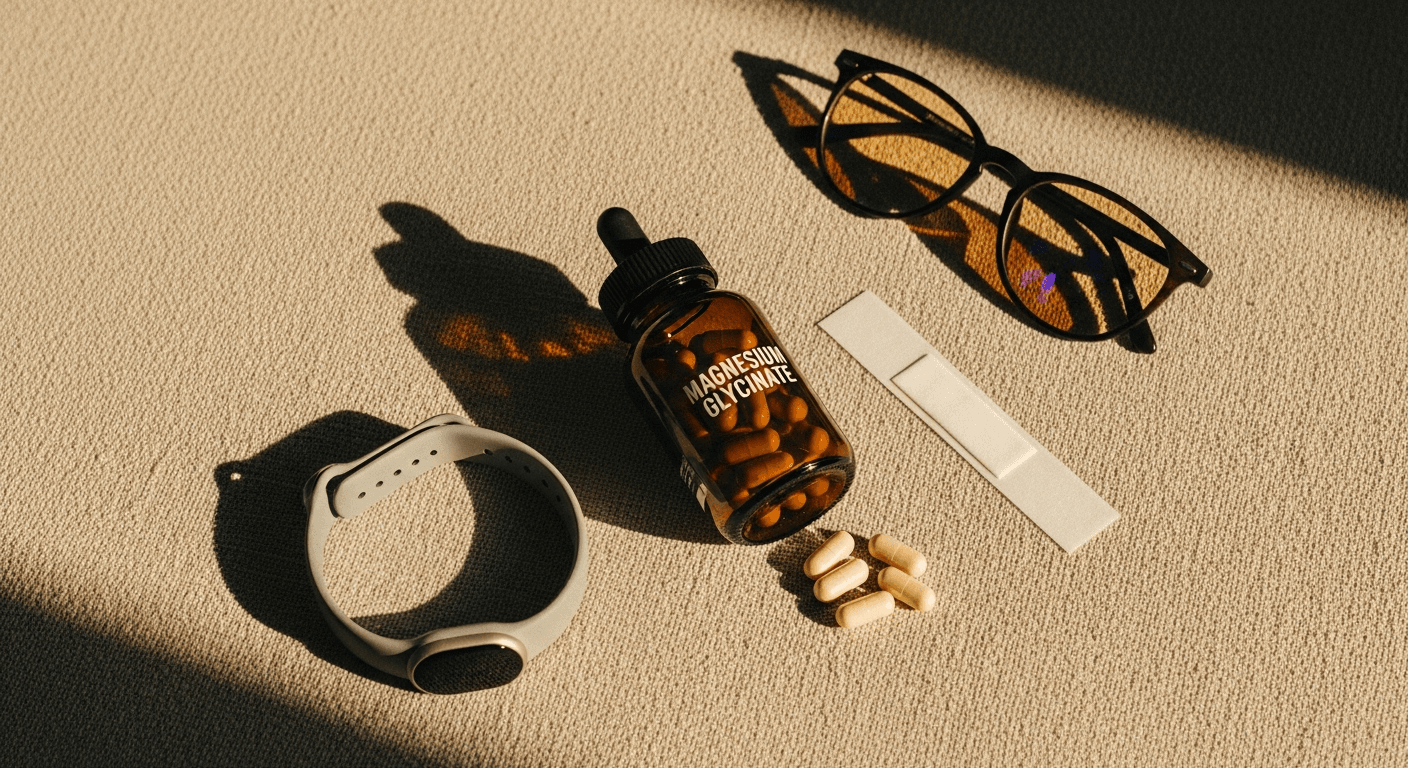
Sleepmaxxing content has racked up billions of views in 2026, and the supplement industry has pivoted hard to tag every sleep-adjacent product as a "sleepmaxxing tool." The core idea, optimizing every controllable variable of your sleep for better recovery, sharper thinking, and longer life, is genuinely worth pursuing. But there's a massive gap between what decades of sleep medicine research confirms and what influencers with ring lights are selling. Here's the honest breakdown.
Key Takeaways
- Sleepmaxxing mixes legitimately evidence-based sleep hygiene with unproven or risky hacks
- What actually works: bedroom at 65-68°F (18-20°C), blue light off 60 minutes before bed, fixed wake times 7 days a week, no alcohol
- What's unproven or risky: mouth taping, excessive melatonin doses, obsessive wearable tracking
- Orthosomnia (sleep score anxiety from wearables) is a documented clinical condition that worsens the sleep it's supposed to optimize
- The Global Wellness Institute named sleep the #1 wellness priority of 2026 in its annual report
What Sleepmaxxing Actually Is
Sleepmaxxing is the practice of applying systematic optimization to your sleep the same way you'd optimize nutrition or training. You control room temperature, light exposure, supplement timing, app usage, and even sleep position. The goal is to extract maximum quality and duration from every night.
The term itself is new (popularized on TikTok in 2024-2025), but the underlying practices aren't. What sleep doctors have called sleep hygiene since the 1990s, sleepmaxxing repackages with connected wearables and a biohacker aesthetic. The Global Wellness Institute confirmed this shift in its 2026 Sleep Initiative Trends report: the world is moving from viewing sleep as wasted time to viewing it as an active performance driver.
What the Science Confirms: Practices That Actually Work
1. Room Temperature: 65-68°F (18-20°C)
This is probably the best-documented sleepmaxxing practice in the entire corpus. Your body's thermoregulation is directly tied to the initiation and maintenance of deep sleep. When your core body temperature drops 0.5-1°C in the early part of the night, your brain receives a clear signal: time to sleep. A room that's too warm (above 72°F/22°C) disrupts this mechanism and fragments both deep sleep (N3) and REM sleep.
Research-validated optimal range: 61-68°F (16-20°C) depending on the individual, with most people hitting their sweet spot around 65-66°F (18°C). If you run warm, go lower. If you wake up cold, adjust up. This is individual tuning, not a universal prescription.
2. Blue Light Off 60 Minutes Before Bed
Blue light from screens (phone, laptop, TV) suppresses melatonin secretion from the pineal gland. Melatonin is the chemical signal your brain sends to your whole body to say "it's night, slow down." If you're scrolling your phone in bed, you're delaying that signal by 30-90 minutes depending on the individual. The result: you fall asleep later, and you get less total sleep even if your alarm stays the same.
Validated solutions: turn off screens 60 minutes before bed (maximum effect), use night mode or an app like f.lux (partial effect), or wear blue-light-blocking glasses if you genuinely can't avoid screens in the evening (documented benefit, but weaker than full screen elimination).
3. Fixed Wake Times 7 Days a Week
Your circadian rhythm is a biological clock that regulates dozens of processes: hormone production, body temperature, digestion, immunity. This clock synchronizes primarily on two signals: morning light and your consistent sleep and wake times.
Waking at 6:30 AM on weekdays and 9 AM on weekends is the equivalent of flying from New York to London twice a week, every week. Researchers call it "social jet lag," and it's associated with chronic fatigue, elevated cortisol, and metabolic dysfunction. The rule: don't vary your wake time by more than 30 minutes between weekdays and weekends.
4. No Alcohol in the Evening
Alcohol helps you fall asleep and destroys the second half of the night. It suppresses REM sleep, the phase associated with memory consolidation and emotional regulation. It also fragments deep sleep by increasing micro-arousals. One glass of wine in the evening can reduce your REM quality by 24% that same night. Two glasses and you're in territory where recovery is seriously compromised.
5. Morning Natural Light Exposure
Ten minutes of natural light within 30 minutes of waking resets your circadian clock for the day. It triggers the morning cortisol peak (the energy that gets you moving) and programs the time at which your brain will start producing melatonin that evening. It's the cheapest, most effective sleepmaxxing lever available: open the blinds, step outside for 10 minutes, eat breakfast near a window.
What's Not Proven (or Actively Risky)
Mouth Taping
Mouth taping involves sticking a piece of medical tape over your mouth to force nasal breathing during sleep. The theory: nasal breathing filters, humidifies, and warms incoming air, and produces more beneficial nitric oxide. There's a logical framework there. In practice, for people with partial nasal obstruction or undiagnosed sleep apnea, mouth taping can be dangerous. There's no large-scale study validating it as a sleep optimization method in otherwise healthy individuals.
Supplements: Too Much Melatonin, Ashwagandha, GABA
Melatonin is widely misused. It's not a sleep drug: it shifts your circadian clock, it doesn't trigger sleep. The effective dose for circadian shifting is tiny, around 0.5 mg. The 5-10 mg capsules sold in most pharmacies are doses 10-20 times higher than what research supports. Taking 10 mg of melatonin every night leads to receptor desensitization: the effect gets weaker over time, not stronger.
For ashwagandha and GABA, studies exist but remain small in scale. Ashwagandha has reasonably consistent data on reducing evening cortisol in stressed individuals, which can indirectly improve sleep onset. But "may help some people under some conditions" is a very long way from "optimizes your sleep" as the marketing claims.
Orthosomnia: When the Tracker Becomes the Problem
Orthosomnia is the anxiety generated by obsessing over wearable sleep scores. Sleep medicine physicians have documented cases of people spending more time checking their Oura or Whoop score in the morning than actually sleeping soundly at night. The irony: the anxiety generated by a bad score causes bad sleep the following night. If you notice yourself dreading your morning sleep score, consider switching your wearable to "no feedback" mode for two weeks. The data collection continues; the anxiety doesn't.
The 2026 Trends Worth Knowing, According to GWI
The Global Wellness Institute's Sleep Initiative Trends 2026 report identifies six major shifts:
- From sleepmaxxing to simplicity: after years of maximum optimization, a counter-trend is emerging. Sleep physicians are advocating for simple, consistent routines over gadget arsenals.
- Sleep by design: architecture and interior design are incorporating sleep-centered principles (acoustic insulation, blackout capacity, thermal-regulating materials).
- Living by the clock: chronobiology is leaving the lab. Apps are aligning meals, exercise, and work schedules to individual circadian rhythms.
- Home sleep diagnostics: over-the-counter sleep apnea detection devices are hitting the consumer market in 2026.
- Intelligent sleep (AI sleep): AI tools are analyzing weeks of sleep data to recommend personalized adjustments, moving beyond one-size-fits-all advice.
The Evidence-Based Sleepmaxxing Protocol You Can Start Tonight
You don't need a $400 tracker to start. Here are 5 actions ranked by scientific impact:
- Tonight (immediate impact): Cut all screens 60 minutes before your bedtime. Set your thermostat to 65-67°F (18-19°C) before you get into bed.
- Tomorrow morning (impacts tonight): Get outside for 10 minutes of natural light within 30 minutes of waking. Even overcast, natural light is 10-100 times more intense than indoor lighting and gives your circadian clock the reset signal it needs.
- This week: Lock in a consistent wake time 7 days a week for 14 days. You might feel tired the first few days as your clock realigns. That's normal.
- This month: Cut evening alcohol 5 nights a week and track your sleep quality subjectively each morning. The difference is visible within two weeks for most people.
- Long term: If you use a wearable, treat it as a trend tool (is my sleep quality improving over 3 months?) rather than a daily verdict on your recovery value. One bad night's score doesn't mean your health is deteriorating.
Practical Takeaways
- Room at 65-67°F, blue light off 60 minutes before bed, same wake time every day: these three practices alone outperform any supplement combination you'll find on TikTok.
- Melatonin is a circadian regulator, not a sleep trigger. If you use it, 0.5 mg is the research-supported dose. 5-10 mg is chronic overdosing that builds receptor tolerance.
- If your tracker creates morning anxiety, turn off the feedback for two weeks. Sleep isn't a competition with yourself.
- Alcohol cuts REM sleep quality by roughly 24% per drink. It's the most underestimated lever in sleep optimization and costs nothing to address.
- Ten minutes of morning sunlight is the cheapest, most effective sleepmaxxing practice available. It costs zero dollars and takes ten minutes.
Sources: Wikipedia Sleepmaxxing , Global Wellness Institute Sleep Trends 2026 , Naturepedic 8 Sleep Trends 2026 , SleepyDeepy Realistic Sleepmaxxing Guide , Business Upturn Sleep Tracking 2026